
水资源节约

Search documents
人民日报海外版:2025年全国万元国内生产总值用水量较“十三五”末下降20%
Shui Li Bu Wang Zhan· 2026-01-26 02:27
Core Viewpoint - The Ministry of Water Resources has implemented a comprehensive water management strategy focusing on water conservation, achieving zero growth in total water usage while maintaining economic growth and agricultural productivity [1][2] Group 1: Achievements in Water Conservation - Since the beginning of the 14th Five-Year Plan, the total water usage in China has achieved zero growth despite significant economic and agricultural advancements [1] - By 2025, the water consumption per unit of GDP and per unit of industrial added value has decreased by 20% and 25% respectively compared to the end of the 13th Five-Year Plan [1] - The effective utilization coefficient of irrigation water in farmland has improved from 0.565 at the end of the 13th Five-Year Plan to 0.583 [1] - The utilization of unconventional water resources has increased by over 91% compared to the end of the 13th Five-Year Plan [1] Group 2: Future Goals and Strategies - By 2030, the Ministry aims to reduce water consumption per unit of GDP and per unit of industrial added value by over 10% compared to 2025, and achieve an effective irrigation water utilization coefficient of over 0.60 [2] - The scale of the water-saving industry is expected to exceed 1.2 trillion yuan, with unconventional water utilization surpassing 30 billion cubic meters [2] - The Ministry plans to enhance the recycling rate of water in severely water-scarce and overloaded areas to over 30%, and achieve a 70% utilization rate of mine water in the Yellow River basin [2] - The focus for 2026 includes improving water resource management, advancing the construction of a water-saving society, and enhancing public awareness of water conservation [2]
法治护航依法治水 守好每一滴水资源
Xi An Ri Bao· 2025-12-01 03:34
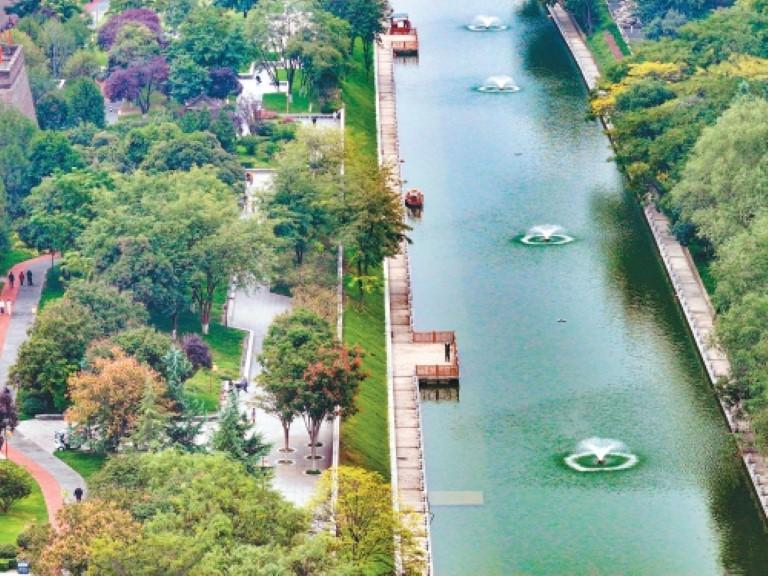
Core Viewpoint - The newly revised "Xi'an Water Conservation Regulation" aims to enhance water resource management and promote the efficient use of recycled water in the city, addressing the challenges of water scarcity in a typical water-deficient city like Xi'an [3][4]. Group 1: Water Resource Management - Xi'an has an average annual water resource volume of 24.10 billion cubic meters, with a per capita availability of less than 200 cubic meters, highlighting its status as a water-scarce city [3]. - The new regulation emphasizes a rigid water resource constraint system, promoting a water-saving society through the development of water-saving agriculture, industry, and services [2][3]. Group 2: Specific Provisions of the New Regulation - The new regulation includes specific provisions for agricultural water conservation, strict control of total water usage, and the promotion of water-saving industries [4][6]. - It mandates that governments develop unconventional water utilization plans, integrating recycled water, rainwater, and other unconventional sources into unified water resource management [5]. Group 3: Water Measurement and Pricing - The regulation requires metering and charging for water usage, prohibiting flat-rate billing, and implementing progressive pricing for agricultural and non-residential water use [6]. - It specifies that water usage must be measured separately for different sources and purposes, with penalties for non-compliance [5][6]. Group 4: Promotion of Water-Saving Measures - The regulation encourages the adoption of water-saving measures in key sectors, requiring construction projects to include water-saving plans and facilities [7]. - It calls for public institutions to lead by example in water conservation practices and the use of advanced water-saving technologies [7]. Group 5: Legal Framework and Enforcement - The new regulation establishes legal consequences for violations, including fines for failing to install metering facilities and for not adhering to water-saving requirements [8]. - It also outlines a system for reporting water waste and recognizes contributions to water conservation efforts through rewards [8].

太湖生态清淤 “拖泥”不带水
Su Zhou Ri Bao· 2025-09-16 00:32
Core Insights - The ecological dredging project in the Suzhou area of Taihu Lake has made significant progress with the successful operation of high-pressure diaphragm filter presses, enhancing the efficiency of sediment treatment [1][2] Group 1: Project Overview - The ecological dredging project has a designed dredging capacity of 4.0355 million cubic meters, with the first phase focusing on the Xishan West section [2] - The project employs an environmentally friendly suction dredging method to minimize ecological disturbance and prevent pollution during sediment removal [2] Group 2: Technology and Efficiency - The sediment volume is reduced by half after being processed through the diaphragm filter, facilitating easier transportation and resource utilization [2] - The project includes a technical upgrade that allows for the reuse of treated water, significantly reducing the reliance on municipal water supply [3] Group 3: Cost and Resource Management - The total water cost for the project is estimated at 4 million yuan, with the technical upgrades saving approximately 2 million yuan in project costs [3] - The project aims to return purified water to nearby rivers after treatment, ensuring sustainable water management [2]