
汉代郡国并行制度

Search documents
揭秘海昏侯的黄金密码 108件/套海昏侯墓宝藏文物重磅亮相
Xin Lang Cai Jing· 2025-12-23 19:08
Core Viewpoint - The exhibition "Haihunhou: Experiencing the Kings, Emperors, and Nobles of the Han Dynasty" showcases 108 artifacts from the Haihunhou tomb, highlighting the cultural and historical significance of the Han Dynasty, particularly through the life of Liu He, the only figure in Chinese history to hold the titles of king, emperor, commoner, and noble [7][8]. Group 1: Exhibition Details - The exhibition opened on December 16 at the Lvxian Ancient City Ruins Museum and is the first thematic exhibition since the park's opening six months ago [7]. - Among the 108 artifacts, over 20 are being displayed in Beijing for the first time after restoration [7][10]. - The exhibition aims to provide insights into the political, economic, cultural, and social aspects of the Western Han Dynasty [8]. Group 2: Artifacts and Their Significance - The Haihunhou tomb is noted for having the highest quantity of gold artifacts discovered in any Han tomb, with items such as 99% pure gold "niaotí" gold and "linzhi" gold on display [10]. - A notable artifact is the "Li Ji Family" inscribed bronze lamp, which reflects the family's migration and adherence to central ceremonial practices [10]. - The exhibition features a unique large bronze mirror depicting Confucius and his disciples, providing valuable insights into early Confucian thought [11]. Group 3: Educational and Cultural Initiatives - The Lvxian Ancient City Ruins Museum has collaborated with the Nanchang Han Dynasty Haihunhou National Heritage Park Museum to create cultural products, including miniature replicas of "niaotí" gold [12]. - Interactive educational activities are planned, such as "The Golden Code of Haihunhou" and "Exploring the Underground Palace of Haihunhou," aimed at engaging the public with Han Dynasty culture [12]. - The exhibition is open to the public from December 16, 2025, to March 15, 2026 [12].


遗址上建展厅,“考古游”成京城文博新风尚
Xin Lang Cai Jing· 2025-12-22 03:54
Group 1 - The article highlights the growing trend of "archaeological tourism" in Beijing, with the Dabaotai Archaeological Museum attracting significant visitor interest due to its unique exhibits, particularly the Han Dynasty burial system known as "Huangchang Tizou" [1][2] - The Dabaotai Archaeological Museum reopened to the public in May 2023 after renovations, and has since welcomed approximately 180,000 visitors, with peak attendance during the National Day and Mid-Autumn Festival holidays [1][2] - The museum's design incorporates elements of Han Dynasty architecture, enhancing the visitor experience by providing a comprehensive view of Han society and culture [2] Group 2 - The Beijing Archaeological Research Institute has transferred nearly 22,500 archaeological artifacts to various cultural heritage institutions during the 14th Five-Year Plan period, positioning it among the top in the country [2] - The Lvxian Ancient City Ruins Park and Museum, which opened in June 2023, has received nearly 600,000 visitors in its first six months, showcasing the daily life of the Han Dynasty through interactive exhibits and activities [5] - The Palace Museum's recent exhibition on archaeological findings from the Forbidden City aims to engage the public by revealing the intricacies of archaeological work and its historical significance [7]
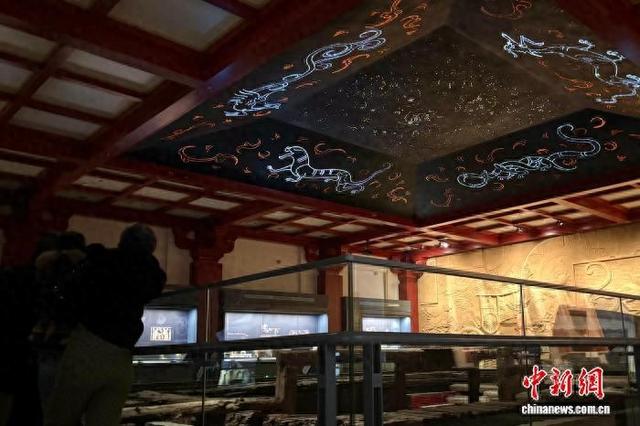
海昏侯临展亮相路县故城遗址博物馆
Xin Lang Cai Jing· 2025-12-20 19:01
Core Viewpoint - The exhibition "Haihunhou: Experiencing the Kings, Emperors, and Commoners of the Han Dynasty" officially opened to the public on December 16, showcasing 108 artifacts from the Haihunhou tomb, providing a systematic interpretation of the dual governance system of the Han Dynasty from a cross-regional perspective [1] Group 1: Exhibition Details - The exhibition features over 20 precious artifacts that are being displayed in Beijing for the first time after restoration [1] - It is organized around the comparative analysis of the "Southern Marquis State (Haihunhou State)" and the "Northern Commandery (Luxian Ancient City)" [1] - The exhibition is divided into four sections: "Haihunhou State," "Centralized Commandery," "Han Lifestyle," and "Guarding Civilization" [1] Group 2: Thematic Focus - The narrative framework of the exhibition is built around the life story of Liu He, emphasizing the relationship between the central government and local governance [1] - The exhibition aims to clearly restore the dual governance system under the centralized authority of the Han Dynasty through artifact evidence [1] - It vividly interprets the deep connections of Chinese civilization's "diversity and unity" [1]
海昏侯展来京
Jing Ji Guan Cha Bao· 2025-12-19 03:33
Core Viewpoint - The exhibition featuring 108 artifacts from the Haihunhou Tomb will provide insights into the Han Dynasty's parallel governance system through a cross-regional perspective between the Haihunhou State and the Lvxian County [1] Group 1: Exhibition Details - The exhibition titled "Haihunhou: Experiencing the Kings, Emperors, and People of the Han, Treasures of the Han Dynasty" will take place at the Lvxian County Ruins Museum from December 16, 2025, to March 15, 2026 [2] - The Haihunhou Tomb is noted for having the highest amount of gold artifacts discovered among all Han tombs, making it a key to understanding the Han Empire [1] Group 2: Artifacts and Historical Significance - The exhibition will showcase various gold artifacts, including types such as gold ingots and gold coins, which are crucial for decoding the Han Dynasty's history [1] - A specific artifact, a gold ingot inscribed with "South Fief Haihunhou Minister He presented one pound of gold in the third year of Yuankang," directly confirms the importance of the "Choujin" system related to ancestral worship in the Western Han Dynasty [1] - The "Choujin" system required vassal kings and marquises to contribute gold for ancestral sacrifices during the August ceremonies, highlighting its significance in the Han Dynasty's religious practices [1]