
麟趾金

Search documents
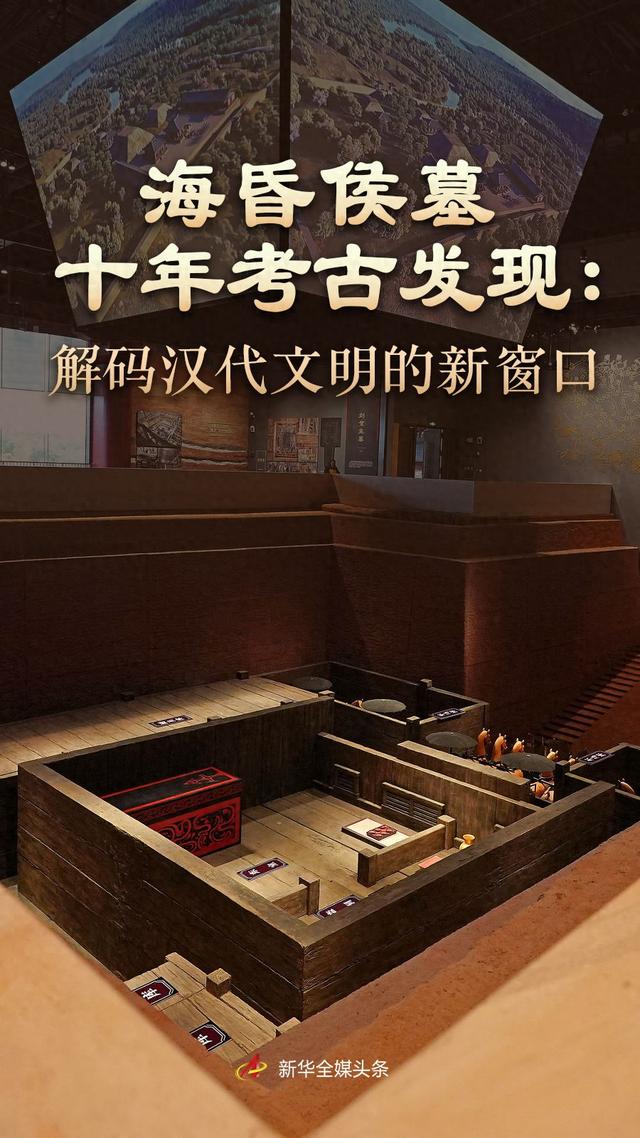
海昏侯墓十年考古发现:解码汉代文明的新窗口
Xin Lang Cai Jing· 2026-01-17 09:28
Core Viewpoint - The archaeological discoveries at the Haihunhou Tomb in Nanchang provide a new perspective on Han Dynasty civilization, revealing rich historical information and cultural artifacts that enhance understanding of this period in Chinese history [2][9]. Archaeological Discoveries - The Haihunhou Tomb, discovered in 2011, is part of a larger site that includes a well-preserved burial complex with a total area of 46,000 square meters, featuring two main tombs, seven accompanying tombs, and a complete sacrificial system [4]. - Over 10 tons of cash coins and more than 115 kilograms of gold artifacts were found, reflecting the economic strength of the Western Han Dynasty [4]. - The tomb contained a jade seal inscribed with "Liu He," identifying the tomb's occupant as Liu He, a grandson of Emperor Wu, who had a brief reign of 27 days [6][9]. Cultural Significance - The artifacts unearthed, including Confucian classics and personal notes, provide a more nuanced view of Liu He's life, contrasting with historical accounts that label him as indulgent [10][21]. - The discovery of the earliest known portrait of Confucius and other significant texts highlights the cultural and educational practices of the time, serving as tangible evidence of the transmission of Confucian thought [19][22]. Public Engagement and Impact - The "Haihunhou phenomenon" has emerged, indicating a successful public engagement with archaeology, transforming academic findings into cultural experiences accessible to the general public [22]. - The ongoing interest in the Haihunhou Tomb has led to record attendance at exhibitions, demonstrating the public's fascination with historical discoveries [22]. Technological Advancements in Archaeology - Innovative techniques such as high-spectral scanning have been employed in the excavation process, enhancing the preservation and understanding of artifacts [26]. - The integration of laboratory methods in field archaeology has set a precedent for future archaeological practices in China [26][28].

揭秘海昏侯的黄金密码 108件/套海昏侯墓宝藏文物重磅亮相
Xin Lang Cai Jing· 2025-12-23 19:08
Core Viewpoint - The exhibition "Haihunhou: Experiencing the Kings, Emperors, and Nobles of the Han Dynasty" showcases 108 artifacts from the Haihunhou tomb, highlighting the cultural and historical significance of the Han Dynasty, particularly through the life of Liu He, the only figure in Chinese history to hold the titles of king, emperor, commoner, and noble [7][8]. Group 1: Exhibition Details - The exhibition opened on December 16 at the Lvxian Ancient City Ruins Museum and is the first thematic exhibition since the park's opening six months ago [7]. - Among the 108 artifacts, over 20 are being displayed in Beijing for the first time after restoration [7][10]. - The exhibition aims to provide insights into the political, economic, cultural, and social aspects of the Western Han Dynasty [8]. Group 2: Artifacts and Their Significance - The Haihunhou tomb is noted for having the highest quantity of gold artifacts discovered in any Han tomb, with items such as 99% pure gold "niaotí" gold and "linzhi" gold on display [10]. - A notable artifact is the "Li Ji Family" inscribed bronze lamp, which reflects the family's migration and adherence to central ceremonial practices [10]. - The exhibition features a unique large bronze mirror depicting Confucius and his disciples, providing valuable insights into early Confucian thought [11]. Group 3: Educational and Cultural Initiatives - The Lvxian Ancient City Ruins Museum has collaborated with the Nanchang Han Dynasty Haihunhou National Heritage Park Museum to create cultural products, including miniature replicas of "niaotí" gold [12]. - Interactive educational activities are planned, such as "The Golden Code of Haihunhou" and "Exploring the Underground Palace of Haihunhou," aimed at engaging the public with Han Dynasty culture [12]. - The exhibition is open to the public from December 16, 2025, to March 15, 2026 [12].

海昏侯展来京
Jing Ji Guan Cha Bao· 2025-12-19 03:33
Core Viewpoint - The exhibition featuring 108 artifacts from the Haihunhou Tomb will provide insights into the Han Dynasty's parallel governance system through a cross-regional perspective between the Haihunhou State and the Lvxian County [1] Group 1: Exhibition Details - The exhibition titled "Haihunhou: Experiencing the Kings, Emperors, and People of the Han, Treasures of the Han Dynasty" will take place at the Lvxian County Ruins Museum from December 16, 2025, to March 15, 2026 [2] - The Haihunhou Tomb is noted for having the highest amount of gold artifacts discovered among all Han tombs, making it a key to understanding the Han Empire [1] Group 2: Artifacts and Historical Significance - The exhibition will showcase various gold artifacts, including types such as gold ingots and gold coins, which are crucial for decoding the Han Dynasty's history [1] - A specific artifact, a gold ingot inscribed with "South Fief Haihunhou Minister He presented one pound of gold in the third year of Yuankang," directly confirms the importance of the "Choujin" system related to ancestral worship in the Western Han Dynasty [1] - The "Choujin" system required vassal kings and marquises to contribute gold for ancestral sacrifices during the August ceremonies, highlighting its significance in the Han Dynasty's religious practices [1]