
汽车经销商经营困境

Search documents
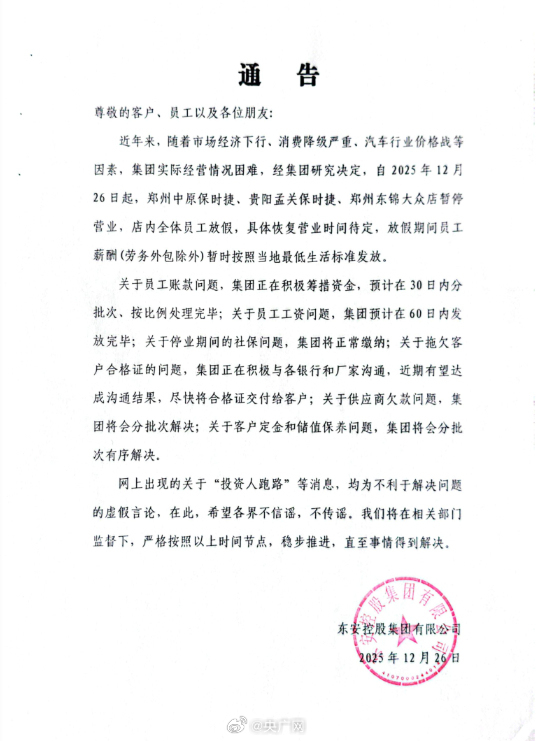
旗下多个保时捷中心疑似闭店“跑路”?东安集团回应
Feng Huang Wang· 2025-12-26 14:02
Core Viewpoint - Dong'an Group has confirmed the suspension of operations at three of its dealerships due to ongoing difficulties in the automotive industry, including price wars, and is facing significant operational challenges [1][3] Group 1: Suspension of Operations - Dong'an Group announced the suspension of operations at Zhengzhou Zhongyuan Porsche, Guiyang Mengguan Porsche, and Zhengzhou Dongjin Volkswagen dealerships effective December 26, 2025 [1] - Reports indicated that the Guiyang Mengguan Porsche and Zhengzhou Zhongyuan Porsche centers were already vacant, with customers unable to redeem prepaid maintenance packages and facing issues with vehicle registration [1] Group 2: Customer and Employee Issues - The company is actively communicating with banks and manufacturers to resolve issues related to the delivery of vehicle registration certificates to customers, with no specific timeline provided [1] - Dong'an Group plans to address customer deposits and prepaid maintenance issues in batches, but again did not specify a timeline [1] - The company is working to secure funds to pay employees, with expectations to resolve employee payment issues within 30 days and to pay outstanding wages within 60 days [3] Group 3: Company Background and Financials - Dong'an Group was founded in 1993 and is headquartered in Xinxiang, Henan, operating multiple brands including Porsche, BMW, and Audi [3] - The company was ranked 80th in the "2024 China Automotive Circulation Industry Dealer Group Top 100" list, with total revenue of 6.2 billion yuan in 2023 [3]

超50%汽车经销商亏损
Di Yi Cai Jing· 2025-08-19 15:29
Group 1 - The after-sales segment remains the largest contributor to gross profit for dealers, despite challenges in new car sales [1] - In the first half of the year, only 30.3% of dealers met their sales targets, with 29% of dealers achieving less than 70% of their goals [1] - The loss in new car sales is a significant challenge for dealers, with 74.4% experiencing some degree of price inversion, and 43.6% facing price inversions exceeding 15% [1] Group 2 - Independent dealers of new energy brands are performing better than those of traditional fuel vehicle brands, with profit ratios of 42.9% versus 25.6% respectively [2] - Many dealers are shifting to new energy brands, citing lower commission rates but compensating with higher sales volume [2] - The industry faces liquidity issues for dealers, particularly traditional fuel brand dealers suffering from severe losses due to price inversion [2] Group 3 - Four major associations in the Yangtze River Delta have called for manufacturers to address the operational difficulties faced by dealers, highlighting issues such as imbalanced target setting and a distorted rebate system [3] - The rebate cycle from manufacturers to dealers is often 2-3 months, with some exceeding 3 months, complicating cash flow for dealers [3] - Only a few manufacturers provide full cash rebates to dealers, with many using complex rebate structures that hinder accurate calculations of received rebates [3]