法治文化

Search documents
法治为基,商业有序:论企业文化中的法治内核与商业秩序构建
Sou Hu Cai Jing· 2026-01-19 07:14
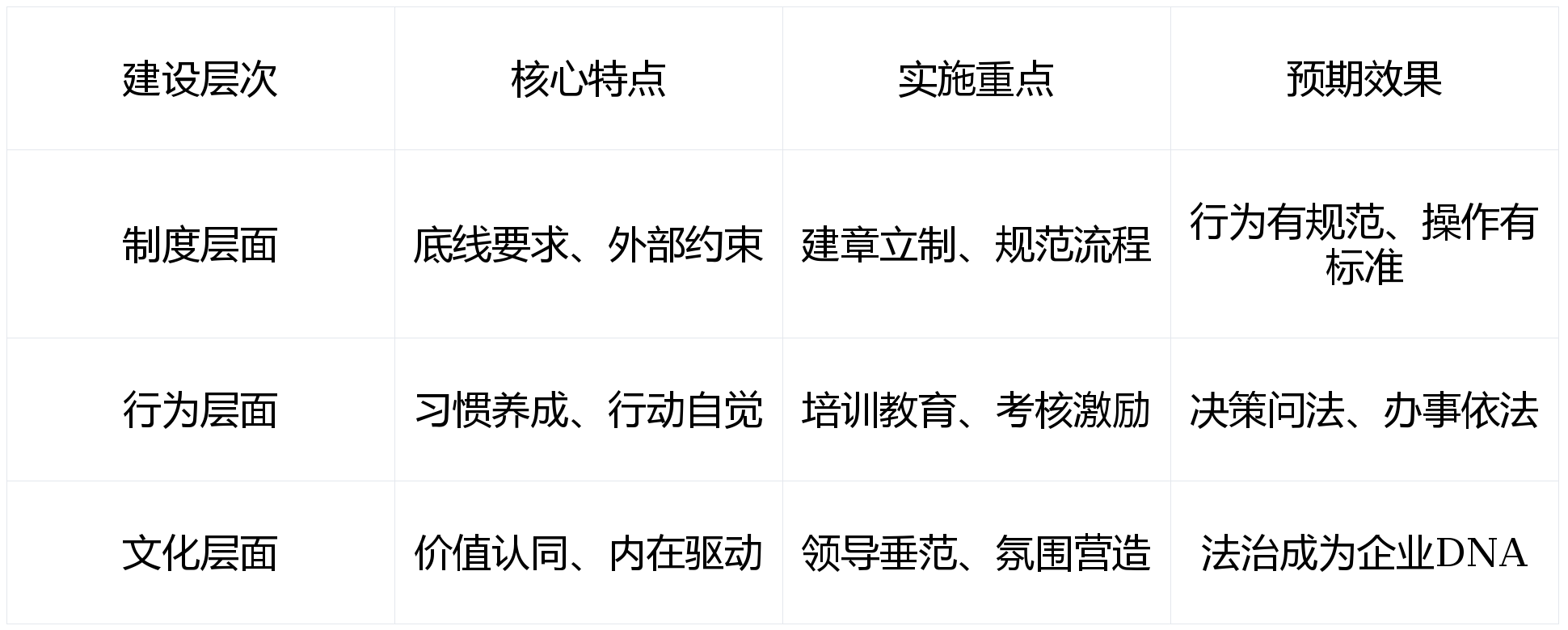
Core Viewpoint - The article emphasizes the importance of a rule-of-law business environment as a fundamental guarantee for healthy corporate development, highlighting that "the rule of law is the best business environment" as stated by President Xi Jinping [1]. Group 1: Rule of Law as a Foundation - The rule of law is essential for ensuring transaction safety, reducing market uncertainty, and promoting business innovation [1]. - A market economy is fundamentally a rule-of-law economy, where orderly business activities and stable expectations stimulate innovation and investment [1]. - The rule of law provides comprehensive protection for business activities through three core mechanisms: establishing rules, safeguarding rights, and resolving disputes [1]. Group 2: Construction of Legal Culture in Enterprises - The construction of corporate legal culture is a systematic project that evolves from compliance as a "bottom line requirement" to cultural "internal recognition" [2]. - Institutional construction is the cornerstone of corporate legal culture, exemplified by China Shipbuilding Group's comprehensive regulatory framework [3]. - Successful institutional design should be systematic, operable, and dynamic, ensuring that regulations are effectively executed and adapted to changing environments [3]. Group 3: Dynamic Balance of Law and Business Order - The relationship between law and business order is dynamic, requiring a balance that ensures orderly business activities while allowing space for innovation [8]. - Law provides a stable framework for business activities, ensuring fair competition and efficient resource allocation [9]. - Legal frameworks must adapt to new business models, balancing innovation with necessary regulations to prevent deviations from established norms [10]. Group 4: Practical Pathways for Legal Culture in Enterprises - Leadership is crucial in the construction of legal culture, with leaders' legal awareness directly influencing the depth and breadth of legal culture within the enterprise [13]. - Institutional construction is a core aspect of legal culture, requiring a comprehensive system that covers all operational management processes [14]. - Digital transformation offers new tools for enhancing legal management efficiency, with companies leveraging information technology for contract management and compliance monitoring [16]. Group 5: Future Trends in Legal Culture Construction - The integration of law and business will deepen, transforming legal work from a supportive function to a strategic support role [18]. - Digital technologies will be widely applied in legal construction, improving the efficiency and precision of legal work [18]. - The ability to manage legal risks in international operations will become a key factor in corporate competitiveness, necessitating a robust legal framework for overseas operations [18].


文明演进视野中的法治文化
Xin Lang Cai Jing· 2026-01-17 18:43
Core Viewpoint - The construction of legal culture in contemporary China should adopt a grand historical perspective, integrating historical governance wisdom and modern core values while addressing ethical rules suitable for the future digital society [1] Group 1: Historical Context and Evolution - Legal culture is deeply rooted in the material production modes, social structures, and value networks of specific civilizations, evolving alongside the progression of civilization [1] - The transition from agricultural civilization to industrial civilization and now to digital civilization is driven by revolutionary technological breakthroughs, necessitating an upgrade in legal culture to maintain social cooperation [1] Group 2: Complexity Management - Legal culture serves as a core mechanism for managing the increasing complexity of society, which has expanded in scale and interaction, requiring abstract, universal, and predictable rule systems [1] - The evolution of legal culture is a continuous process of re-encoding the meaning system of order to adapt to internal complexities and external challenges [1] Group 3: Practical Implications - The construction of legal culture should focus on three key aspects: 1. Revitalizing traditional governance resources for modern significance, such as integrating mediation mechanisms with modern judicial processes [1] 2. Restructuring the cultural roots of modern legal core values, ensuring that principles like rights, equality, and transparency become ingrained in citizens' beliefs and lifestyles [1] 3. Cultivating a new legal culture that aligns with digital civilization, promoting ethical guidelines in technology and enhancing public digital literacy [1] Group 4: Future Mission - The historical positioning of contemporary Chinese legal culture construction reveals its dual task of transforming traditional culture and embedding modern legal spirit while pioneering new paradigms for rules in the digital age [1] - A comprehensive historical awareness is essential for fostering a resilient legal culture that is both locally rooted and globally engaged, contributing to the great rejuvenation of the Chinese nation and the peaceful development of human civilization [1]
论法治文化的内涵与特征
Xin Lang Cai Jing· 2026-01-03 18:14
Group 1: Core Concepts of Rule of Law Culture - The term "rule of law culture" emerged in the 1990s, evolving from earlier terms like "legal culture" and "law-based culture" [3] - Rule of law culture can be categorized into seven aspects: rule of law ideology culture, legal organization culture, legal system culture, legal behavior culture, rule of law carrier culture, legal language text culture, and local customs culture [3] Group 2: Rule of Law Ideology Culture - Rule of law ideology culture encompasses fundamental concepts, principles, and relationships, including democracy, freedom, and the relationship between law and ethics [4] - The basic principles of socialist rule of law include the supremacy of law, equality before the law, fairness and justice, respect for human rights, and the independence of judicial organs [4] Group 3: Legal Organization Culture - Legal organization culture refers to the collective mindset, values, and norms developed within legal institutions such as courts, government bodies, and law enforcement agencies [5][6] - It includes both explicit elements like symbols and ceremonies, and implicit elements like historical evolution and operational methods [5][6] Group 4: Legal System Culture - Legal system culture encompasses the laws, regulations, and institutional frameworks that govern social relations, including political, economic, social, cultural, judicial, and military systems [7] - It reflects the cultural connotations and the spirit of the law inherent in these systems [7] Group 5: Legal Behavior Culture - Legal behavior culture pertains to the legal actions taken by individuals and institutions, including legislative, judicial, and law enforcement actions [8] - It is influenced by the motivations, methods, effects, and environments surrounding these legal actions [8] Group 6: Rule of Law Carrier Culture - Rule of law carriers include physical structures, media, and publications that promote and implement legal systems and values [9] - These carriers can be categorized into legal facilities, legal publications, and media, each playing a vital role in disseminating legal information and values [9] Group 7: Legal Language Text Culture - Legal language text culture consists of legal terminology, literature, and legal documents that convey legal meanings and principles [10][11] - It includes various forms of artistic expression that reflect legal ideals and emotions, enhancing public awareness of the rule of law [10][11] Group 8: Local Customs Culture - Local customs culture refers to community-established norms that govern behavior, often seen as a form of "folk law" [12] - It plays a significant role in both traditional and modern rural governance, reflecting unique cultural values within the legal framework [12] Group 9: Characteristics and Essence of Rule of Law Culture - Rule of law culture is characterized by inheritance, ethnicity, temporality, diversity, stratification, and extensive integration [13] - Understanding the essence of rule of law culture is crucial for promoting social justice, stability, and the long-term governance of the state [13]

让简牍里的法治文化“活”起来(法治头条)
Ren Min Ri Bao· 2025-11-16 22:31
Core Points - The article highlights the importance of preserving and promoting traditional Chinese legal culture through the study and utilization of ancient Qin bamboo slips found in Yunmeng County, Hubei Province [2][5]. Group 1: Cultural Heritage and Legal Education - The Yunmeng Qin slips, consisting of 1,155 pieces, are significant as they contain over half of the recorded laws from the Qin Dynasty, emphasizing the need for archaeological research and cultural preservation [2]. - The local government has invested nearly 50 million yuan since 2022 to enhance the museum's facilities, integrating technology to make legal culture more accessible and engaging for visitors [4]. - The establishment of the Yunmeng Cultural Integrity Education Museum has attracted over 100,000 visitors, showcasing original texts, translations, and educational products related to legal culture [6]. Group 2: Community Engagement and Legal Awareness - The "Sleeping Tiger Legal Lecture Hall" serves as a platform for legal education, reaching out to schools, communities, and enterprises to enhance public understanding of the law [9][10]. - The integration of traditional legal culture into community projects, such as the construction of a legal-themed park, has fostered community cooperation and increased legal awareness among residents [11]. - A network of 758 mediators has been established to resolve disputes effectively, achieving a 99.8% success rate in conflict resolution, demonstrating the practical application of legal culture in everyday life [13].
陕西省第十届高校法治文化宣传季在西安启动
Shan Xi Ri Bao· 2025-10-23 00:35
Core Points - The 10th Law Culture Promotion Season in Shaanxi Province was launched on October 22, focusing on the theme "Promoting Rule of Law, Dancing Youth" [1] - The event included recognition of winners from the 9th Law Culture Promotion Season, showcasing achievements in youth law short video competitions and other cultural works [1] - Over 500 participants, including officials and students from various universities, attended the launch ceremony [1] Summary by Categories Event Overview - The launch ceremony was organized by the Provincial Office for the Rule of Law and involved multiple provincial departments and organizations [1] - The event featured artistic performances such as poetry recitation, cross-talk, situational dramas, and dance, highlighting the vibrant development of campus law culture [1] Activities and Initiatives - The 10th season will include a series of activities such as the Digital Creative Law Popularization Competition, collection of law culture works, a law-themed quiz challenge, and a debate competition on "Law and Culture" [1] - These activities aim to engage youth in law culture initiatives and contribute to the construction of a safe and lawful Shaanxi [1] Historical Context - Since 2016, Shaanxi Province has integrated law education into the national education system, organizing various thematic and innovative law promotion activities [1] - This has led to the establishment of a distinctive campus law culture brand in Shaanxi [1]
法润相城 守护美好生活
Su Zhou Ri Bao· 2025-08-30 23:24
Core Viewpoint - The article highlights the innovative legal education initiatives in Suzhou's Xiangcheng District, emphasizing the integration of legal knowledge into daily life and community activities, thereby enhancing public legal awareness and fostering a strong legal foundation for high-quality development [1][2][5]. Group 1: Legal Education Initiatives - Xiangcheng District has implemented targeted legal education activities tailored to different community groups, such as the elderly and youth, to effectively address their specific needs [2][5]. - The district has established various professional legal education teams, conducting over 190 legal lectures and introducing engaging formats like "legal stand-up comedy" to make legal knowledge more accessible [2][5]. - The "Non-Heritage + Law" experience classes combine cultural heritage with legal education, making the learning process more engaging for students [3][4]. Group 2: Cultural Integration - Xiangcheng District has integrated legal culture with tourism, creating unique cultural routes and projects that allow citizens to experience legal principles in a relaxed environment [4]. - The district has developed several law-themed cultural sites, such as the Wu Gate Cultural Park and Feng Menglong's No-Litigation Education Base, which serve as community hubs for legal education [3][4]. Group 3: Grassroots Legal Framework - The district emphasizes the importance of grassroots legal education, implementing a model that pairs legal advisors with local "legal understanders" to enhance community governance [5]. - Xiangcheng has successfully created a robust grassroots governance system that combines self-governance, legal governance, and moral governance, resulting in the establishment of numerous model democratic legal villages and communities [5]. - The district's legal initiatives are ongoing, with plans to continue innovating and enriching legal education to ensure that legal principles remain a vital part of community life [5].
非遗里生生不息的法治文化
Ren Min Wang· 2025-06-13 01:11
Group 1 - The core viewpoint emphasizes the rich legal culture and governance wisdom embedded in traditional Chinese culture, which is considered a treasure of Chinese civilization [1] - Traditional craftsmanship serves as a living carrier of culture, embodying collective values and principles, with specific technical standards and responsibilities in practices like Nanjing Yunjin weaving [2] - The dual symbolism of "rules" and "standards" in traditional artifacts reflects the governance system of "ritual, music, punishment, and politics," showcasing the integration of social norms into tangible forms [2] Group 2 - The narrative of legal education in Chinese culture has evolved through various artistic expressions, creating a unique mechanism for disseminating legal principles [3] - Artistic creations, such as shadow plays and folk performances, serve to shape public perceptions of justice and legal understanding [3] - Symbolic representations in cultural artifacts, like the Guangxi Yao people's stone tablet, materialize legal authority and norms, making law a part of daily cultural life [3] Group 3 - The interaction between rituals and customary practices in traditional legal culture fosters a resilient social governance system, blending national laws with local knowledge [4] - Rituals facilitate community integration and establish shared legal principles, as seen in various ethnic practices across China [4] - Community self-governance is promoted through traditional dispute resolution methods, where local elders mediate conflicts using customary laws and proverbs [4] Group 4 - The evolution of legal civilization is characterized by creative transformation rather than simple replacement, with intangible cultural heritage containing valuable legal wisdom for contemporary legal development [5] - The legal codes inscribed in cultural genes are being reinterpreted and activated in the journey to build an independent Chinese legal knowledge system [5]
“文化+普法”新地标,法治书屋打造学法新风尚
Zhong Guo Xin Wen Wang· 2025-05-30 07:44
Core Viewpoint - The establishment of the Wenxian Masses' Legal Reading Room serves as a grassroots legal education platform that integrates traditional culture with modern legal concepts, addressing the legal needs of the community and enhancing public legal awareness [1][3]. Group 1: Legal Education and Cultural Integration - The Wenxian Masses' Legal Reading Room is designed as a "one-stop" legal reading space, combining legal education with cultural tourism, and filling the gap in legal cultural infrastructure at the county level [3]. - The reading room features over a thousand legal books covering areas such as the Constitution, Civil Code, and youth protection, equipped with an electronic reading area and intelligent search system to facilitate access to legal knowledge [3][5]. - Various interactive elements, such as legal animation videos, situational dramas, and famous legal quotes, are incorporated to make legal education engaging and relatable [3]. Group 2: Legal Consultation Services - The reading room includes a "Legal Clinic" area where experienced lawyers provide weekly consultations, offering legal aid guidance, contract reviews, and dispute mediation services [5]. - An intelligent legal robot named "Xiao Fa" is available online to answer common legal questions related to family law, labor disputes, and other public concerns [5]. - The reading room collaborates with local communities and schools to create a "1+N" legal dissemination network, conducting outreach activities and distributing legal educational materials [5]. Group 3: Community Impact - The reading room has distributed over 30,000 legal promotional materials and benefited more than 20,000 individuals, effectively extending the reach of legal education throughout the community [5].