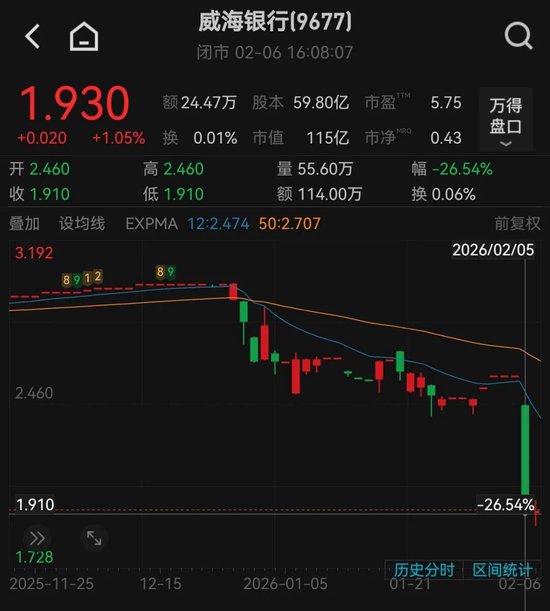
港股中小内银股流动性不足

Search documents
115万砸掉41亿市值!看完这家银行的遭遇,可能再没银行想去香港上市了
Xin Lang Cai Jing· 2026-02-13 07:34
Core Viewpoint - The recent dramatic drop in the stock price of Weihai Bank (stock code: 9677.HK) on February 5, 2024, which fell by 26.54% to a record low of 1.91 HKD, has raised concerns about the bank's market position and liquidity issues despite no significant negative news accompanying the decline [1][2]. Group 1: Stock Performance - Weihai Bank's stock price has been in a continuous decline since its IPO at 3.35 HKD per share in 2020, with a cumulative drop of 32.54% over the past three months [1][3]. - The bank's stock has experienced over 30% decline in the past year, and it has been characterized as a "zombie stock" due to a record of 62 consecutive trading days with zero transactions from late 2022 to early 2023 [1][3]. Group 2: Market Context - The recent stock price drop occurred without any major negative news, with the only recent issue being a minor regulatory fine of 350,000 RMB for improper loan issuance, which is unlikely to have triggered such a significant market reaction [2]. - The Hong Kong stock market has seen a structural shift where funds are increasingly concentrated in large-cap, liquid stocks, marginalizing smaller banks like Weihai Bank, which has led to low liquidity and trading volumes [3][4]. Group 3: Financial Performance - Despite the stock price decline, Weihai Bank has shown steady growth in asset size, with total assets projected to grow from 391.88 billion RMB at the end of 2023 to 502.82 billion RMB by September 2025, reflecting a 12.65% and 13.9% year-on-year growth respectively [3]. - The bank's revenue and net profit are expected to stabilize and show growth in 2024 and the first half of 2025, with revenue increasing by 10.98% and net profit by 4.94% year-on-year in the first half of 2025 [3]. Group 4: Liquidity Issues - The low trading volume of Weihai Bank, which saw only 55,600 shares traded on the day of the price drop, has created a vicious cycle where low liquidity leads to significant price volatility, further deterring investors [4][5]. - The bank's stock has been part of a broader trend among small and medium-sized banks in Hong Kong, with over 80% of these stocks trading below their IPO prices, indicating a severe compression of valuations [6][7]. Group 5: Future Outlook - To address capital pressures, Weihai Bank announced a private placement plan in July 2025 to raise 3 billion RMB, but the placement price of 3.29 RMB per share is significantly above the current market price, indicating potential losses for institutional investors involved [7]. - The situation of Weihai Bank serves as a warning for other banks considering an IPO in Hong Kong, highlighting the importance of addressing liquidity issues to avoid damaging brand value and market perception [7].
威海银行暴跌26.5%
Xin Lang Cai Jing· 2026-02-06 12:18
Core Viewpoint - The article discusses the challenges faced by Weihai Bank, particularly its significant stock price drop and the implications of its listing on the Hong Kong Stock Exchange, suggesting that local banks may not need to pursue such listings for performance improvement [1][10]. Group 1: Stock Performance - Weihai Bank's stock price fell to 1.91 HKD on February 5, 2026, marking a 26.54% drop in a single day, the lowest since its listing in 2020 [2][12]. - The stock has consistently underperformed since its IPO, with a listing price of 3.35 HKD that quickly fell below this value [4][14]. - As of February 6, 2026, the bank's market capitalization had decreased to 11.542 billion HKD [4][14]. Group 2: Trading Volume and Liquidity Issues - The significant drop in stock price occurred with a low trading volume of only 556,000 shares, translating to a mere 1.14 million HKD in transaction value, highlighting the liquidity issues faced by small banks in the Hong Kong market [3][14]. - Weihai Bank experienced a period of 61 consecutive trading days with no transactions in 2022, and the total trading volume for early 2024 was less than 2 million HKD, ranking last among Hong Kong-listed banks [4][14]. Group 3: Capital Increase Challenges - In July 2025, Weihai Bank announced a 3 billion HKD capital increase plan, with domestic shares priced at 3.29 HKD each, nearly double the current market price, indicating a significant disconnect between market valuation and the capital raise price [5][15]. - Three state-owned institutions planned to subscribe for nearly 2.9865 billion HKD of the capital increase, reflecting a commitment to support the bank despite the risks associated with the price disparity [5][15]. Group 4: Financial Performance - Despite the stock market struggles, Weihai Bank reported a revenue of 5.07 billion HKD for the first half of 2025, a year-on-year increase of 11.0%, and a net profit of 1.13 billion HKD, up 5.0% [6][15]. - The bank's total assets grew from 267.6 billion HKD in 2020 to 441.5 billion HKD in 2024, a cumulative increase of 65% [8][17]. - The core tier one capital adequacy ratio fell to 8.02% by the end of Q3 2025, nearing the regulatory minimum of 7.50% [8][17]. Group 5: Broader Industry Context - The challenges faced by Weihai Bank are reflective of broader issues within the Hong Kong market, where small and medium-sized banks struggle with liquidity and investor interest [9][19]. - As of March 2023, among over 30 mainland bank stocks listed in Hong Kong, 10 had no trading activity, indicating a systemic issue with liquidity in this segment [9][19]. - Efforts by Weihai Bank to rebrand and amend its articles of association have had limited success in improving its market position [9][19].