煤电清洁化转型

Search documents
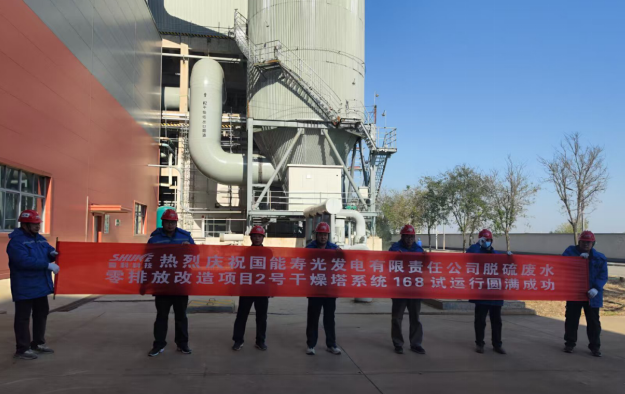
国能寿光电厂实现脱硫废水零排放,树立煤电清洁化转型新标杆
Zhong Guo Neng Yuan Wang· 2025-12-03 07:26
Core Viewpoint - The Shouguang Power Plant has successfully implemented a zero discharge system for desulfurization wastewater, setting a new benchmark for the clean transformation of coal-fired power generation [1][7]. Group 1: Project Breakthroughs - The zero discharge project has a processing capacity of 20m3/h, sufficient to meet the wastewater treatment needs of two 1010MW units [3]. - Over 80% of water resources can be recovered during the flash evaporation process, which is then reused in the desulfurization water system, achieving water resource recycling [3]. - The project innovatively addresses the conflict between deep peak regulation of coal power and the operation of environmental facilities, maintaining a treatment capacity of 1.8m3/h even at 30% load [3] [5]. Group 2: Key Challenges - The project team overcame multiple construction challenges over nearly nine months, including site constraints, extreme weather, and complex integration of new and old systems [5]. - A dedicated team was formed to ensure quality and progress, utilizing a self-developed eccentric switch-type electric isolation door to achieve zero gas leakage [5]. - The introduction of a thermal automation system enabled automatic control of the entire process, significantly reducing the workload of operators [5]. Group 3: Industry Significance - The project exemplifies a practical approach to pollution reduction and carbon emission control in the power industry, meeting stringent national and local environmental regulations [9]. - Data from the China Electricity Council indicates that by 2024, nationwide emissions of sulfur dioxide and smoke from thermal power will have decreased by over 90% compared to 2014 [9]. - The project not only reduces pollutant emissions but also lowers fresh water consumption through wastewater recycling, achieving dual benefits of pollution reduction and carbon emission control [9]. Group 4: Future Outlook - The implementation of the 14th Five-Year Plan will continue to optimize China's energy structure, with a focus on achieving peak carbon emissions and reducing coal consumption [12]. - The role of coal power is shifting from a primary energy source to a regulatory power, emphasizing clean, efficient, and flexible capabilities [12]. - The success of the Shouguang project validates the feasibility of deep environmental upgrades while maintaining energy security, providing a reliable technical pathway for the transformation of traditional thermal power in the new power system [12].