现实资产)

Search documents
RWA项目手册1.0版本(九):RWA 项目落地的5大方案
Sou Hu Cai Jing· 2025-06-10 09:32
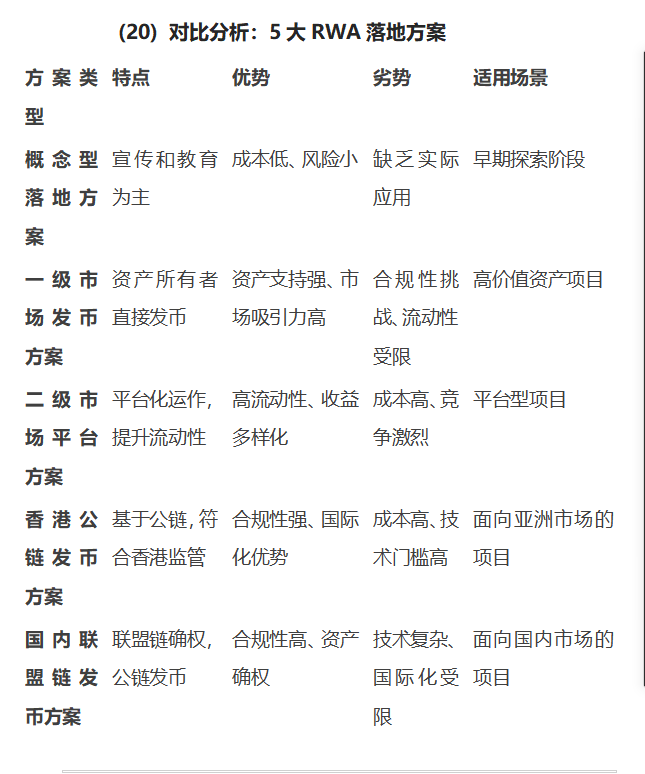
Core Insights - The article discusses five main landing solutions for Real World Assets (RWA) projects, each tailored to different project types, target markets, and compliance requirements [1]. Group 1: Conceptual Landing Solutions - The RWA conceptual landing solution focuses on promotion and education, aiming to attract investor and user attention through market research and preliminary pilots [1]. - Advantages include low cost, high flexibility, and low risk due to minimal compliance and funding issues [1]. - Disadvantages involve a lack of practical application and low market recognition, as it relies solely on concept validation [1]. - Suitable for early exploration stages or projects aiming to build market awareness through education [1]. Group 2: Primary Market Solutions - The primary market solution involves actual asset owners directly issuing tokens to digitize their assets [1]. - Advantages include asset backing for tokens, direct participation from asset owners, and strong market appeal due to potential asset-related returns [1]. - Disadvantages include compliance challenges, high technical requirements, and limited liquidity in the primary market [1]. - Suitable for enterprises or individuals with high-value assets looking to tokenize their asset value [1]. Group 3: Secondary Market Solutions - The secondary market solution focuses on building a trading platform for tokenized real assets, enhancing liquidity [1][2]. - Advantages include high liquidity due to active trading, user aggregation, and diverse revenue streams from transaction fees and asset management [3][4]. - Disadvantages involve high construction costs, complex compliance, and intense market competition [7]. - Suitable for enterprises or institutions capable of building platforms to enhance asset liquidity [4]. Group 4: Hong Kong Public Chain Solutions - This solution utilizes public chain technology in Hong Kong, aligning with local blockchain policies and compliance [6]. - Advantages include strong compliance, international appeal as a financial center, and high transparency [6]. - Disadvantages consist of high compliance costs, technical challenges, and a limited market scope primarily focused on Asia [6]. - Suitable for projects aiming to develop in the Asian market with a focus on compliance [10]. Group 5: Domestic Alliance Chain Solutions - This solution employs an alliance chain for asset confirmation and a public chain for token issuance, ensuring compliance with Chinese regulations [8]. - Advantages include high compliance, asset confirmation through technology, and localization benefits [8]. - Disadvantages involve technical complexity and potential changes in domestic policies affecting digital assets [8]. - Suitable for projects primarily targeting the Chinese market that seek asset confirmation and tokenization [11]. Recommendations - For early-stage projects, the RWA conceptual landing solution is recommended for low-cost market validation [9]. - High-value asset projects should consider the primary market token issuance solution for direct asset tokenization [9]. - Platform-based projects are advised to adopt the secondary market solution to enhance liquidity [9]. - Projects targeting the Asian market should utilize the Hong Kong public chain solution to leverage compliance advantages [10]. - Domestic projects should opt for the alliance chain solution to ensure adherence to local laws and policies [11].