电化学固氮

Search documents
国际首次!上海交大团队破解电合成氨全球难题
Huan Qiu Wang Zi Xun· 2026-02-14 01:16
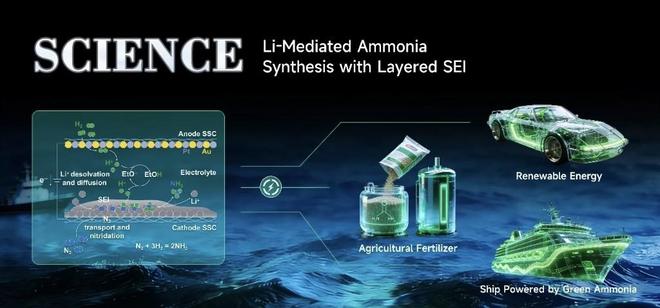
Core Viewpoint - The research team from Shanghai Jiao Tong University has developed a groundbreaking system for the electrochemical synthesis of ammonia, achieving a high current density of 100 mA cm⁻² and an energy efficiency of 21% under ambient conditions, which could revolutionize green ammonia production [1][7]. Group 1: Research Breakthrough - The traditional Haber-Bosch process for ammonia synthesis requires high temperature and pressure, relying heavily on fossil fuels and resulting in significant carbon emissions [4]. - Lithium-mediated electrochemical reduction for ammonia synthesis has faced limitations due to poor ion conduction at the solid electrolyte interface (SEI) and failure at high current densities, with ammonia production historically remaining below 8 mA cm⁻² and energy efficiency at only 3% [4]. Group 2: Innovative Solutions - The research team has innovatively constructed a functional layered SEI structure (DDLA), which enhances lithium ion transport efficiency by two orders of magnitude [4]. - This multilayer interface consists of a LiF outer layer, a Li₂CO₃ ion conduction layer, and a Li₃N interface layer, significantly reducing the energy barrier for lithium ion desolvation and migration, thereby stabilizing the interface at high current densities [5]. Group 3: Experimental Validation - Experimental results confirm that the new system achieves a Faradaic efficiency of 98% at 100 mA cm⁻² and can operate stably for 50 hours, marking a significant step towards industrial and continuous production of lithium-mediated electrochemical ammonia synthesis [7]. - The design of the interface and the ion transport mechanism have important implications for other fields, including electrochemical nitrogen fixation, metal-air batteries, and solid-state batteries [7].