盆景艺术

Search documents
一景见天地
Hang Zhou Ri Bao· 2025-11-21 02:34
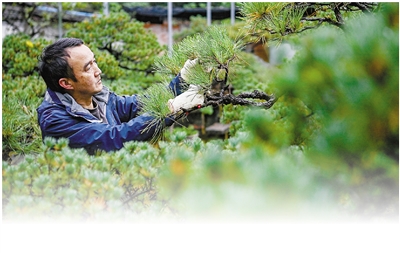
Core Viewpoint - The article highlights the significance of Zhejiang-style bonsai art, its historical roots, and the ongoing efforts to preserve and promote this cultural heritage through exhibitions and dedicated practitioners [4][9]. Group 1: Historical Background - Zhejiang-style bonsai has a history dating back to the Southern and Northern Dynasties, with documented evidence through various dynasties including Tang, Song, Yuan, Ming, and Qing [4]. - The establishment of Duojing Garden in 1958 provided a dedicated venue for showcasing Zhejiang-style bonsai, which was recognized as an intangible cultural heritage in 2022 [4][9]. Group 2: Artistic Characteristics - The art of Zhejiang-style bonsai emphasizes the use of pine and cypress, with the Five-Needle Pine being a representative species [7]. - The creation of bonsai is likened to painting, where the artist must envision the overall framework from the roots up, reflecting a deep aesthetic understanding [7][8]. Group 3: Current Developments - Duojing Garden has become the most representative specialized bonsai garden for Zhejiang-style bonsai, showcasing over 1,000 bonsai specimens across 18 families, 25 genera, and 35 species [9]. - Recent exhibitions have garnered positive social feedback, contributing to the promotion of Zhejiang-style bonsai and attracting new enthusiasts to the craft [9]. Group 4: Personal Contributions and Legacy - Jin Guoqiang, a representative inheritor of this intangible cultural heritage, emphasizes the importance of passion and patience in bonsai creation, encouraging younger generations to continue this tradition [9]. - His works and those of his students have won numerous awards, reflecting the ongoing success and recognition of Zhejiang-style bonsai in national competitions [9].