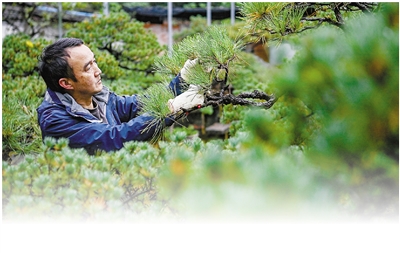
五针松盆景

Search documents
北京首次发布花卉价格预测预警系统
Xin Lang Cai Jing· 2026-01-18 19:30
Core Viewpoint - The 2026 Beijing Family Gardening Carnival and Spring Festival Flower Exhibition has commenced, showcasing popular flowers and plants from ten major flower production areas across the country, promoting regional collaboration in the flower industry [1][2]. Group 1: Event Overview - The event features two main venues: the Beijing Flower Trading Center in Fengtai District and the Jingbei Flower World in Changping District, with various exhibitions and promotional activities linked to major flower markets and online platforms like "Beijing Flowers," Meituan, and JD.com [1]. - The event aims to provide a multi-faceted experience for citizens, including themed exhibitions such as orchid shows and a special carnival focused on rare orchids [1][2]. Group 2: Price Index System - The Beijing Flower Price Index Prediction and Early Warning System has been launched, capable of generating a market price index with over 90% accuracy, benefiting flower businesses and consumers by providing timely market information [2][5]. - The system has established standardized archives for 1,887 flower varieties and integrated data from 4,264 key enterprises, creating a high-quality data set of 370 million entries [2]. Group 3: Online and Offline Sales Integration - An integrated sales model combining online and offline channels has been introduced, allowing citizens to browse and order flowers through platforms like the "Beijing Flowers" app, Meituan, and JD.com [3]. Group 4: Regional Collaboration and Cultural Exchange - The event features a special showcase of bonsai from Shiyan, Hubei, including a notable "Golden Bullet" bonsai valued over 20,000 yuan, highlighting the cultural and economic exchange between cities [4][5]. - Interactive experiences and themed activities, such as DIY potting and lantern riddle contests, are designed to engage the public and enhance the cultural significance of the event [5][6]. Group 5: Future Development Plans - Shiyan plans to establish three cooperative bases in Beijing, Langfang, and Tangshan over the next three years, aiming to create a supply chain system for bonsai that facilitates rapid distribution to the Beijing-Tianjin-Hebei region [6]. - The goal is to export 3,000 bonsai annually, generating a production value of 100 million yuan, positioning Shiyan as a leading supplier of high-end bonsai in northern China [6].
一景见天地
Hang Zhou Ri Bao· 2025-11-21 02:34
Core Viewpoint - The article highlights the significance of Zhejiang-style bonsai art, its historical roots, and the ongoing efforts to preserve and promote this cultural heritage through exhibitions and dedicated practitioners [4][9]. Group 1: Historical Background - Zhejiang-style bonsai has a history dating back to the Southern and Northern Dynasties, with documented evidence through various dynasties including Tang, Song, Yuan, Ming, and Qing [4]. - The establishment of Duojing Garden in 1958 provided a dedicated venue for showcasing Zhejiang-style bonsai, which was recognized as an intangible cultural heritage in 2022 [4][9]. Group 2: Artistic Characteristics - The art of Zhejiang-style bonsai emphasizes the use of pine and cypress, with the Five-Needle Pine being a representative species [7]. - The creation of bonsai is likened to painting, where the artist must envision the overall framework from the roots up, reflecting a deep aesthetic understanding [7][8]. Group 3: Current Developments - Duojing Garden has become the most representative specialized bonsai garden for Zhejiang-style bonsai, showcasing over 1,000 bonsai specimens across 18 families, 25 genera, and 35 species [9]. - Recent exhibitions have garnered positive social feedback, contributing to the promotion of Zhejiang-style bonsai and attracting new enthusiasts to the craft [9]. Group 4: Personal Contributions and Legacy - Jin Guoqiang, a representative inheritor of this intangible cultural heritage, emphasizes the importance of passion and patience in bonsai creation, encouraging younger generations to continue this tradition [9]. - His works and those of his students have won numerous awards, reflecting the ongoing success and recognition of Zhejiang-style bonsai in national competitions [9].