
磁振子学技术

Search documents
无需外加磁场的自旋波器件问世,为未来通信技术提供新路径
Huan Qiu Wang Zi Xun· 2026-01-16 01:28
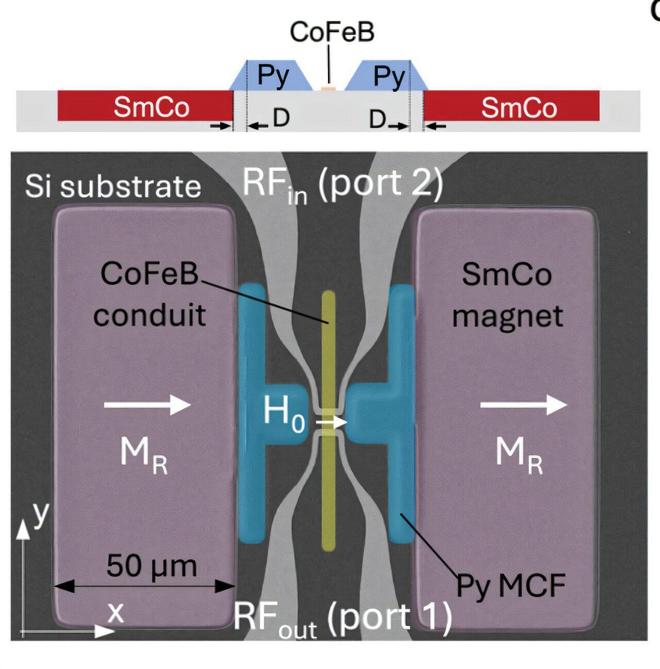
Core Insights - A research team led by the Politecnico di Milano has developed the first integrated spin-wave device that operates without an external magnetic field, enabling full tunability [2][3] - This innovation is expected to contribute to next-generation high-speed, low-power communication systems, paving the way for technologies that exceed current 5G and 6G standards [2] Group 1: Device Characteristics - The new device is miniaturized, measuring only 100×150 square micrometers, significantly smaller than current acoustic-based RF signal processing devices [2] - It features a spin waveguide made of magnetic material, equipped with input and output antennas for RF signal input and reading [2] - The device can continuously vary the transverse magnetic field strength between 11 to 20.5 millitesla by precisely adjusting the distance between the micro-magnet and the magnetic flux concentrator [2] Group 2: Performance Metrics - Experimental results indicate that the device's operating frequency can be adjusted between 3 to 8 gigahertz, achieving a maximum phase modulation capability of approximately 120 degrees at 6 gigahertz [2] - The prototype device has demonstrated stable operation as a time delay line and phase shifter without the need for an external magnetic field, which are critical components in wireless communication systems [2] Group 3: Future Applications - The device is expected to integrate with micro-electromechanical systems (MEMS) for real-time reconfigurability during operation [3] - The micro-magnet used in the device maintains stable magnetic performance at temperatures up to 200°C and generates the required magnetic field without additional energy consumption, making it suitable for practical applications [3] - This achievement marks a significant step in advancing magnonics technology from the laboratory to communication systems, bringing spin-wave chips closer to electronic device applications [3]

无需外加磁场的自旋波器件问世 为未来通信技术提供新路径
Ke Ji Ri Bao· 2026-01-16 00:56
Core Insights - A research team led by the Politecnico di Milano has developed the first integrated spin-wave device that operates without an external magnetic field, enabling full tunability [1] - This innovation is expected to be utilized in next-generation high-speed, low-power communication systems, paving the way for technologies that exceed current 5G and 6G standards [1] Group 1: Device Characteristics - The new device is miniaturized, measuring only 100×150 square micrometers, significantly smaller than current acoustic-based RF signal processing devices [1] - The core of the device consists of a spin waveguide made from magnetic materials, equipped with input and output antennas for RF signal input and reading [1] - The device can continuously vary the transverse magnetic field strength between 11 to 20.5 millitesla by precisely adjusting the distance between the micro-magnet and the magnetic flux concentrator [1] Group 2: Performance Metrics - Experimental results indicate that the device's operating frequency can be adjusted between 3 to 8 gigahertz, achieving a maximum phase modulation capability of approximately 120 degrees at 6 gigahertz [1] - The prototype device has demonstrated stable operation as a time delay line and phase shifter without the need for an external magnetic field, which are critical components in wireless communication systems [1] Group 3: Future Applications - The device is expected to integrate with micro-electromechanical systems (MEMS) for real-time reconfigurability during operation [2] - The micro-magnet used in the device maintains stable magnetic performance at temperatures up to 200°C and can generate the required magnetic field without additional energy consumption, making it suitable for practical applications [2] - This achievement marks a significant step in advancing magnonics technology from the laboratory to communication systems, bringing spin-wave chips closer to electronic device applications [2]