社保诈骗

Search documents
让情人潜入局长办公室假扮“局长”,女公职人员诈骗近200万元;一受害者要求见到局领导才能放心交钱,被骗19万元
Mei Ri Jing Ji Xin Wen· 2025-08-06 05:34
Core Points - The article discusses a fraud case involving a public official, Liu, who scammed elderly individuals under the pretense of assisting with social security applications, resulting in significant financial losses and health impacts for the victims [1][8] - Liu's fraudulent activities were driven by her gambling debts, leading her to exploit her position and connections to deceive victims [3][5] - The case highlights systemic issues in rural elder care governance, including reliance on intermediaries for social security matters and insufficient anti-fraud education [8] Group 1: Fraud Case Details - Liu accumulated debts exceeding one hundred million due to online gambling and subsequently engaged in fraudulent activities by claiming to facilitate social security applications [1][3] - The total amount involved in the fraud was 199.2 million, affecting 19 victims [1][6] - Liu was sentenced to 12 years and 6 months in prison and fined 200,000 for her crimes [7] Group 2: Victim Experiences - Victims were misled by Liu's fabricated credentials and false assurances, including the use of fake documents and impersonation of government officials [4][5] - One victim, Ray, was deceived into believing he was meeting a legitimate official, resulting in a loss of over 190,000 [4] Group 3: Systemic Issues and Responses - The case revealed weaknesses in the execution of social security policies at the grassroots level, with elderly individuals overly dependent on acquaintances for assistance [8] - In response, the local authorities initiated a "Silver Age Protection" campaign to enhance legal awareness and prevent similar frauds [8]


为还巨额赌债,公职人员竟让情人扮演“局长”行骗,案情披露
Xin Jing Bao· 2025-08-05 10:38
Core Points - The article highlights the serious issue of social security fraud targeting the elderly, emphasizing the need for strict enforcement and protection of their rights [1] - A specific case involving a public official, Liu, who committed fraud under the guise of helping with social security, is discussed in detail, illustrating the methods used and the consequences faced [2][3][4] Group 1: Case Overview - Liu, a public servant, engaged in fraudulent activities to repay gambling debts, resulting in a total fraud amount of 199.2 million yuan involving 19 victims [1][5] - Liu used deceptive tactics, including impersonating government officials and creating fake documents to gain the trust of victims [2][3] - The court sentenced Liu to 12 years and 6 months in prison and imposed a fine of 200,000 yuan for her actions [5] Group 2: Fraud Mechanisms - Liu's scheme involved promising early retirement benefits and using fake documents to convince victims of her legitimacy [2][3] - Victims were misled into believing they were engaging in legitimate transactions, with Liu providing false assurances and documentation [4][5] Group 3: Systemic Issues and Responses - The case revealed weaknesses in rural social security governance, including reliance on intermediaries and insufficient anti-fraud education [6] - The local prosecutor's office initiated measures to improve data sharing and risk assessment related to elder fraud cases [6][7] - Recommendations were made to enhance security protocols in administrative offices to prevent similar frauds in the future [7]

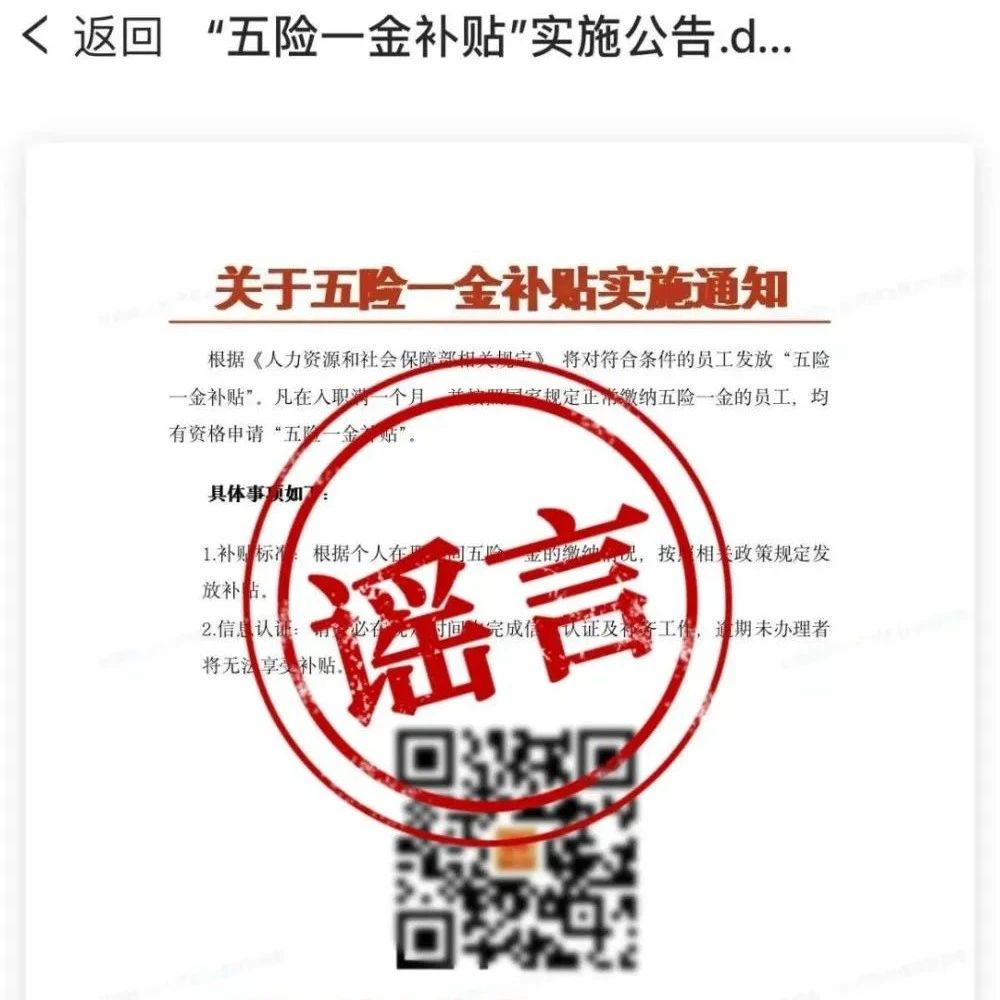
人社部门辟谣!
证券时报· 2025-04-12 12:31
Core Viewpoint - The article emphasizes that the so-called "five insurances and one fund subsidy" notifications received by some individuals are fraudulent and not issued by the Ministry of Human Resources and Social Security [1][3]. Group 1: Fraudulent Notifications - Notifications claim that employees who have been employed for over a month and have paid the five insurances and one fund are eligible for a subsidy, urging them to complete information verification within a specified time [3]. - The notifications direct individuals to scan a QR code that leads to a fake "Ministry of Finance website," requiring personal information such as name, ID number, and bank account details [4]. Group 2: Common Scam Tactics - Scammers often use illegal means to obtain personal contact information and send false messages, enticing individuals to click on links or scan QR codes that lead to counterfeit official applications [7]. - Various scams have emerged over the past two years, including "economic recovery subsidies" and "personal labor subsidies," with fraudsters creating fake websites that mimic official government sites [7]. Group 3: Warning Signs - Genuine notifications from the Ministry of Human Resources and Social Security will never ask for sensitive personal information like bank account numbers or passwords [10]. - There are also scams that falsely claim social security card status is "abnormal," urging individuals to complete online verifications [10]. Group 4: Advice for Individuals - Individuals are advised to avoid clicking on unknown links or providing personal information on unfamiliar websites to prevent financial loss [17]. - For any inquiries regarding social security subsidies or benefits, individuals should confirm with local social insurance agencies or call the hotline 12333 for assistance [18].