离子通道精确从头设计

Search documents
我国科学家在离子通道精确从头设计领域再获突破
Huan Qiu Wang Zi Xun· 2025-10-21 02:08
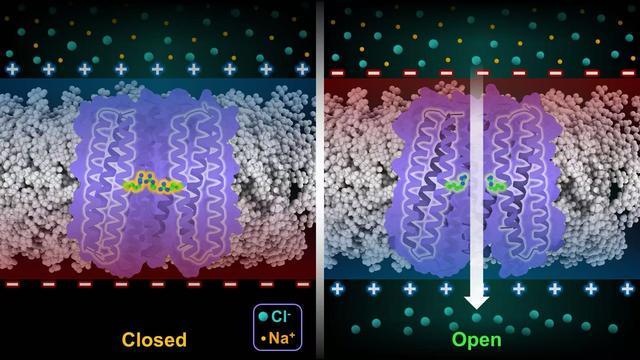
Core Insights - The research team from Westlake University's School of Life Sciences achieved two "world firsts" in the field of protein design: the precise de novo design of voltage-gated anion channels and the successful in vivo testing of artificially designed ion channel proteins [1][3][4] Group 1: Research Achievements - The team successfully designed a stable channel framework using traditional protein design algorithms combined with deep learning methods, resulting in a pentameric transmembrane protein that forms an ion channel [3] - The design includes a critical "gate" mechanism that incorporates three layers of arginine, functioning as both a voltage sensor and an ion-selective filter [3][4] - Experimental results demonstrated that at a voltage of 40 millivolts, the current significantly increased, confirming the voltage-gated design intent and showcasing the ion-selective capabilities of the channel [3] Group 2: Implications for Future Research - This breakthrough allows for the transition from designing static membrane proteins to creating dynamic transmembrane proteins that can respond to external stimuli and undergo conformational changes [4] - The collaboration with another research team led to the implantation of the artificial channel into mouse brain neurons, resulting in a significant decrease in neuronal firing frequency, indicating the functionality of the designed ion channel protein under physiological conditions [4] - The research highlights the immense potential of de novo protein design and brings the development of artificial ion channel protein drugs for regulating cellular and neural activities closer to reality [4]