科技与新消费题材

Search documents
联博基金:全球AI题材或暂无泡沫风险
Guo Ji Jin Rong Bao· 2025-11-17 13:58
Core Viewpoint - The recent fluctuations in the A-share market are primarily driven by emotional shocks rather than a weakening of the fundamentals, despite a decline in valuations and ongoing external market pressures [2]. Group 1: Market Analysis - In October, the A-share market experienced a volatile pattern influenced by trade tensions and profit-taking, with the CSI 800 index recording its first monthly decline since May [2]. - The impact of Sino-U.S. trade tensions on the market is gradually diminishing, while the "14th Five-Year Plan" emphasizes high-quality development, indicating a clear signal of "moderate strengthening" from the policy side [2]. - A-share market is expected to transition from a "hope" market driven by valuation expansion to a "growth" market driven by profit growth [2]. Group 2: Investment Strategy - The long-term investment logic in the Chinese stock market is rooted in the evolution of the national economic growth model, with a current focus on innovation and capital efficiency potentially reshaping corporate profitability and competitiveness [3]. - A healthy inflation environment may provide a more favorable macro backdrop for profit growth, suggesting that the long-term investment value of the Chinese stock market is improving [3]. - Two key investment directions are recommended: high-quality companies with both dividend and value attributes, and technology and new consumption themes with sustained growth potential [3]. Group 3: AI and Market Risks - Concerns about an "AI bubble" are mitigated by the current positive profit backdrop, with global AI themes showing no bubble risk at present [3]. - Strong earnings in technology, healthcare, and consumer sectors were reported in the U.S. stock market's third-quarter results, alongside robust capital expenditure intentions from tech giants, maintaining optimism about AI's long-term growth potential [3]. - However, potential risks in the U.S. market are accumulating, including defaults by non-deposit financial institutions and record durations of government shutdowns, which could impact employment and market sentiment [3].
外资巨头 “抱团”买入
Shang Hai Zheng Quan Bao· 2025-10-22 13:42
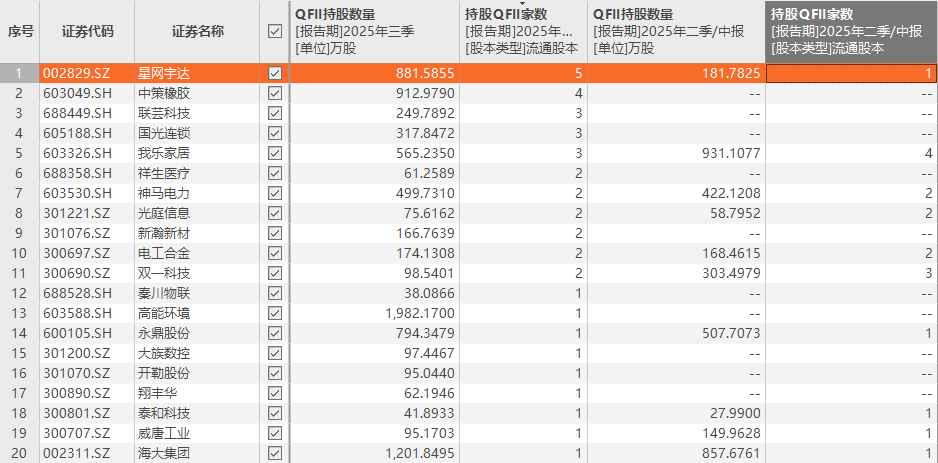
Group 1 - Major global institutions, including Merrill Lynch, Goldman Sachs, JPMorgan, and UBS, have increased their holdings or newly invested in multiple A-shares in the third quarter of this year, focusing on sectors such as technology, healthcare, and chemical materials [1][2] - A total of 22 A-share listed companies have seen QFII (Qualified Foreign Institutional Investor) appear in their top ten circulating shareholders as of the end of the third quarter [2] - The investment trend by foreign institutions is interpreted as a positive signal for the market, indicating their long-term confidence in China's economic transformation and industrial upgrading [1][8] Group 2 - For example, Zhongce Rubber has seen four well-known QFII institutions, including Merrill Lynch and Goldman Sachs, enter its top ten circulating shareholders, with Merrill Lynch holding 6.355 million shares [3][5] - XWYD (StarNet) has also attracted multiple QFII interests, with UBS and Barclays becoming new top shareholders [6][7] - The A-share market is currently viewed as having high cost-effectiveness after a phase of adjustment, with structural investment opportunities gradually emerging [8][9] Group 3 - The structural growth trends in sectors such as technology and innovative pharmaceuticals continue, with specific focus areas including computing chips, storage, liquid cooling, cloud services, and AI applications [9] - Investment opportunities are expected to arise in the domestic chip industry and related sectors due to the effects of recent policies aimed at reducing competition [8][9] - The market sentiment fluctuations have created opportunities for reassessment and positioning in these sectors [9]