纪检监察学

Search documents
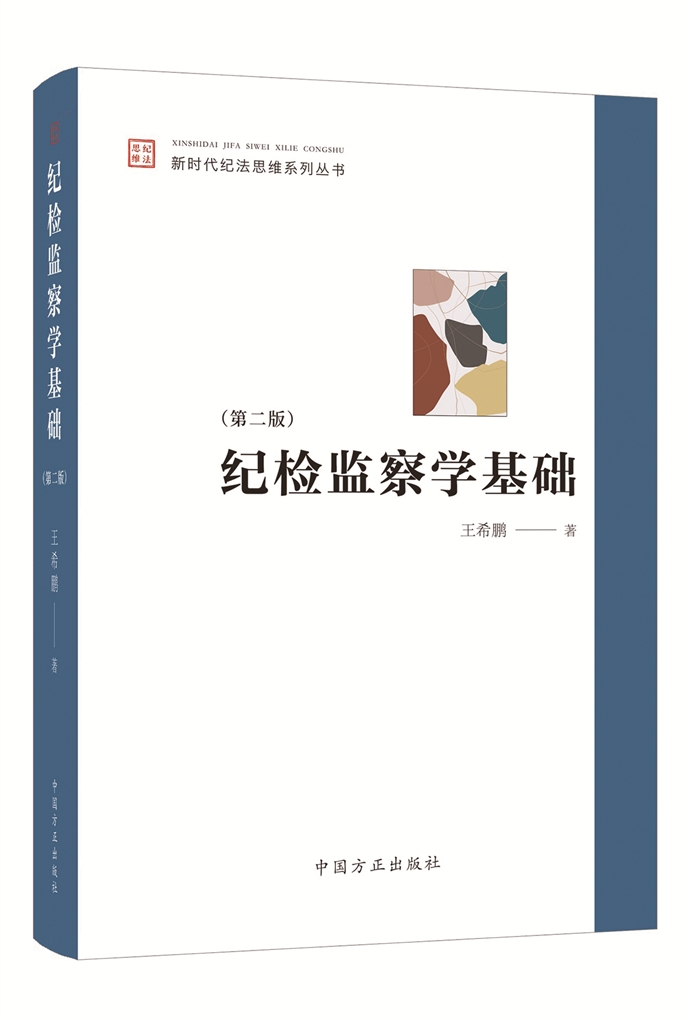
纪检监察学科教材出版发行
Xin Lang Cai Jing· 2026-02-26 00:06
Core Viewpoint - The Central Commission for Discipline Inspection and the Ministry of Education have published a set of nine textbooks on discipline inspection and supervision, marking a significant step in the development of this academic field in China [2][3]. Group 1: Textbook Overview - The nine textbooks represent the first systematic compilation of discipline inspection and supervision theories and practices in China, contributing to the "China Series" of original philosophical and social science textbooks [2]. - The textbooks are guided by Xi Jinping's thoughts on socialism with Chinese characteristics for a new era, integrating key ideas on the Party's self-revolution and summarizing the development, practical experiences, and theoretical achievements of discipline inspection and supervision, especially since the new era [2][3]. Group 2: Educational and Practical Applications - The textbooks are designed to meet the educational needs of universities offering discipline inspection and supervision programs and serve as training resources to enhance the capabilities of discipline inspection officials [2]. - The subjects covered in the textbooks include "Discipline Inspection and Supervision," "Principles of Discipline Inspection and Supervision," "Party Discipline Studies," "Supervision Law Studies," "Integrity Studies," "Discipline Inspection and Supervision Oversight," "Discipline Inspection Investigation," "Discipline Inspection Case Review," and "Discipline Inspection External Cooperation" [3]. Group 3: Continuous Development - The textbooks will evolve alongside the deepening of theories and practices in discipline inspection and supervision, reflecting the ongoing commitment to the Party's self-revolution and strict governance [3].

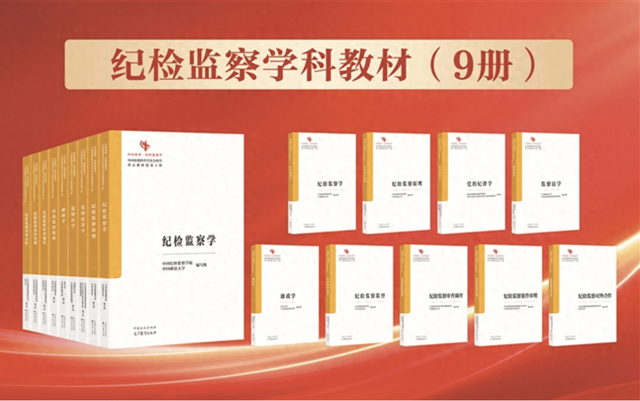
新书架丨探索建构中国纪检监察学自主知识体系
Zhong Yang Ji Wei Guo Jia Jian Wei Wang Zhan· 2025-11-25 00:33
Core Viewpoint - The article emphasizes the importance of establishing a Chinese independent knowledge system in the field of discipline inspection and supervision, highlighting its relevance to the Communist Party's self-revolution and the broader context of anti-corruption efforts in China [2][3]. Group 1: Discipline Inspection and Supervision as a Discipline - Discipline inspection and supervision is presented as an innovative discipline rather than an interdisciplinary one, guided by Xi Jinping's thoughts on socialism with Chinese characteristics for a new era [3]. - The book "Fundamentals of Discipline Inspection and Supervision (Second Edition)" systematically explains the independent knowledge system of this discipline, covering its significance, characteristics, research objects, and theoretical framework [2][4]. Group 2: Systematic Knowledge Framework - The knowledge framework of Chinese discipline inspection and supervision is characterized by relative independence and systematic integration of content elements, outlining concepts, attributes, functions, and foundational theories [4]. - The book details the nature, responsibilities, and operational principles of discipline inspection agencies, as well as the rules and procedures for various investigative processes, creating a clear depiction of the discipline's knowledge structure [4]. Group 3: Integration of Theory and Practice - The book provides detailed regulations on various aspects of supervision and enforcement, including conditions for investigations, evidence collection, and case handling, reflecting the integration of disciplinary and legal principles [4]. - It emphasizes the importance of aligning theoretical education with practical operations, ensuring a comprehensive understanding of the discipline [4]. Group 4: Reflection of Contemporary Developments - The second edition of the book incorporates recent advancements in the reform of the discipline inspection and supervision system, addressing issues such as the prevention of new and hidden corruption [5]. - It aims to support the high-quality development of discipline inspection and supervision work in the new era, aligning with the evolving needs of the Party and the state [5].