绿氢发电

Search documents
洛杉矶将启用全球最大绿氢发电厂
Zhong Guo Hua Gong Bao· 2025-12-12 03:57
Core Insights - Los Angeles has officially ceased coal power generation and plans to launch the world's largest green hydrogen power facility by Q2 2026, aiming for 100% carbon-free electricity by 2035 [1] Group 1: Project Overview - The power plant, previously coal-fueled, will be converted to use a blend of natural gas and green hydrogen, starting with a mix of 30% hydrogen and 70% natural gas, with plans to transition to 100% hydrogen [1] - The project will utilize large underground salt caverns for green hydrogen storage, produced through water electrolysis powered by renewable energy, resulting in only oxygen emissions during production [1] Group 2: Production Capacity and Environmental Impact - The facility is expected to produce 21 million kilograms of hydrogen annually, making it the largest operational green hydrogen project globally [1] - To address nitrogen oxide emissions from hydrogen fuel during power generation, the plant will implement advanced catalytic reduction systems to ensure emissions are significantly below permitted limits, achieving zero carbon dioxide emissions [1]
趋势研判!2025年中国燃料电池发电站行业产业链图谱、发展现状、竞争梯队及未来前景分析:技术迭代驱动场景深化,固体氧化物燃料电池领航产业升级[图]
Chan Ye Xin Xi Wang· 2025-05-09 01:13
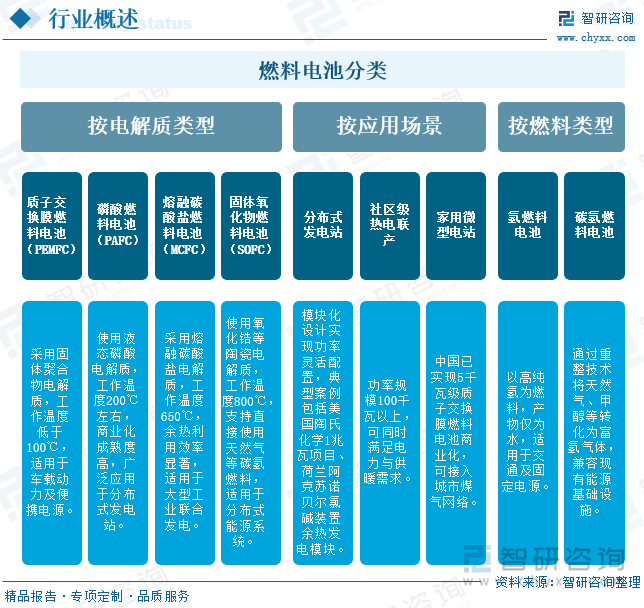
Core Insights - The fuel cell power generation industry in China is in its early commercialization stage, but its development potential is gradually becoming evident [1] - By 2030, the installed capacity of fuel cell power generation in China is expected to exceed 2000-2500 MW, with an annual compound growth rate of over 30% [1][14] Industry Overview - Fuel cell power stations convert chemical energy from fuels (like hydrogen and natural gas) into electrical energy through electrochemical reactions, achieving energy conversion efficiencies of 40%-60%, and up to 80% in combined heat and power (CHP) systems [2] - The industry has formed a complete ecosystem with innovative companies like Kunhua Technology, Aidemeng, and Qingneng Technology collaborating with listed companies and research institutions [1][16] Market Dynamics - The market size of China's hydrogen fuel cell industry grew from 1.63 billion yuan in 2019 to 3.93 billion yuan in 2023, with a compound annual growth rate of 24.61% [10] - In 2024, the industry is expected to experience explosive growth, with fuel cell heavy truck sales increasing by 80% year-on-year and the number of hydrogen refueling stations surpassing 550 [10] Technological Landscape - The fuel cell technology is categorized based on electrolyte type, operating temperature, and fuel applicability, including proton exchange membrane fuel cells (PEMFC), phosphoric acid fuel cells, molten carbonate fuel cells, and solid oxide fuel cells (SOFC) [3][5] - SOFCs have higher efficiency, reaching nearly 90% in CHP applications, and a broader range of fuel options, making them suitable for various applications [5] Competitive Landscape - The industry is characterized by a "leading enterprises, regional clustering, and diverse technologies" competitive structure, with major players like Dongfang Electric and Weichai Power leading in SOFC technology [19][21] - The collaboration between upstream material suppliers and downstream application developers is crucial for driving the commercialization of fuel cell power stations [8][19] Future Trends - The industry is transitioning from policy-driven to market-driven, with technological breakthroughs and cost reductions accelerating commercialization [23] - The application scenarios are expanding from demonstration projects to large-scale commercial use, with a projected 60% of installed capacity in CHP projects by 2030 [26] - The cost of green hydrogen production is decreasing, with projections of 25 yuan/kg in 2024 and potentially 15 yuan/kg by 2030, enhancing the competitiveness of hydrogen energy [27]