
网络烂梗

Search documents
「网络烂梗」本身就是一个「网络烂梗」| Knock Knock 世界
声动活泼· 2025-12-27 10:04
Group 1 - The article discusses the popularity of "internet memes" and their cultural significance, questioning why they have become so widespread [5][6] - It highlights a conversation between the author and a teacher about the term "internet meme," suggesting that it may be a misused term that encompasses various other expressions [6][7] - The article emphasizes the importance of language expression and the potential negative impact of overusing certain phrases, indicating that this could lead to a decline in cognitive engagement [6][7] Group 2 - The "Knock Knock World" podcast is introduced, which aims to engage young audiences with global events and diverse perspectives, releasing episodes three times a week [7][9] - The first season of the podcast runs from March 25, 2025, to March 24, 2026, with a subscription price of 365 yuan per year [7][10] - The podcast is available on various audio platforms, including Apple Podcast and QQ Music, indicating a broad distribution strategy [7][15]

抽象烂梗正在毁掉美国小学生
Xin Lang Cai Jing· 2025-11-27 20:18
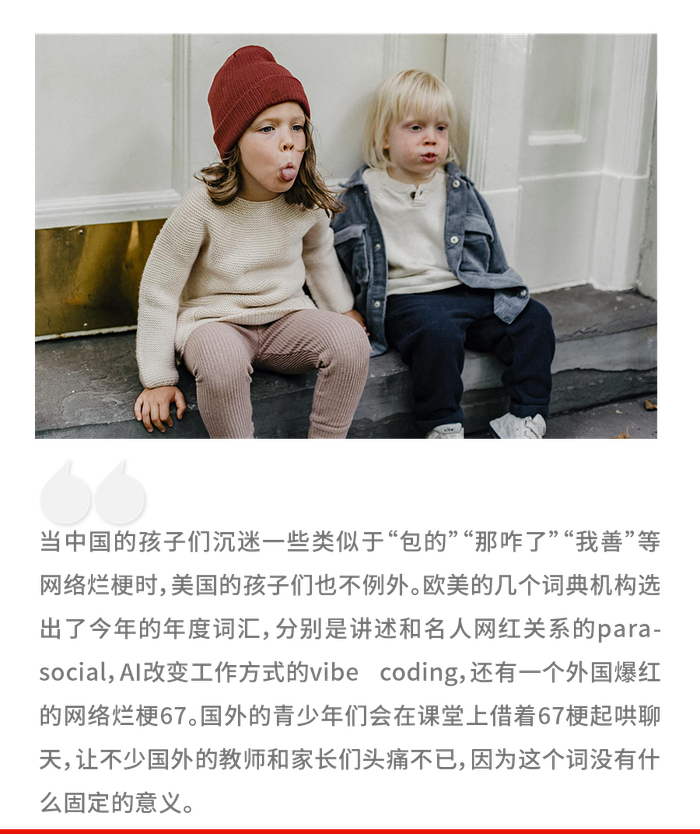
Core Insights - The annual word selections from various dictionaries highlight the influence of social media and AI on personal relationships and communication styles [2][5][44] - The chosen words reflect a shift in how individuals interact with celebrities, AI, and each other, indicating a new era of social dynamics [5][44] Group 1: Selected Words and Their Implications - Cambridge Dictionary's word "parasocial" refers to the one-sided relationships individuals form with celebrities and online personalities, showcasing emotional connections despite a lack of real-life interaction [5][9] - Collins Dictionary's term "vibe coding" describes the ability to communicate with AI in natural language to generate code, simplifying complex tasks for users [11][44] - Dictionary.com's choice of the number "67" symbolizes a viral internet meme among children, illustrating how meaningless phrases can dominate youth culture and communication [4][23][44] Group 2: Cultural Impact and Trends - The rise of "parasocial" relationships is exemplified by a fan's extreme engagement with a celebrity's personal life, leading to increased online searches and discussions [7][9] - The popularity of "vibe coding" reflects a broader trend of integrating AI into daily tasks, with students and professionals increasingly relying on AI for assistance [11][44] - The phenomenon of the "67" meme highlights the influence of social media on youth communication, with educators expressing concern over its disruptive nature in classrooms [23][44]
烂梗包围小学生
Jing Ji Guan Cha Wang· 2025-11-07 09:25
Core Viewpoint - The phenomenon of "internet memes" or "烂梗" is increasingly prevalent among elementary school students, raising concerns about its impact on language skills and social behavior [3][4][12]. Group 1: Background and Trends - Internet memes, characterized by their overuse and lack of depth, have spread from middle school students to younger elementary school children [3][4]. - The popularity of these memes is uniform across various regions in China, indicating a national trend among young students [3]. - The rise of internet memes among younger students is attributed to their early exposure to digital devices and social media [8][12]. Group 2: Impact on Language and Behavior - The use of internet memes can weaken children's language expression abilities, as they struggle to differentiate between meaningful language and superficial expressions [4][15]. - Teachers have observed a decline in reading skills and attention spans among students, correlating with the rise of short video consumption [15][16]. - The prevalence of memes has led to a shift in social interactions, with students preferring to engage in meme-based communication rather than traditional reading or writing [15][16]. Group 3: Parental and Educational Responses - Parents and educators are increasingly concerned about the influence of internet memes on children's behavior and attitudes [5][17]. - Some parents have attempted to engage with their children by using memes in conversations, but this has not always been successful [6][11]. - Experts suggest that parents and teachers should approach the issue with understanding and use it as an opportunity to guide children towards healthier communication methods [17][18]. Group 4: Recommendations for Platforms - Current measures by online platforms to protect young users from harmful content are deemed insufficient, with calls for more tailored approaches based on age groups [18]. - Experts recommend that platforms implement layered content controls to minimize exposure to inappropriate material for younger audiences [18].
被网络烂梗包围的小学生
经济观察报· 2025-11-06 11:56
Core Viewpoint - The article discusses the rising trend of internet memes, referred to as "烂梗" (làn gěng), among elementary school students in China, highlighting the potential impact on language skills and social behavior [3][5][10]. Group 1: Popularity and Spread of Internet Memes - Many elementary school students across various regions in China, including Beijing, Shanxi, Chongqing, Guangdong, and Zhejiang, are increasingly using internet memes, indicating a nationwide trend [3][5]. - The memes often originate from games, anime, internet celebrities, and live streaming, and have transitioned from being popular among middle school students to younger elementary school students [3][8]. - The rapid spread of these memes is facilitated by short video platforms, where students mimic and adopt the language they encounter [10][16]. Group 2: Impact on Language and Behavior - The use of internet memes can weaken students' language expression abilities, as they struggle to differentiate between meaningful language and memes [3][8]. - Teachers have observed a decline in reading abilities and a lack of patience for long texts among students, attributed to the influence of short videos [12][13]. - Some memes, such as "唐" (táng), which references a genetic disorder, and others that trivialize serious issues, can be harmful and inappropriate for children [6][12]. Group 3: Parental and Educational Responses - Parents and teachers are concerned about the influence of these memes, with some parents attempting to engage with their children by using the same language, while others express frustration [5][15]. - Educators suggest that addressing the issue with understanding and guiding children towards healthier expressions of emotions is crucial [15][16]. - There is a call for internet platforms to implement more age-appropriate content filtering to protect younger audiences from exposure to inappropriate memes [16].
拥抱现实社交 超越网络“烂梗”之困
Zhong Guo Qing Nian Bao· 2025-05-09 03:15
Core Viewpoint - The popularity of internet "memes" among teenagers reflects a shift in social interaction and communication styles, driven by the need for quick, attention-grabbing expressions rather than complex language [1][2][3][4] Group 1: Characteristics of Teen Social Interaction - Teen social interaction today is characterized by immediacy, performative expression, and low-cost emotional exchanges, leading to a preference for concise communication [2] - The rapid pace of information exchange encourages teenagers to use brief expressions to gain attention, making complex language seem cumbersome [2] - The stage effect of social media amplifies teenagers' desire to perform, leading to the use of exaggerated and provocative expressions to attract an audience [2] Group 2: Impact of Social Environment - Many teenagers grow up in isolated and flattened environments, with real-life interactions replaced by digital devices, limiting their social experiences [3] - The reduction of independent social spaces for minors, due to adult concerns for safety and health, confines their social interactions primarily to online platforms [3] - The competitive academic environment consumes significant time and energy, further diminishing opportunities for real-world social engagement [3] Group 3: Consequences of Reduced Real-World Interaction - Limited face-to-face interactions hinder teenagers' ability to learn nuanced language expressions and emotional communication [4] - The absence of real social experiences means teenagers miss opportunities to understand the art of communication, coordination, and compromise [4] - The proliferation of internet memes is a response to the flattened social life of teenagers, which aligns with the internet's "traffic logic" where attention equates to value [3][4] Group 4: Solutions and Recommendations - To cultivate nuanced and profound language skills, teenagers need ample opportunities to engage in real-life social interactions [4] - Creating and promoting culturally rich content and meaningful expressions is important, but addressing the root causes of social interaction deficits is crucial [4] - Protecting teenagers' language abilities is essential for safeguarding their social interaction skills [4]