美国对伊军事行动

Search documents
特朗普称正考虑逐步降级对伊朗的军事行动
21世纪经济报道· 2026-03-20 22:54
Core Viewpoint - The article discusses the strategic military objectives of the United States regarding Iran, emphasizing the intent to weaken Iran's military capabilities and ensure regional security in the Middle East. Group 1: Military Objectives - The U.S. aims to completely weaken Iran's missile capabilities, launch systems, and all related facilities [1] - The destruction of Iran's defense industrial base is a key objective [2] - The U.S. seeks to eliminate Iran's naval and air forces, including air defense systems [3] Group 2: Regional Security and Responsibilities - The U.S. will no longer take responsibility for the security and patrol of the Strait of Hormuz, suggesting that other nations using the strait should assume this role [4] - The U.S. is committed to preventing Iran from approaching nuclear capabilities and will maintain a posture to respond swiftly and forcefully if necessary [5] - The U.S. intends to protect its allies in the Middle East, including Israel, Saudi Arabia, Qatar, the UAE, Bahrain, Kuwait, and others, with the highest level of support [5]

国际观察|美国重兵集结中东,背后是怎样的盘算
Xin Hua She· 2026-02-25 05:18
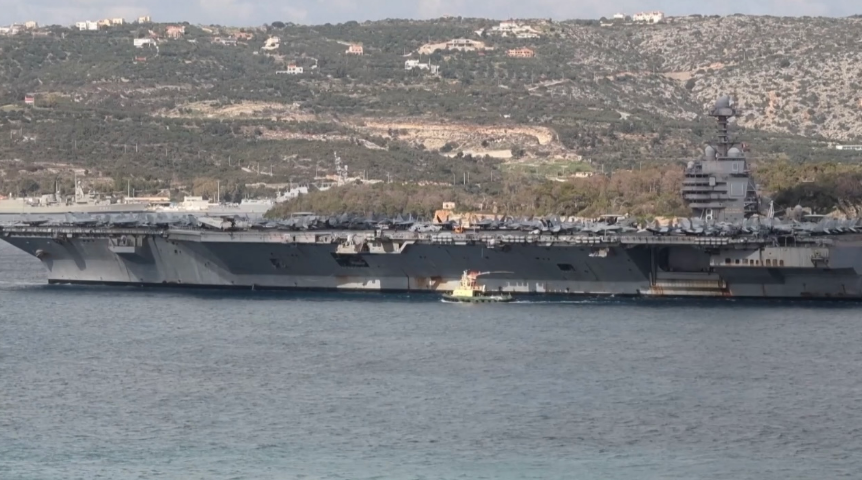
Core Viewpoint - The article discusses the significant military buildup by the United States in the Middle East, highlighting the strategic implications behind this deployment and the potential for military action against Iran as negotiations approach [1][3]. Military Deployment - The U.S. has completed a "dual aircraft carrier" deployment in the Middle East, with the USS Ford and USS Lincoln aircraft carrier strike groups, which include nearly 100 aircraft such as F-35s and F-18s, supported by multiple destroyers [1][2]. - This is reported to be the largest military deployment in the region since the Iraq War in 2003, comparable to the 1998 "Desert Fox" operation against Iraq [2]. Strategic Objectives - The military buildup serves two main objectives: 1. To exert extreme pressure on Iran ahead of negotiations, with President Trump indicating that Iran must reach a "meaningful agreement" or face consequences [3]. 2. To prepare for potential military action, with reports suggesting Trump is considering a "limited strike" against Iran to compel compliance [3][4]. Potential Military Strategies - Analysts have identified three possible military strategies the U.S. could employ against Iran: 1. "Limited strikes" targeting key military and security forces to establish deterrence [4]. 2. "Long-term weakening" through periodic strikes on Iran's nuclear facilities and military capabilities [4]. 3. "Regime change" aimed at directly targeting Iran's leadership, though this faces logistical challenges [4]. Concerns and Consequences - There are concerns within the U.S. government regarding the potential for prolonged conflict and the risks associated with military action against Iran, including possible casualties among U.S. personnel stationed in the region [6]. - The potential for rapid escalation of conflict is significant, as Iran could activate its regional allies to retaliate against U.S. and Israeli interests, potentially expanding the conflict beyond the Gulf [6][7]. - The situation could also disrupt global energy markets, with Iran capable of closing the Strait of Hormuz, leading to a spike in oil prices and broader economic repercussions [7].
美伊26日谈判在即 是否对伊朗动武:白宫先内讧了
Xin Lang Cai Jing· 2026-02-23 23:46
Group 1 - The U.S. and Iran are set to hold a new round of negotiations on February 26 in Geneva, with U.S. Special Envoy Wittecoff and Jared Kushner participating [1] - The U.S. military presence in the region is increasing, with the USS Gerald R. Ford aircraft carrier arriving at a key base in the Eastern Mediterranean and multiple U.S. military aircraft landing at Israel's Ben Gurion Airport [3][5] - The U.S. State Department has raised its travel warning for Lebanon to the highest level, advising American citizens to leave and suspending regular consular services at its embassy in Beirut [5] Group 2 - Reports indicate that President Trump is considering a preliminary military strike against Iran, potentially followed by a larger military action in the coming months [6] - There are internal divisions within the U.S. decision-making body regarding military action against Iran, with some officials expressing concerns about the risks of prolonged conflict [8] - Iran has warned that any attack, regardless of scale, will be viewed as aggression, and they are closely monitoring developments while engaging in diplomatic talks [10] Group 3 - An unnamed Iranian official stated that Iran is willing to make concessions on nuclear issues, including sending half of its enriched uranium abroad and diluting the remaining portion, in exchange for U.S. recognition of its right to peaceful uranium enrichment and the lifting of economic sanctions [11] - Experts suggest that while Iran is showing more flexibility, the likelihood of reaching a preliminary agreement remains uncertain due to various factors, including Israel's potential actions [13] - Israeli Prime Minister Netanyahu has warned that any attack from Iran will be met with an unimaginable level of retaliation [15]
爆料:美国通报对伊行动时间表
第一财经· 2026-01-28 00:00
Core Viewpoint - The article discusses the potential military actions that the United States may take against Iran, as communicated to Israel, indicating a readiness for action within a specific timeframe [1]. Group 1 - The U.S. has informed Israel about its preparations for possible military action against Iran, with completion of these preparations expected within two weeks [1]. - There may be a "window of opportunity" for action in the coming months, although this does not imply that action will only occur after all preparations are finalized [1]. - If President Trump issues a command, U.S. actions could occur sooner than planned, but this option is not currently viewed as urgent [1]. Group 2 - Official confirmation from U.S. and Israeli authorities regarding the reported military preparations has not been provided [2].