美国移民政策收紧

Search documents
名单曝光!美国将暂停75个国家和地区签证,引发质疑
Xin Lang Cai Jing· 2026-01-15 03:58
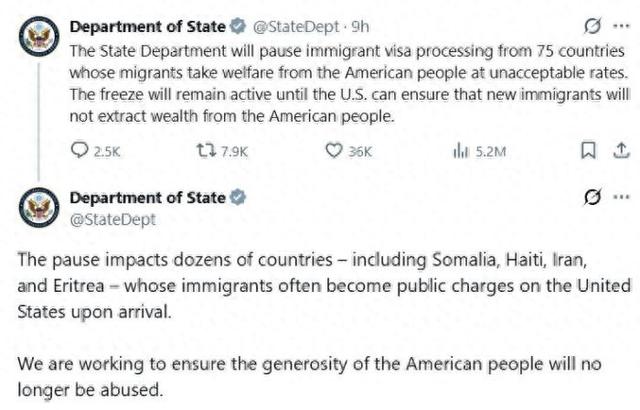
Core Points - The U.S. Department of State announced a suspension of immigrant visa applications from 75 countries, stating that this measure will be "in effect indefinitely" [1] - The suspension will affect countries such as Somalia, Haiti, Iran, and Eritrea, with the U.S. government emphasizing that immigrants from these nations often become public burdens [1] - The implementation of this suspension is set to begin on January 21 [2] Group 1 - The list of affected countries includes Afghanistan, Albania, Algeria, Antigua and Barbuda, Armenia, Azerbaijan, Bahamas, Bangladesh, Barbados, Belarus, Belize, Bhutan, Brazil, Myanmar, Cambodia, Cameroon, Cape Verde, Colombia, Côte d'Ivoire, Cuba, Democratic Republic of the Congo, Dominican Republic, Egypt, Eritrea, Ethiopia, Fiji, Gambia, Georgia, Ghana, Grenada, Guatemala, Guinea, Haiti, Iran, Iraq, Jamaica, Jordan, Kazakhstan, Kuwait, Kyrgyzstan, Laos, Lebanon, Liberia, Libya, North Macedonia, Moldova, Mongolia, Montenegro, Morocco, Nepal, Nicaragua, Nigeria, Pakistan, Republic of the Congo, Russia, Rwanda, Saint Kitts and Nevis, Saint Lucia, Saint Vincent and the Grenadines, Senegal, Sierra Leone, Somalia, South Sudan, Sudan, Syria, Tanzania, Thailand, Togo, Tunisia, Uganda, Uruguay, Uzbekistan, and Yemen [2] - The U.S. government has tightened immigration policies, with increased scrutiny on visa applicants and restrictions on entry for citizens from multiple countries [2][3] - The Trump administration has implemented measures such as nearly closing the U.S.-Mexico border, imposing visa restrictions, and terminating several humanitarian refugee programs [3] Group 2 - In August 2025, the Trump administration announced a review of all foreign nationals holding valid U.S. visas, with potential revocation or deportation for any violations found [4] - A new pilot program requires visa applicants from certain countries to pay a bond of up to $15,000, expanding the list to 38 countries including Algeria and Angola [4] - Economic experts have raised concerns about the long-term impacts of reduced immigration on the U.S. economy, suggesting that for the first time in over fifty years, the number of immigrants leaving the U.S. may exceed those entering, potentially leading to slower economic growth and weak job and GDP growth [4]

打击潜在公共负担申请人,美国将暂停对75个国家的所有签证
Xin Lang Cai Jing· 2026-01-14 15:33
Group 1 - The U.S. Department of State will suspend visa processing for 75 countries to combat potential public charge applicants, affecting nations like Somalia, Russia, Afghanistan, Brazil, Iran, Iraq, Egypt, Nigeria, Thailand, and Yemen [1] - The number of countries subject to full and partial entry restrictions has increased from 19 to 40 since January 1, primarily targeting nations from Asia, Africa, and Central America, as well as countries with strained relations with the U.S. like Iran, Venezuela, and Russia [1] - New directives require visa officers to assess applicants based on various factors, including age, health, family status, financial resources, education, skills, English proficiency, and past use of public assistance [1] Group 2 - The new regulations expand health considerations for visa applicants, with potential rejection reasons including obesity, hypertension, cardiovascular diseases, metabolic or neurological disorders, and mental health issues, which could lead to high medical costs [2] - The H-1B visa program has seen fee increases, with applicants now required to pay $100,000 annually, affecting H-4 visa holders as well [2] - The "Trump Gold Card" visa program has been officially accepted, encouraging wealthy individuals to move to the U.S. with application fees set at $1 million for individuals and $2 million for businesses, alongside a proposed $5 million "Platinum Card" [2] - The International Monetary Fund warns that tightening immigration policies could significantly impact U.S. economic growth, estimating that deporting 10% of undocumented immigrants could shrink GDP by 3.3% and reduce wage levels by 1.7% [2]
特朗普签了!进一步限制外国公民入境美国
证券时报· 2025-12-17 00:04
Core Points - The article discusses the recent immigration policy changes by the U.S. government under President Trump, including the signing of an announcement that imposes further restrictions on foreign citizens' entry into the U.S. [2] Group 1: Immigration Restrictions - The U.S. has implemented comprehensive entry restrictions for citizens from Burkina Faso, Mali, Niger, South Sudan, and Syria, as well as for holders of travel documents issued by the Palestinian Authority [2] - Laos and Sierra Leone, which previously had partial restrictions, are now subject to comprehensive entry limitations [2] - Partial entry restrictions are also applied to 15 countries, including Angola, Benin, Nigeria, and Tanzania [2] Group 2: Visa Revocations - Since the beginning of the year, approximately 80,000 non-immigrant visas have been revoked by the U.S. government, with reasons including DUI, assault, and theft [5] - Of the revoked visas, around 16,000 were due to DUI, 12,000 for assault, and 8,000 for theft, indicating that these three categories account for nearly half of the total revocations [5] - The government has intensified scrutiny on legal visa holders, including students, with reports of hundreds to thousands of student visas being revoked for various violations [5][6] Group 3: Enhanced Visa Screening - The U.S. government has strengthened the visa issuance review process, tightening social media scrutiny and expanding background checks [6]
外媒:不到一年,特朗普政府已吊销8万份非移民签证
Zhong Guo Xin Wen Wang· 2025-11-06 10:22
Group 1 - The Trump administration has revoked approximately 80,000 non-immigrant visas since January, citing reasons such as DUI, assault, and theft [1][3] - About 16,000 of the revoked visas are related to DUI, 12,000 to assault, and 8,000 to theft, accounting for nearly half of the total visa revocations this year [3] - The U.S. Secretary of State, Marco Rubio, indicated that hundreds to thousands of visas, including student visas, have been revoked for actions that contradict U.S. foreign policy priorities [3] Group 2 - The U.S. State Department has reported the revocation of over 6,000 student visas due to overstays, illegal activities, and "supporting terrorism" [3] - Among the visas revoked in October, at least six individuals were involved in comments related to the assassination attempt on conservative figure Charlie Kirk on social media [3] - The U.S. government is tightening immigration policies, enhancing scrutiny on visa issuance, including social media reviews and expanding background checks [3]
美国:一些国家游客入境需要交最高1.5万美元保证金
财联社· 2025-08-05 07:00
Core Viewpoint - The United States is initiating a pilot program that may require some incoming travelers to pay a bond of up to $15,000, targeting countries with historically high visa overstay rates [1][3]. Group 1: Pilot Program Details - The pilot program will last for 12 months and is expected to take effect 15 days after its official announcement [2]. - The U.S. Department of State will soon publish a list of countries whose nationals will be required to pay the bond [4]. - The bond amounts will be tiered at $5,000, $10,000, and $15,000, determined by consular officials based on individual circumstances such as travel purpose, employment, income, skills, and education [7]. Group 2: Targeted Countries and Overstay Rates - The program specifically targets countries with high visa overstay rates, including Chad (50%), Laos (35%), and Haiti (31%) [4]. - The countries with the highest number of overstays include Mexico (approximately 49,000), Brazil (21,000), Colombia (41,000), Haiti (27,000), Venezuela (22,000), and the Dominican Republic (20,000) [4]. Group 3: Objectives and Compliance - The pilot program aims to ensure that visitors comply with their visa terms and to encourage foreign governments to reduce their nationals' overstay rates and improve travel screening processes [8]. - Approximately 2,000 individuals are expected to pay the visa bond during the pilot program, reflecting uncertainty regarding the number of eligible applicants and their ability to pay [6].