肉品腐败预警技术

Search documents
大学生“争鲜夺秒”预报肉品腐败
Zhong Guo Qing Nian Bao· 2025-11-21 23:36
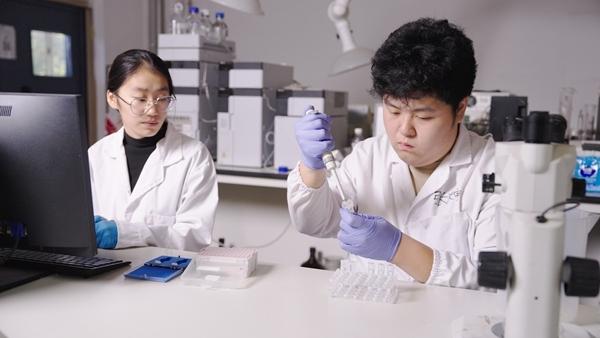
Core Insights - The "Chasing Freshness" team from Shandong University of Technology developed a fluorescent probe to detect early signs of meat spoilage, winning a national award for their innovative research [1][6]. Group 1: Project Background - The project was inspired by a visit to a meat processing company, where the team identified a significant time gap in traditional spoilage detection methods, which can take 12 to 24 hours [2][3]. - The team aimed to create a pre-warning system for meat spoilage, akin to weather forecasting, to enhance food safety [2]. Group 2: Research and Development Process - Initial attempts to find suitable indicators for early spoilage detection were met with numerous failures, leading to extensive late-night research sessions [3][4]. - A breakthrough occurred when the team discovered that the viscosity of cells increases during apoptosis, which could be analogous to the early stages of meat spoilage [4][5]. Group 3: Technological Innovation - The team developed a new detection method based on the correlation between meat spoilage, viscosity changes, and fluorescent response, which allows for a 12-hour early warning [6]. - The final molecular structure selected for the probe was "acrylonitrile-morpholine," which enhances fluorescence in response to increased viscosity due to spoilage [6]. Group 4: Practical Applications - The technology has been piloted with two companies, reducing detection time to under 10 minutes, improving accuracy by approximately 15%, and lowering costs by over 30% [6]. - A portable testing kit has been developed to facilitate rapid, visual detection of meat spoilage, making advanced technology accessible to consumers [6].