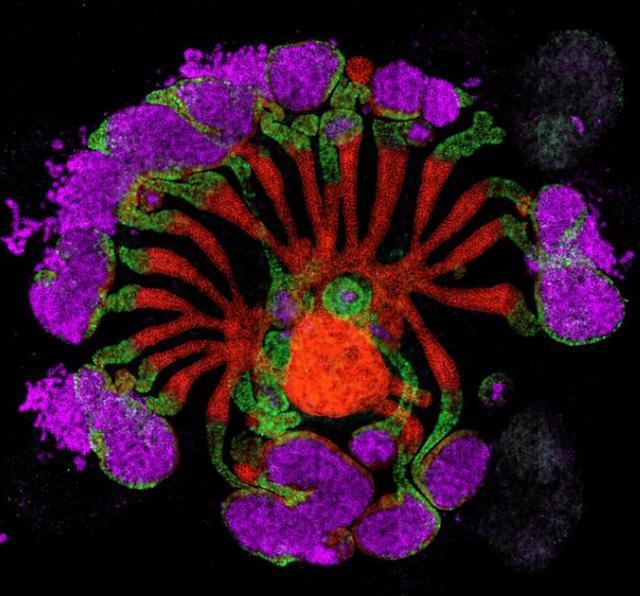
肾脏类器官

Search documents
科学家构建新型“组合体”肾脏组织,为疾病研究和器官移植带来新希望
Huan Qiu Wang Zi Xun· 2025-09-18 07:33
Core Insights - An international research team has achieved a significant breakthrough in constructing synthetic kidneys by integrating key structures to create a new type of kidney tissue known as "composite" [2] - This advancement allows for the cultivation of more mature and complex kidney organoids, offering new hope for disease research and organ transplantation [2] Group 1: Research Achievements - The team, which includes institutions like the University of Southern California and Tongji University, optimized growth conditions for mouse and human kidney "composites" in the lab [2] - These "composites" were successfully transplanted into live mice, where they matured further, increasing in size and developing connective tissue and vascular networks [2] - The transplanted "composites" exhibited multiple functions similar to real kidneys, such as blood filtration, protein absorption, hormone secretion, and early signs of urine generation [2] Group 2: Disease Modeling Potential - The research demonstrated the potential of "composites" as disease models by cultivating human "composites" with PKD2 gene mutations, which lead to autosomal dominant polycystic kidney disease [3] - These diseased "composites" developed large human kidney cysts in mice, displaying inflammation and fibrosis, which are complex pathological features difficult to replicate in previous in vitro models [3] Group 3: Future Implications - This research not only provides a powerful new tool for studying various complex kidney diseases but also lays a solid foundation for designing transplantable functional synthetic kidneys [4] - The findings hold promise for offering new options for patients with end-stage kidney disease awaiting transplantation [4]