
虚拟连挂技术

Search documents
重载列车开启“蓝牙跟车”时代
Xin Lang Cai Jing· 2026-02-01 23:26
Core Insights - The article discusses the successful implementation of the world's first automatic train formation technology for heavy-haul trains in Inner Mongolia, marking a significant technological breakthrough in railway transportation [1][2] - The new "virtual coupling" technology allows trains to operate without physical connections, relying instead on wireless communication, thus entering the "smart grouping" era for heavy-haul rail transport [1] Group 1: Technology Overview - The "virtual coupling" system is the first of its kind globally, developed independently by China, and is likened to a smart beehive where the control center acts as the "queen bee" and each train functions as an autonomous "worker bee" [1] - This system enables trains to form and disband groups on command, enhancing operational flexibility and efficiency [1] Group 2: Operational Efficiency - The technology addresses significant challenges in heavy-haul transport, such as the risks associated with longer trains, including coupling failures and braking synchronization issues [1] - The system reduces the tracking distance between trains from over 4 kilometers to approximately 1 kilometer and decreases the departure interval from over 10 minutes to under 5 minutes, thus improving operational efficiency [2] Group 3: Capacity Enhancement - The "virtual coupling" technology is set to be first applied in a key transportation corridor formed by the Baoshen, Shenshuo, and Shuohuang railways [2] - It is estimated that this technology could enhance the overall capacity of heavy-haul railways by over 50% [2]
3.5万吨群组列车试验成功
Xin Lang Cai Jing· 2026-01-04 20:03
Group 1 - The world's first successful trial of a 35,000-ton heavy-haul train group was conducted by Guoneng Baoshen Railway Company, marking a significant technological breakthrough in heavy-haul railway development [3] - The trial demonstrated a "virtual coupling" system that allows multiple heavy freight trains to maintain a safe distance without physical connections, utilizing precise wireless signal transmission for dynamic grouping [3] - This successful trial has major strategic implications for the efficient and low-cost transportation of bulk goods such as coal and ore, and provides a replicable "Chinese technology solution" for global heavy-haul railway development [3]

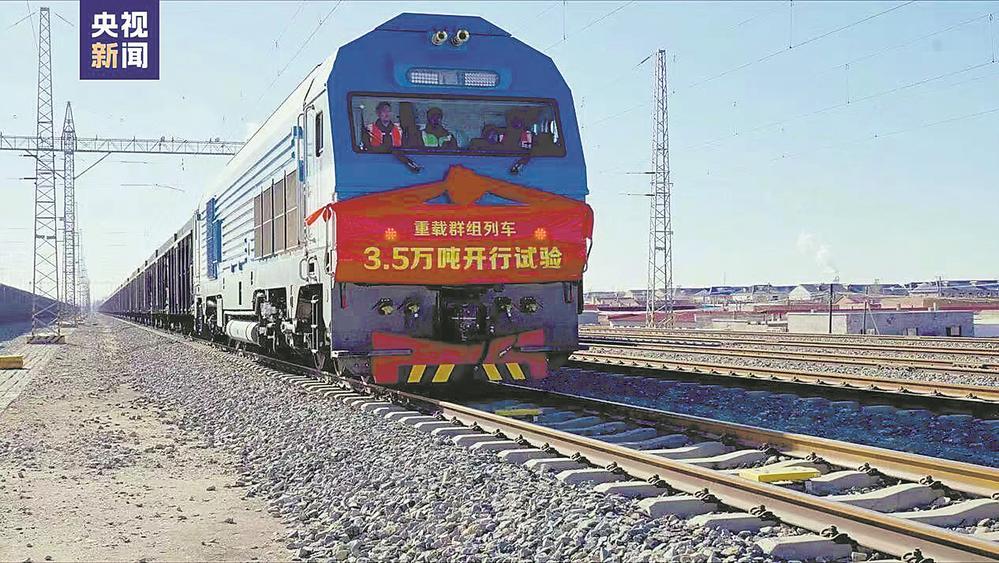
世界首列3.5万吨级重载群组列车试验开行
Ke Ji Ri Bao· 2025-12-16 01:32
Core Insights - The project "Research and Application of Heavy Load Train Group Operation Control System" has achieved a significant breakthrough by successfully testing the world's first 35,000-ton heavy load group train [1][2] - This test marks the first time in the world that multiple freight trains can operate in coordination without mechanical couplings, relying solely on wireless signals [1] Group 1: Project Overview - The project aims to transform the traditional "hard connection" between 20,000-ton and 30,000-ton long trains into a "virtual soft connection" using "virtual coupling" technology [2] - Since its initiation in 2022, the project has achieved multiple world-first milestones in theoretical innovation, standards, simulation experiments, complete equipment, test section construction, and on-site verification [2] Group 2: Technical Achievements - Key breakthroughs include the validation of core scenarios for single units, 5,000-ton empty trains, and 10,000-ton empty trains, achieving a departure interval of 3 minutes and 43 seconds for 10,000-ton empty trains and entering the 3-minute era for heavy load trains [2] - At a speed of 60 km/h, the group of 5,000-ton heavy trains demonstrated a tracking distance of 1,091 meters and 943 meters for empty trains, showcasing significant advancements in precise control technology [2] Group 3: Future Implications - The heavy load train group control system represents a major original innovation in China's railway technology, validating the collaborative control capabilities of railway signal systems under high-density operating conditions [2] - This technology is expected to be applied in high-speed rail, urban rail, and conventional rail, providing core technical support for China's railway industry and promoting advancements in global heavy load railway train control towards greater efficiency, safety, and intelligence [2]
