行业结构性出清

Search documents
昔日“西南陶瓷王”谢幕背后:陶瓷行业面临三重冲击
Mei Ri Jing Ji Xin Wen· 2025-11-06 12:55
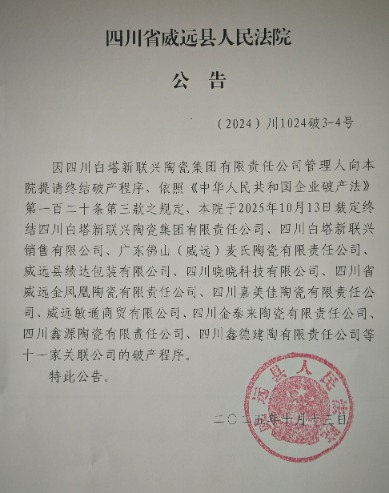
10月13日,四川省威远县人民法院的一纸公告,为四川白塔新联兴陶瓷集团有限责任公司(以下简称白 塔陶瓷)及其10家关联公司长达518天的破产程序画上句点。这家拥有46年历史、曾声名显赫的"西南陶 瓷王",最终以一种极为彻底的方式退出了历史舞台。 白塔陶瓷退出背后,是公司早已停摆的经营和涉及超百件被执行案件。它的落幕更像一面棱镜,折射出 中国陶瓷产业在地产周期下行、内部结构失衡与外部环境重压之下,所经历的一场剧烈而痛苦的结构性 出清。 从盛极一时的"西南陶瓷王",到如今彻底破产,白塔陶瓷用了10多年的时间。11月2日下午,《每日经 济新闻》记者(以下简称 超6亿元债务压顶 资产早已抵押一空 截至2022年9月30日(破产程序启动前),白塔陶瓷的资产总额约为1.58亿元,而负债总额已攀升至6.24 亿元,资产负债率高达394.79%,已陷入严重资不抵债的境地。 法院执行系统的数据显示,截至2024年4月17日,以白塔陶瓷为被执行人的首执案件达139件,申请执行 的标的总额高达5亿元。其中,金融债权案件10件,申请标的额约2.19亿元;劳动争议案件61件,申请 标的额3111.69万元;合同纠纷案件65件,申请标的 ...
昔日“西南陶瓷王”正式落幕!资产负债率近400%,破产前经营已停摆
Mei Ri Jing Ji Xin Wen· 2025-11-04 04:10
Core Viewpoint - The bankruptcy of Sichuan Baita New Lianxing Ceramics Group Co., Ltd. marks a significant event in the Chinese ceramics industry, reflecting broader structural challenges faced by the sector amid a declining real estate cycle and internal imbalances [1][10]. Company Summary - Sichuan Baita Ceramics, once known as the "King of Southwest Ceramics," has a history of 46 years and has now completely exited the market after 518 days of bankruptcy proceedings [1]. - As of September 30, 2022, the company's total assets were approximately 158 million, while total liabilities had risen to 624 million, resulting in a staggering debt-to-asset ratio of 394.79% [2]. - Prior to entering bankruptcy, Baita Ceramics had already ceased operations, with 139 enforcement cases against it totaling 500 million in claims [5]. Industry Summary - The downfall of Baita Ceramics is indicative of a larger crisis within the building ceramics industry, characterized by shrinking demand, excess capacity, and rising macroeconomic costs [10]. - Since 2018, the production of ceramic tiles has been on a downward trend, with a reported decline of over 34% from the peak production of 67.3 billion square meters in 2016 [11]. - The industry is facing a significant overcapacity issue, with a surplus rate exceeding 30% in 2023, leading to intense price competition among companies lacking brand premium and technological advantages [11][12]. - Environmental regulations and energy efficiency policies have further pressured the industry, acting as a filter that accelerates the exit of financially troubled companies like Baita Ceramics [12].

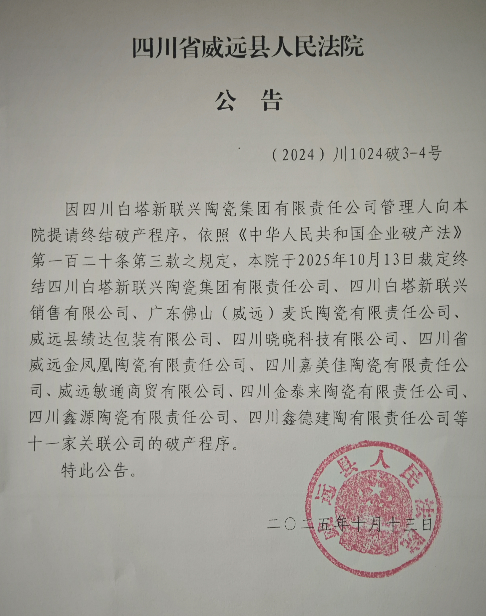
历经518天的破产程序终结!资产负债率近400% 昔日“西南陶瓷王”正式落幕
Mei Ri Jing Ji Xin Wen· 2025-11-03 17:35
Core Viewpoint - The bankruptcy of Sichuan Baita New Lianxing Ceramics Group Co., Ltd. marks a significant event in the Chinese ceramics industry, reflecting broader structural challenges faced by the sector amid a declining real estate cycle and internal imbalances [1][9]. Company Summary - Baita Ceramics, once a dominant player known as the "King of Southwest Ceramics," has officially concluded its bankruptcy proceedings after 518 days, highlighting a long decline over more than a decade [1][6]. - As of September 30, 2022, Baita Ceramics reported total assets of approximately 158 million yuan and total liabilities of 624 million yuan, resulting in a staggering debt-to-asset ratio of 394.79% [2]. - The company's core assets were fully mortgaged prior to bankruptcy, with production equipment pledged to a rural commercial bank and land and office buildings mortgaged to another bank [3]. - Baita Ceramics faced 139 enforcement cases with a total claim amount of 500 million yuan, indicating a comprehensive debt default situation [5]. Industry Summary - The ceramics industry is undergoing a significant structural adjustment, with Baita Ceramics' downfall serving as a reflection of the challenges faced by the entire sector, including shrinking demand, overcapacity, and rising costs [9][10]. - The demand for ceramics is closely tied to the construction industry's health, which has seen a decline in demand for tiles since 2018, leading to a drop in production [9]. - In 2023, 44 construction companies triggered 238 credit defaults totaling 267.6 billion yuan, impacting the cash flow of suppliers like Baita Ceramics [9]. - The ceramics industry has transitioned away from rapid growth, with a significant overcapacity of over 30% in 2023, leading to intense price competition among companies lacking brand strength [10]. - Environmental regulations have increased operational challenges for high-energy-consuming industries like ceramics, acting as a filter that accelerates the exit of financially troubled companies from the market [10].