认知鸿沟(Cognitive Gap)

Search documents
「上下文工程」 已经30岁了,而你可能刚知道它
3 6 Ke· 2025-11-03 03:02
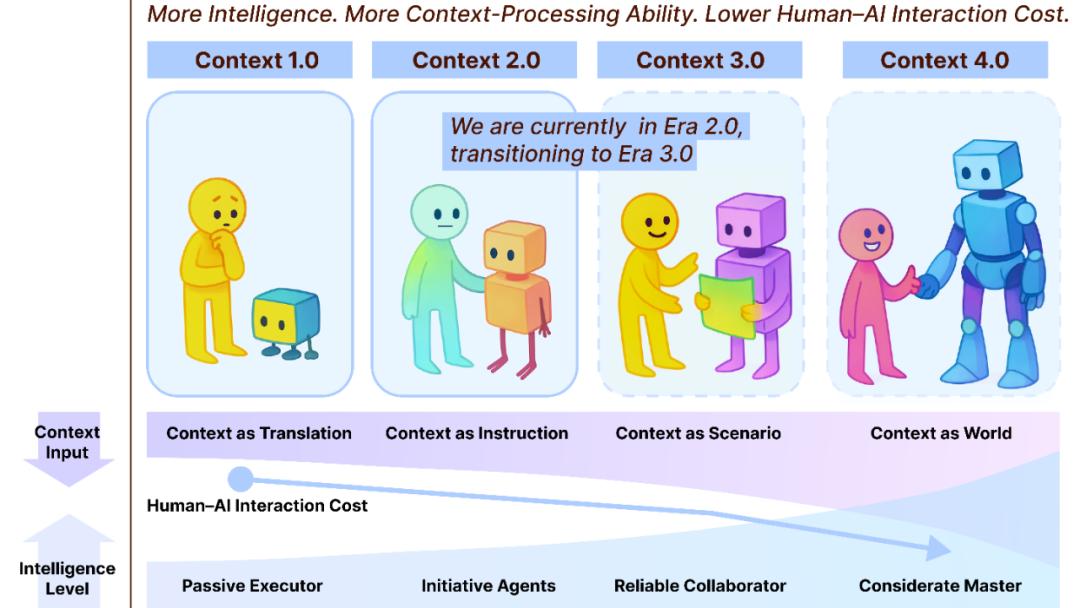
Core Insights - The article discusses the evolution and significance of Context Engineering, emphasizing its role in bridging the cognitive gap between humans and machines [3][12][64] - It highlights the transition from Era 1.0, characterized by limited machine understanding, to Era 2.0, where machines can comprehend and respond to human context more effectively [21][27][29] - The future of Context Engineering is projected to evolve into Era 4.0, where AI may surpass human cognitive abilities in certain tasks, fundamentally changing human identity and interaction with technology [62][64] Group 1: Context Engineering Evolution - Context Engineering has been evolving for 30 years, with its roots tracing back to the early concepts of context-aware computing introduced in the 1990s [8][11][12] - The transition from Era 1.0 (sensor-based systems) to Era 2.0 (intelligent assistants) marks a significant shift in how machines process and understand human intent [21][27] - Each technological breakthrough in Context Engineering leads to a revolution in interaction, expanding the capacity of machines to handle context [20][19] Group 2: Cognitive Gap and Its Implications - The cognitive gap between humans and machines is defined as the difference in context processing capabilities, which has been narrowing over time [16][12] - The article outlines four levels of this cognitive gap, from machines understanding almost nothing (Era 1.0) to potentially surpassing human understanding (Era 4.0) [16] - The essence of Context Engineering is described as an entropy reduction process that transforms high-entropy human intentions into low-entropy representations that machines can understand [16][12] Group 3: Future Directions and Challenges - The future of Context Engineering involves the seamless collection and management of context, with predictions of a shift towards more intuitive and less intrusive data gathering methods [40][38] - The management of context is crucial for effective usage, requiring strategies for organizing and utilizing information efficiently [43][55] - The article emphasizes the need for a systematic framework in Context Engineering to address the complexities of context usage in AI interactions [37][55]