超新星爆发

Search documents
黄金能“长”出来?广州科学家首次发现自然“炼金术”
Xin Lang Cai Jing· 2026-01-22 04:45
Group 1 - The core discovery by the research team from the Guangzhou Institute of Geochemistry reveals that gold is not formed through extreme geological processes but rather grows from common ore, specifically pyrite, under milder conditions [2] - Scientists estimate that the total gold reserves on Earth are approximately 4.8 billion tons, which means if distributed evenly, each person could theoretically receive about 600 kilograms of gold [1] - The previous belief that gold is brought to the surface through volcanic eruptions and tectonic movements is challenged by the new understanding that most gold is trapped deep within the Earth's core [1] Group 2 - The new method of "alchemy" discovered involves the oxidation and dissolution of ancient gold deposits by natural fluids, which transport soluble gold complexes [2] - A unique "nano workshop" forms at the interface of pyrite, which has a strong adsorption capability, allowing it to capture and concentrate gold atoms into nano-sized particles [2] - This breakthrough opens up possibilities for developing more precise and environmentally friendly technologies to extract gold from traditional waste ores and to guide global searches for new gold deposits [2]
恒星内部结构究竟如何?一次罕见超新星爆发研究揭示
Zhong Guo Xin Wen Wang· 2025-08-21 02:37
Core Insights - The recent astronomical study published in the journal "Nature" reveals new insights into the internal structure of stars through the observation of a rare cosmic event, specifically a supernova explosion [1][2] - The research challenges existing theories regarding the mechanisms of mass loss and stripping in massive stars, suggesting the presence of a rare mechanism [2] Summary by Sections Study Findings - Astronomers observed supernova SN 2021yfj, which revealed that the progenitor star had shed most of its outer layers, exposing its internal stellar layers during the explosion [1] - A thick, massive shell rich in silicon and sulfur was detected, which was expelled shortly before the supernova event, alongside unexpected helium presence [1] Theoretical Implications - The findings directly confirm theoretical predictions regarding the shell structure of massive stars, extending to layers rich in silicon and sulfur, thus addressing the mystery surrounding the end of massive star life [2]
天文学家发现宇宙最强能量爆发事件:黑洞撕裂恒星引发“极端核瞬变”
Ke Ji Ri Bao· 2025-06-11 08:18
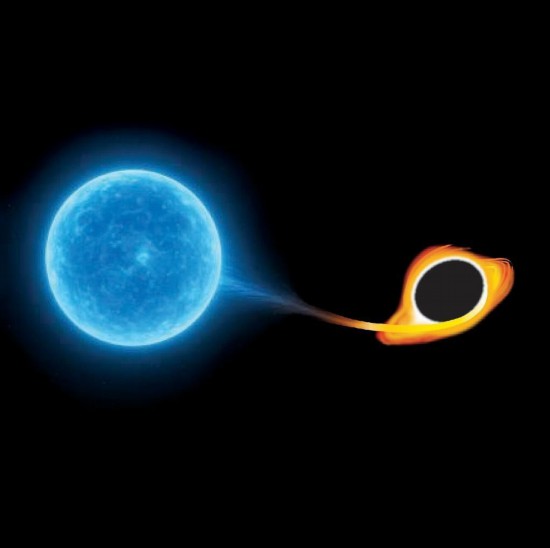
Core Findings - The University of Hawaii's Institute for Astronomy has discovered the most powerful energy explosion in the universe, termed "Extreme Nuclear Transients" (ENT) [1][3] - This phenomenon occurs when a massive star, more than three times the mass of the Sun, approaches a supermassive black hole and is torn apart by its tidal forces, releasing immense energy [1][3] Energy Release Characteristics - The brightness of the ENT phenomenon is over ten times that of typical tidal disruption events, with a duration lasting several years [3] - The specific event named Gaia18cdj released energy equivalent to 25 times that of the most intense supernova explosions, illustrating that these cosmic "energy giants" can emit the total energy of hundreds of suns in a year [3][4] Observational Insights - The research team initially identified anomalies in brightness from the European Space Agency's Gaia mission data, which exhibited unique characteristics and longer brightness variation periods than known transient phenomena [3] - Continuous observations using telescopes like the Keck Observatory allowed the team to gather electromagnetic wave data, confirming the existence of ENT as a new class of extreme astrophysical phenomena [3] Implications for Astrophysics - ENT events not only mark the dramatic end of massive stars but also provide insights into the growth of the universe's largest black holes [4] - Due to their exceptional brightness, these events can be observed from great distances, offering a glimpse into the ancient history of the universe [4] - The rarity of ENT occurrences, estimated at one in ten million compared to supernova explosions, poses significant challenges for detection, but upcoming observational facilities like the Vera C. Rubin Observatory and NASA's Roman Space Telescope are expected to enhance the discovery of such spectacular events [4]