
轨道交通技术创新

Search documents
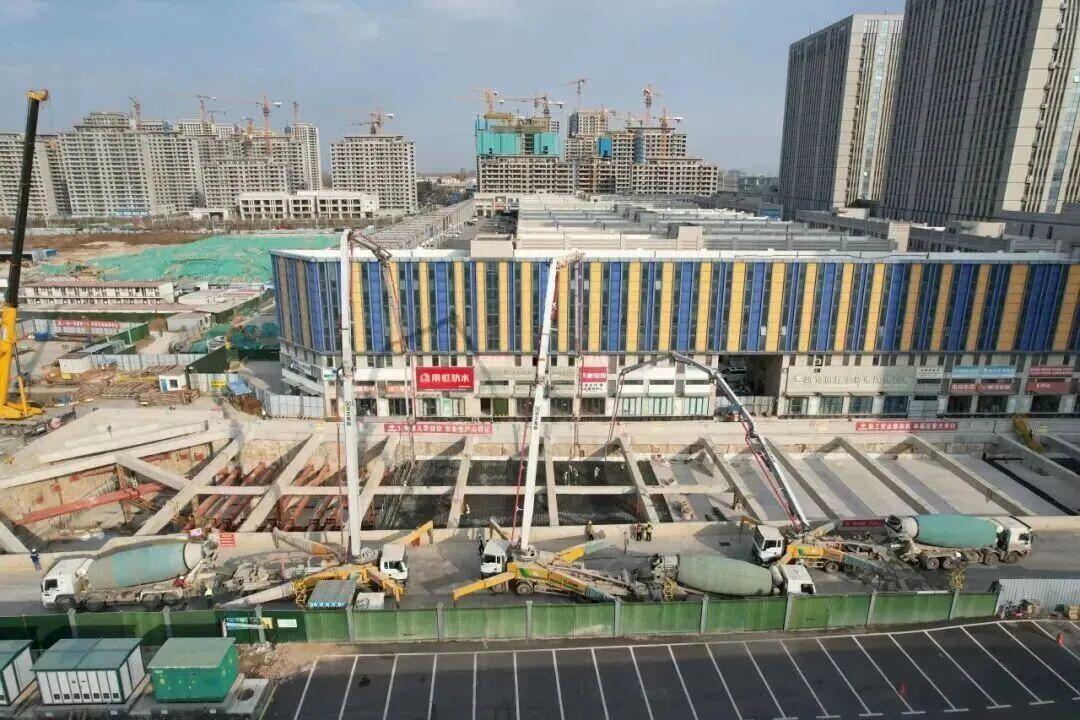
车站封顶、区间联络通道贯通~9号线建设迎来新进展
Qi Lu Wan Bao· 2026-01-13 08:45
Core Viewpoint - The construction of Jinan Metro Line 9 has reached a significant milestone with the completion of the main structure of all 12 stations, while the shield tunneling is progressing steadily despite challenging geological conditions [1][4]. Group 1: Construction Progress - The main structure of the Huanghenan Station has been completed, marking the completion of the main structures for all stations on Line 9 [1]. - The shield tunneling is advancing, with the connection tunnel between Wangsheren North Station and Peijiaying Station successfully completed [1]. Group 2: Geological Challenges - The construction faces significant challenges due to complex geological conditions, including karst fissures, water-rich soft soil, and interwoven gravel layers, which increase the risk of water and sand inflow [1][3]. - Specific challenges include a minimum vertical clearance of only 6.1 meters under multiple pipelines in the Fengming North Road Station to Maozhuang Station section, and a "V" shaped steep slope in the Kaishan Road Station to Wangsheren North Station section with a minimum cover of 12.33 meters [1][3]. Group 3: Technical Innovations - The construction team has implemented targeted technical innovations to address these challenges, such as equipping the shield machine with a combination cutter head and dynamically adjusting the opening rate to reduce tool wear by 20% [3]. - Techniques like geological radar for locating weak layers and the use of a soil pressure balance pipe jacking machine have been employed to mitigate risks associated with water and sand inflow [3]. - The team has optimized soil improvement formulas by injecting foam and bentonite slurry to tackle the challenges posed by cohesive soil [3]. Group 4: Project Overview - Jinan Metro Line 9 is a key line in the northeastern part of the main urban area, with a total length of 15.73 kilometers, all underground, featuring 12 stations and 11 sections [4]. - The project team is focused on meeting the traffic operation target by efficiently coordinating subsequent phases such as shield tunneling and track laying [4].

佳都科技全资子公司与西门子、工控国际在广州共建城轨信号系统国际级合资平台
Zheng Quan Ri Bao· 2025-11-16 11:08
Core Insights - The collaboration between Jiadu Technology, Siemens, and Industrial Control International aims to establish an international-level joint venture platform for urban rail signaling systems in Guangzhou, marking a significant step in enhancing Guangzhou's position as a global hub for rail transit technology innovation [2][3]. Group 1: Strategic Importance - Urban rail transit is a strategic industry cluster for Guangzhou, which is positioned as a core engine of the Guangdong-Hong Kong-Macao Greater Bay Area, focusing on high-end and intelligent development in the rail transit sector [2]. - The partnership leverages the strengths of all three parties to support Guangzhou's strategy of prioritizing industry and manufacturing, facilitating the city's elevation in global industrial chains [2][3]. Group 2: Technological Development - The joint venture will utilize Siemens' leading signaling technology to create a digital application model tailored for the Chinese market, integrating local industrial resources to help Guangzhou's rail transit industry reach a trillion-level cluster target [2][3]. - Jiadu Technology plans to accelerate the digitalization and intelligence of key scenarios through its expertise in smart rail transit engineering, system integration, and technology research and development [3]. Group 3: Market Expansion - The joint venture will adopt a dual approach of new line construction and existing line renovation to expedite the localization of Siemens' signaling technology in China [3]. - Siemens will share its methodologies and tools with the joint venture, promoting local talent development and building a partner ecosystem in Guangzhou, aiming to create demonstration projects that serve the Greater Bay Area and extend nationwide [3]. Group 4: Collaborative Framework - Industrial Control International emphasizes the importance of open cooperation and mutual benefits, aiming to deepen practical collaboration in technology innovation, industrial support, market expansion, and capital operations [4]. - The collaboration seeks to strengthen the industrial chain through a coordinated mechanism involving state-owned enterprises, private enterprises, and multinational leaders, enhancing upstream and downstream synergy to seize market opportunities [4].

佳都科技与西门子、工控国际设立合资公司 推进轨道交通信号系统本土化落地
Zheng Quan Shi Bao Wang· 2025-11-15 05:07
Core Viewpoint - The collaboration between Jiadu Technology, Siemens, and Industrial Control International marks a significant step in establishing a joint venture for rail transit signal systems, transitioning from strategic planning to project implementation [1][2]. Group 1: Joint Venture Establishment - A joint venture for rail transit signal systems will be established in Huangpu District, Guangzhou, aimed at localizing Siemens' signal technology to meet national requirements for domestic production and innovation [1][2]. - The partnership is seen as a model for strategic cooperation among state-owned, private, and foreign enterprises, with the local government providing strong support for rapid project execution and efficient operations [1][3]. Group 2: Market and Technology Development - The collaboration will leverage Siemens' leading signal system technology to create digital applications tailored for the Chinese market, aiming to help Guangzhou's rail transit industry reach a trillion-level cluster target [2]. - The joint venture will adopt a dual approach of new line construction and existing line renovation to accelerate the localization of Siemens' signal technology in China, addressing gaps in Guangzhou's high-end signal system industry [2]. Group 3: Strategic Goals and Ecosystem Building - Jiadu Technology plans to utilize its strengths in engineering implementation, system integration, and technology research to advance the digital and intelligent transformation of signal systems [2]. - Siemens will share methodologies and tools with the joint venture, focusing on local talent development and building a partner ecosystem, with the goal of creating demonstration projects that serve the Greater Bay Area and extend nationwide [2][3].
佳都科技、西门子、工控国际合作推进轨道交通信号系统本土化落地
Zhong Zheng Wang· 2025-11-15 03:56
Core Insights - The collaboration between Jiadu Technology, Siemens, and Industrial Control International aims to establish an international-level joint venture for urban rail signaling systems in Guangzhou, marking a significant step in enhancing Guangzhou's position as a global hub for rail transit technology innovation [1][4] Group 1: Partnership Objectives - The joint venture will leverage Siemens' leading signaling system technology to create digital application models tailored for the Chinese market [2] - The partnership aims to integrate local industrial chain resources to help Guangzhou's rail transit industry reach a trillion-level cluster target [2] - The collaboration will facilitate the localization of Siemens' signaling technology in China, addressing the gap in high-end signaling systems in Guangzhou [2][3] Group 2: Company Contributions - Jiadu Technology will utilize its strengths in smart rail transit engineering, system integration, and technology research and development to accelerate the digital and intelligent implementation of new signaling systems [2][3] - Siemens will share methodologies and tools with the joint venture, providing reliable system engineering and digital practice solutions while promoting local talent development in Guangzhou [2][4] - Industrial Control International aims to deepen practical cooperation in technology innovation, market expansion, and capital operations, enhancing the overall industrial chain [3] Group 3: Industry Impact - The collaboration is expected to strengthen Guangzhou's strategic industry cluster in rail transit, promoting high-end and intelligent development within the sector [1][3] - Jiadu Technology has already established a significant presence in the urban rail sector, covering 45 cities and over 2,200 stations, with a cumulative service mileage exceeding 4,100 kilometers [3] - The partnership is positioned to create a competitive market and industrial ecosystem, aligning domestic technology development with international standards [2][3]