通用人工智能(Artificial General Intelligence

Search documents
我国学者推出“AI-牛顿”,根据实验数据自主发现牛顿第二定律、万有引力定律等基本定律
生物世界· 2025-11-15 10:00
Core Insights - The article discusses the development of an innovative system called AI-Newton, which autonomously derives physical laws from raw experimental data without prior physical knowledge, marking a significant step towards AI-driven scientific discovery [2][4]. Group 1: Challenges in Current Scientific Discovery - Current scientific discovery faces two main challenges: long research cycles influenced by human biases and the limitations of existing AI methods, which are often opaque and struggle with complex systems [5]. Group 2: AI-Newton System Design - AI-Newton is inspired by human scientific reasoning but does not rely on human knowledge. It starts from basic observational data and autonomously defines physical concepts, successfully rediscovering core laws of Newtonian mechanics [6][10]. Group 3: Knowledge Discovery Engine - The core architecture of AI-Newton consists of a three-layer knowledge base (symbols, concepts, and laws), mimicking how human physicists organize knowledge, starting from simple concepts to complex physical laws [8]. Group 4: Workflow and Methodology - AI-Newton combines logical reasoning with symbolic regression, selecting experiments and concepts to analyze, and correcting laws through reasoning when they do not hold in new scenarios [12]. Group 5: Experimental Validation - The research team tested AI-Newton on 46 Newtonian mechanics experiments, successfully rediscovering key physical laws such as Newton's second law, conservation of energy, and the law of universal gravitation, averaging the discovery of about 90 physical concepts and 50 universal laws [14][17]. Group 6: Key Features of AI-Newton - AI-Newton exhibits two main features: progressive improvement, where it builds knowledge gradually, and discovery diversity, where the order and timing of discovered concepts and laws vary across different test cases [18][21]. Group 7: Future Prospects - The framework of AI-Newton shows strong potential for expansion, suggesting that with more advanced mathematical tools and natural language integration, it could tackle more complex physical concepts and contribute to the realization of Artificial General Intelligence (AGI) [21].


深度解析谷歌Genie 3:“一句话,创造一个世界”
Hu Xiu· 2025-08-18 08:55
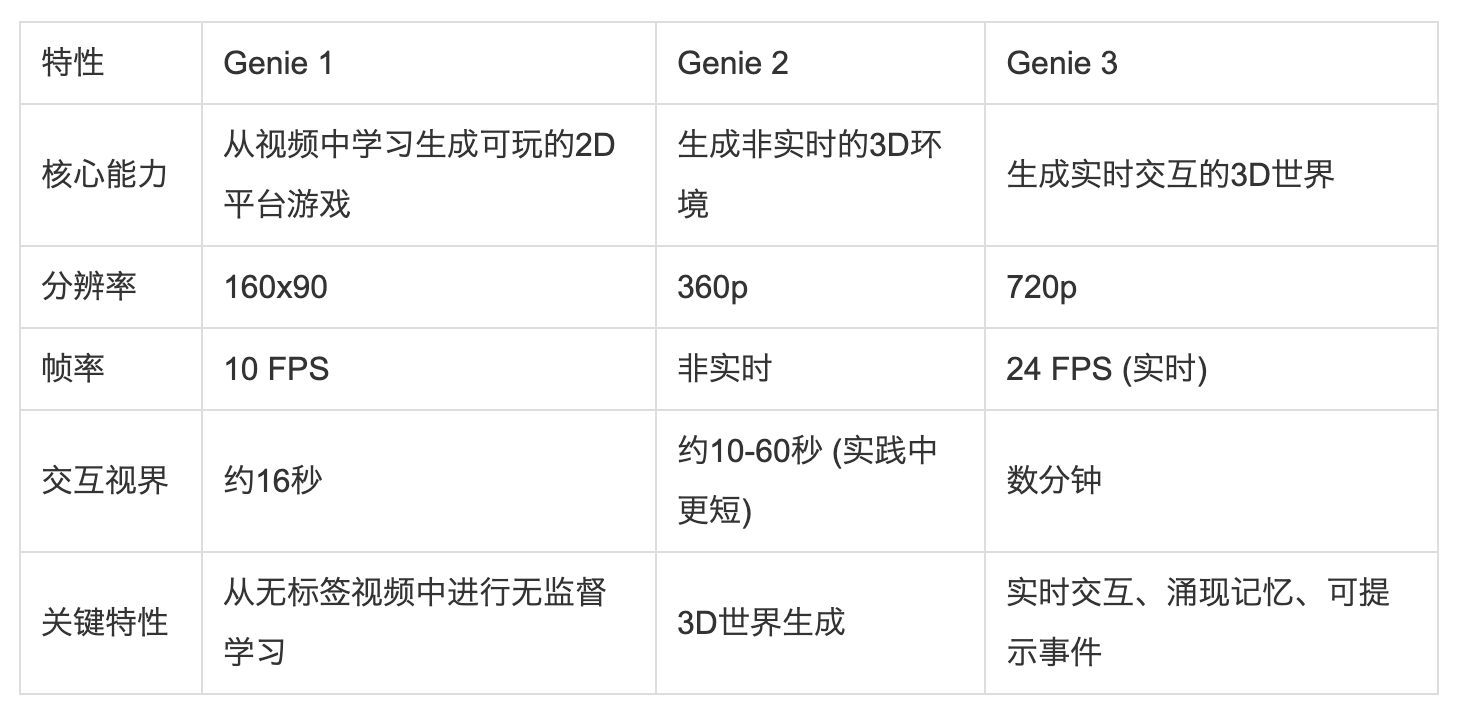
Core Insights - Google DeepMind's Genie 3 represents a significant paradigm shift in AI-generated content, transitioning users from passive consumers to active participants in a generative interactive environment [1][2] - The ultimate goal of the Genie project is to pave the way towards Artificial General Intelligence (AGI), with Genie 3 serving as a critical foundation for training AI agents [2][15] Group 1: Technological Breakthroughs - Genie 3 achieves real-time interactivity, generating a fully interactive world at 720p resolution and 24 frames per second, contrasting sharply with its predecessor Genie 2, which required several seconds to generate each frame [5][6] - The interaction horizon of Genie 3 allows for coherent and interactive sessions lasting several minutes, enabling more complex task simulations compared to Genie 2's limited interaction time [6][7] - Emergent visual memory allows objects and environmental changes to persist even when not in view, indicating a significant advancement in the AI's understanding of object permanence [8][10] - Users can dynamically alter the world by inputting new prompts, granting them the ability to inject events or elements into the environment in real-time, enhancing the training capabilities for AI agents [11][12] Group 2: Applications and Implications - Genie 3 is primarily designed as a training ground for the next generation of AI agents, particularly embodied agents like robots and autonomous vehicles, addressing the need for diverse and safe training data [15][16] - The technology has the potential to revolutionize the gaming industry by drastically reducing the time and cost of game development, although it currently faces limitations in user experience and precision compared to established game engines [17][18] - In education, Genie 3 can create immersive learning environments, allowing students to engage with historical or medical scenarios in a risk-free setting, aligning with broader trends in educational technology [19] Group 3: Competitive Landscape - Genie 3 differs fundamentally from other models like Sora and Runway, as it functions as a world model for interactive simulation rather than a video generation model [21][22] - The comparison highlights that while Sora excels in high-fidelity video generation, Genie 3 focuses on real-time interactive simulations, positioning itself uniquely in the AI landscape [24][25] Group 4: Future Directions - Despite its advancements, Genie 3 still faces challenges in stability, fidelity, and control, indicating that further development is needed to achieve practical applications in gaming and simulation [28][31] - The integration of Genie 3 with VR/AR technologies presents exciting possibilities, but it requires overcoming significant technical hurdles to ensure real-time, immersive experiences [32][33]