
量子计算与AI融合

Search documents
深聚合力助推产业发展 第四届 “量旋杯” 量子计算挑战赛圆满落幕
Huan Qiu Wang Zi Xun· 2026-01-20 07:36
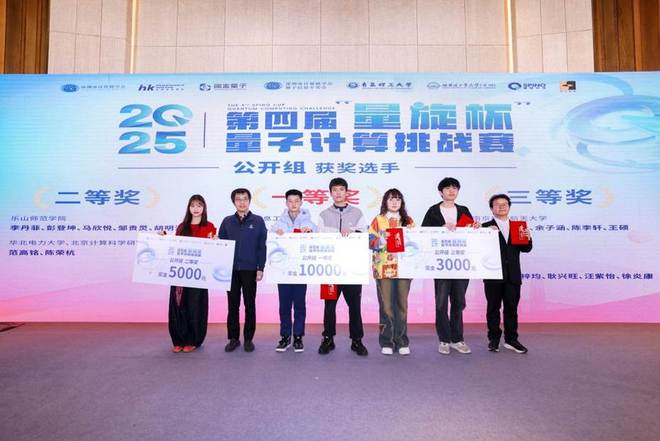
Group 1: Event Overview - The fourth "Quantum Cup" Quantum Computing Challenge and the "Quantum Intelligence and AI Empowerment Forum" were held in Shenzhen from January 18 to 20, 2026, focusing on talent cultivation and industry integration in quantum technology [1][2] - The event aimed to gather global elites in the quantum field, promoting the development of quantum technology in the Greater Bay Area [1][2] Group 2: Quantum Cup Challenge - The "Quantum Cup" has become a benchmark event in the quantum computing field, showcasing the talents of the new generation and emphasizing the value of "competition promotes learning and talent selection" [2][9] - The event attracted nearly 700 participants from over 100 top universities worldwide, including Tsinghua University and Oxford University, highlighting the international and high-level nature of the competition [3] - Awards were given in various categories, with the Chengdu University of Information Technology team winning first place in the open group, while students from Shenzhen Yantian High School won first place in the popularization group [3][5] Group 3: Forum Insights - The "Quantum Intelligence and AI Empowerment Forum" focused on the integration of quantum technology and AI, discussing industry development strategies and talent cultivation [10][11] - Key topics included the potential of quantum computing to enhance AI capabilities and the challenges of applying AI in quantum problem-solving [11][13] - Experts emphasized the need for a systematic approach to talent cultivation in quantum technology, integrating multiple disciplines and fostering collaboration between academia and industry [19][21] Group 4: Future Prospects - The successful hosting of the "Quantum Cup" and the forum established a positive interaction model between talent cultivation and industry integration, promoting innovation in quantum education and collaborative development [22] - The deep integration of quantum computing with various fields such as finance, medicine, and new materials is expected to drive high-quality economic and social development [22]

玻色量子马寅:量子计算与AI融合 开启产业新纪元
Zhong Guo Zheng Quan Bao· 2025-12-29 21:13
Core Insights - Quantum computing is transitioning from laboratory research to industrial applications, with the integration of quantum computing and artificial intelligence (AI) seen as a key path to overcoming computational limitations and accelerating commercialization [1][2] Group 1: Technological Breakthroughs - The integration of quantum computing and AI has achieved significant technological breakthroughs, particularly in fields like biopharmaceuticals, with a future product form expected to combine quantum computing infrastructure, quantum algorithm frameworks, and AI products [1][2] - The global quantum computing landscape is diversifying, with three main technical routes: superconducting, photonic, and ion trap technologies, leading to two core directions: gate-based universal quantum computers and non-gate-based specialized quantum computers [1][2] Group 2: Commercialization Acceleration - The "quantum + AI" technological advancements are driving quantum computing towards industrial applications, with quantum computing not reliant on high-quality big data, allowing for precise calculations in drug development [2][3] - Boson Quantum has developed a Python-based compiler to lower the algorithm development barrier, enabling developers without quantum computing expertise to utilize quantum algorithms [2][3] Group 3: Supply and Demand Challenges - A significant challenge in the quantum computing industry is the insufficient supply of computational power to meet growing demand, prompting Boson Quantum to establish the first large-scale dedicated photonic quantum computer manufacturing facility in Shenzhen, with an expected annual production capacity of 30 to 50 units [3] - Boson Quantum has established three business models: complete machine sales, cloud services, and "quantum computing + industry solutions," collaborating with various partners to expand application boundaries [3] Group 4: Future Outlook - The global quantum computing industry is currently characterized by diverse development paths, with both universal and specialized routes progressing simultaneously; specialized quantum computers are expected to achieve commercialization first [3][4] - Over the next five years, significant breakthroughs are anticipated in quantum computing, including standardized industrial production, an explosion in quantum AI, and deep integration of quantum and classical computing systems [4]
玻色量子马寅: 量子计算与AI融合 开启产业新纪元
Zhong Guo Zheng Quan Bao· 2025-12-29 21:08
Core Insights - Quantum computing is emerging as a key driver of the new technological revolution and industrial transformation, particularly through its integration with artificial intelligence (AI) [1] - The combination of quantum computing and AI is seen as a critical path to overcoming computational limitations and accelerating commercialization [1] Technological Breakthroughs - The global quantum computing landscape is diversifying, with three main technical routes: superconducting, photonic, and ion trap [2] - Two core directions in quantum computing are identified: gate-based universal quantum computers and non-gate-based specialized quantum computers, with D-Wave and Boson Quantum as representatives [2] - The integration of quantum computing and AI is a mutually empowering process, where AI aids in the development of quantum computers and quantum computing enhances AI's computational capabilities [2] Commercialization Acceleration - The technological breakthroughs in "quantum + AI" are driving the accelerated industrial application of quantum computing [3] - Unlike AI, which relies on high-quality data, quantum computing can operate independently of data quality, particularly in drug development [3] - Boson Quantum has developed a Python-based compiler to lower the algorithm development barrier for users without a quantum computing background [3] - A new specialized photonic quantum computer manufacturing facility in Shenzhen is expected to produce 30 to 50 units annually to address the supply shortage [3] Business Models - Boson Quantum has established three main business models: complete machine sales, cloud services, and "quantum computing + industry solutions" [4] - Collaborations with companies like Weid Information and Electronic City are expanding the application boundaries of quantum computing in sectors like power scheduling and chip design [4] Ecosystem Development - The global quantum computing industry is currently in a phase of diverse development, with both universal and specialized routes progressing [5] - It is predicted that universal quantum computers will take about ten years to achieve practical application, while specialized quantum computers will see earlier industrialization [5] - Future quantum computing products are expected to combine quantum computing bases, quantum algorithm frameworks, and AI products, leading to advanced applications similar to DeepSeek and Tongyi Qianwen [5] Future Outlook - Boson Quantum recently completed a financing round of several hundred million yuan to support the development of specialized and universal quantum computers, as well as to expand the commercial ecosystem of "quantum computing + AI" [6] - Over the next five years, three major breakthroughs in quantum computing are anticipated: standardized industrial production, an explosion in quantum AI, and deep integration with classical computing systems [6]