银河系

Search documents
我国科学家在银河系边缘发现一对“双胞胎”,系恒星诞生新证据
财联社· 2026-03-11 13:21
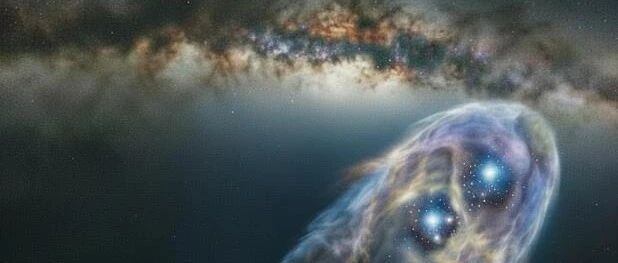
Core Viewpoint - A significant cosmic collision has been observed 45,000 light-years away, leading to the discovery of a pair of newly formed star clusters named "Emei" [1][4]. Group 1 - The collision involved a high-speed cloud of gas impacting the edge of the Milky Way galaxy, resulting in extreme compression and the birth of new stars [4]. - This discovery marks the first time evidence of star formation has been found within such high-velocity gas [4]. - The "Emei" star clusters are relatively young, estimated to be only over 10 million years old, indicating that the Milky Way is an evolving system that continuously attracts fresh gas from external sources [4].

罗曼望远镜计划绘制更精细银河系地图
Huan Qiu Wang Zi Xun· 2025-12-19 01:44
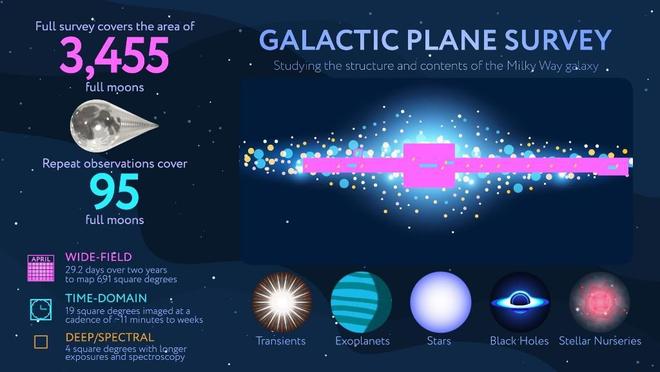
Core Viewpoint - NASA has announced detailed plans for the Nancy Grace Roman Space Telescope's future "Galactic Plane Survey," which aims to observe billions of stars in unprecedented detail, exploring unknown structures and further unraveling the mysteries of the Milky Way [1][3]. Group 1 - The Roman Telescope team states that this survey will fundamentally change human understanding of the Milky Way, helping scientists explore the galaxy's distant edges and densely packed central regions [3]. - The telescope is scheduled for launch in May 2027, with potential early launch procedures starting in the fall of 2026 [3]. - The Roman Telescope will utilize infrared wavelengths to penetrate interstellar dust, revealing hidden secrets of the galaxy that were obscured in previous observations by the retired Gaia space telescope [3]. Group 2 - The survey will cover nearly 700 square degrees of the Milky Way's central luminous band, where most of the galaxy's stars, gas, and dust are concentrated [3]. - It is expected to map the positions of up to 20 billion stars and capture minute positional changes through repeated high-resolution observations [3]. - The telescope will penetrate "stellar nurseries" to observe millions of stellar embryos, newly formed stars still enveloped in dust, and young stars that may be forming planetary systems [3]. Group 3 - The Roman Telescope will study nearly 2,000 young open star clusters to understand how galactic spiral arms trigger star formation [4]. - It will map dozens of ancient and dense globular clusters near the center of the Milky Way to help reconstruct the galaxy's early history [4]. - Continuous monitoring of stars in the central bar structure of the Milky Way will be conducted to study dense binary systems nearing the end of their life cycles, revealing more secrets about gravitational waves [4].
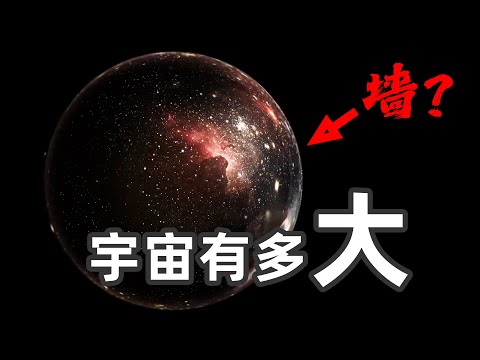
宇宙有多大?人类就有多渺小!所以,请认真过好每一个平凡的今天。
李永乐老师· 2025-10-11 10:01
不好意思,各位!这个视频做太久了,导致更新慢了。 本视频建议全屏观看,效果更佳! 另外,本来视频不想加字幕的,怕影响体验。但是介于本人普通话口音太重,考虑再三还是加了字幕,尴尬…… 视频章节: 00:00 宇宙有多大? 00:32 离开地球 01:16 月球 02:10 太阳系 04:10 比邻星 04:20 半人马座alpha 04:33 银河系 06:58 本地泡 08:25 仙女座星系 09:04 本星系群 09:37 室女座超星系团 10:08 拉尼亚凯亚超星系团 11:17 巨引源 11:54 夏普利超星系团 12:13 宇宙网 13:18 宇宙空洞 14:00 暗物质和暗能量 14:56 可观测宇宙 17:42 宇宙的形态 ...