锂电循环

Search documents
天奇股份现金不足营收近三年连降 拟募资9.77亿稳固智能装备基本盘
Chang Jiang Shang Bao· 2025-12-30 23:21
Core Viewpoint - Tianqi Co., Ltd. plans to raise up to RMB 977 million through a private placement to enhance production capacity and R&D despite a continuous decline in revenue over the past three years [1][3]. Group 1: Financial Performance - Tianqi's revenue has been declining for three consecutive years, with reported revenues of RMB 43.51 billion in 2022, RMB 36.16 billion in 2023 (down 16.89%), and RMB 29.60 billion in 2024 (down 18.14%) [4][5]. - The company reported a net profit of RMB 1.98 billion in 2022, but incurred losses of RMB 4.15 billion in 2023 and RMB 2.55 billion in 2024 [5]. - As of the end of Q3 2025, Tianqi had cash and cash equivalents of RMB 5.23 billion and short-term borrowings of RMB 12.63 billion, indicating a tight liquidity position [2][3]. Group 2: Business Segments - The smart equipment business remains the core segment, contributing approximately 70% of revenue and showing stable growth [2][10]. - The lithium battery recycling sector is facing challenges due to low market demand and competition, impacting revenue generation [5][10]. - The company is focusing on global expansion, with plans for a factory in Thailand to be operational by Q1 2026, and aims to increase overseas business contribution from 30% to potentially over 50% [10]. Group 3: Future Outlook - Despite recent financial struggles, the management expresses confidence in future growth, particularly in the smart equipment and lithium recycling sectors [10]. - The company anticipates significant revenue growth in the lithium recycling business by 2026, driven by the increasing demand for recycled materials [10]. - Tianqi's stock has recently experienced a surge, attributed to multiple growth catalysts including plans for a capital increase and advancements in robotics and lithium recycling [11].

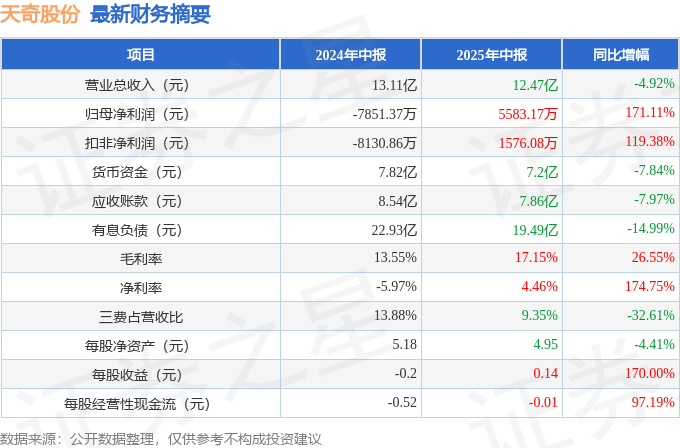
天奇股份2025年中报简析:净利润同比增长171.11%,盈利能力上升
Zheng Quan Zhi Xing· 2025-08-19 23:00
Core Viewpoint - Tianqi Co., Ltd. reported a mixed performance in its 2025 mid-year financial results, with a decline in total revenue but a significant increase in net profit, indicating improved profitability despite revenue challenges [1]. Financial Performance Summary - Total revenue for the first half of 2025 was 1.247 billion yuan, a decrease of 4.92% year-on-year [1]. - Net profit attributable to shareholders reached 55.83 million yuan, up 171.11% compared to the previous year [1]. - Gross margin improved to 17.15%, reflecting a year-on-year increase of 26.55% [1]. - Net margin turned positive at 4.46%, a significant increase of 174.75% from a negative margin in the previous year [1]. Cost and Expense Analysis - Total selling, administrative, and financial expenses amounted to 117 million yuan, accounting for 9.35% of revenue, down 32.61% year-on-year [1]. - The company managed to reduce operating expenses significantly, with selling expenses down by 20.74% and administrative expenses down by 20.49% [3][4]. Cash Flow and Asset Management - Operating cash flow per share improved to -0.01 yuan, a 97.19% increase year-on-year [1]. - Cash and cash equivalents decreased by 4.17%, attributed to increased cash outflows from financing activities [2]. - Accounts receivable decreased by 7.97%, indicating better collection from customers [2]. Investment and Financing Activities - The company increased its investment in subsidiaries, with long-term equity investments rising by 13.09% due to new contributions to various companies [2]. - Short-term borrowings increased by 2.46%, reflecting a rise in short-term financing loans [3]. Profitability Drivers - The significant increase in net profit was driven by the performance of the intelligent equipment business, which saw a boost from multiple project deliveries [8]. - The completion of the sale of real estate assets contributed to increased asset disposal gains [8]. Overall Financial Health - The company’s financial metrics indicate a recovery in profitability, although total revenue remains under pressure due to declines in certain business segments [1][8]. - The historical performance shows a mixed track record, with periods of losses and weak return on invested capital (ROIC) [11].