长周期彗星

Search documents
这颗“千年等一回”的彗星即将远去,且看且珍惜!
Xin Hua She· 2025-11-06 09:26
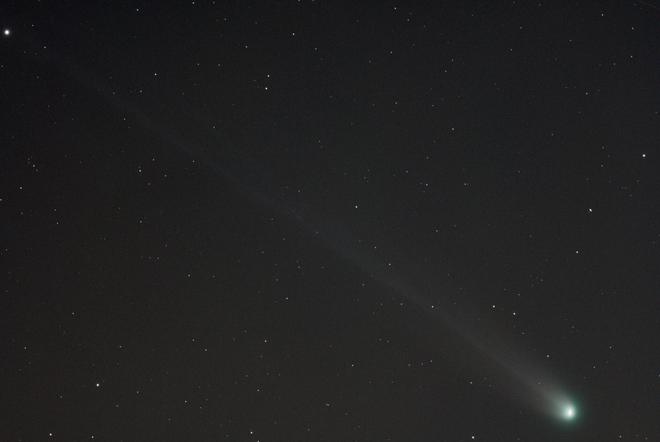
Core Points - The Leimon Comet, discovered in January this year, is a long-period comet with an orbital period of approximately 1150 to 1350 years, making it a rare astronomical event [3] - The comet is expected to reach its closest point to the Sun on November 8, marking its most active phase during this solar system journey [1][4] - The comet's survival through this close encounter with the Sun is uncertain, as it may either disintegrate or create a bright display of gas and dust if it withstands the solar radiation [3][4] Summary by Sections - **Comet Characteristics** - Leimon Comet is classified as a long-period comet with an orbital cycle exceeding 200 years [3] - It is composed of ice, dust, and other compounds, which can either lead to its disintegration or a spectacular display as it approaches the Sun [3] - **Current Observations** - The comet has been performing steadily since passing its closest approach point on October 21, and it is currently moving towards the Sun [3] - Observers in the Northern Hemisphere have enjoyed its presence, capturing beautiful moments alongside natural landscapes [4] - **Viewing Opportunities** - The predicted brightness of the Leimon Comet is around magnitude 4-5, making it visible in the western sky after sunset [7] - Enthusiasts are encouraged to find dark locations away from city lights for optimal viewing, using small telescopes or binoculars [7]


今年以来最亮彗星现身天际,它的名字叫“莱蒙”
Xin Hua She· 2025-10-19 09:58
Core Viewpoint - The C/2025 A6 (Lemmon) comet, with a 1300-year orbital period, has gained public attention as it approaches its perihelion, providing a rare opportunity for observation in various regions of China during dawn and dusk [1][4]. Group 1 - The Lemmon comet is expected to pass its perihelion on November 8, 2025, and will be visible in the early morning and evening skies in most parts of China [1][4]. - The comet is likely a long-period comet originating from the Oort Cloud, which contains billions of primitive small celestial bodies [2][3]. - Initial brightness expectations for the comet were low, but it has exceeded these expectations since early July, leading to increased global interest and successful observations by astronomy enthusiasts [4]. Group 2 - The comet's nucleus appears green with a long, pale blue tail, making it visually distinctive [4]. - Observers in the northern hemisphere can see the comet in the eastern sky before sunrise until October 20, after which it will be visible in the western sky after sunset [4]. - Visibility of the comet will vary slightly by region, and it will become increasingly difficult to observe after its perihelion [4].