长文本推理

Search documents
QwenLong-L1.5发布:一套配方,三大法宝,让30B MoE模型长文本推理能力媲美GPT-5
机器之心· 2025-12-29 04:44
Core Insights - The article discusses the challenges faced by large models in long-text reasoning, highlighting issues such as false prosperity in performance metrics and difficulties in multi-hop reasoning tasks [2][3] - It introduces QwenLong-L1.5, a new model designed to address these challenges through a comprehensive post-training framework that includes data synthesis, reinforcement learning optimization, and memory management [4][32] Group 1: Challenges in Long-Text Reasoning - Models often achieve high scores in simple tasks but struggle with complex multi-hop reasoning, revealing limitations in deep understanding [2] - The training data for long-text tasks is complex and heterogeneous, leading to instability in reinforcement learning algorithms and potential performance degradation [14][16] - The physical memory limitations of models restrict their ability to process extensive knowledge, necessitating compromises that can result in loss of critical information [3] Group 2: QwenLong-L1.5 Model Features - QwenLong-L1.5 is built on the Qwen3-30B-A3B architecture and aims to provide a systematic solution to long-text reasoning challenges [4] - The model incorporates a high-quality data synthesis pipeline that generates multi-hop reasoning tasks, enhancing the model's ability to think critically [9] - It employs a stable and efficient reinforcement learning strategy to address challenges such as distributional drift and credit assignment problems [12][17] Group 3: Performance Improvements - QwenLong-L1.5 has shown significant performance improvements, achieving an average score increase of 9.9 points compared to its predecessor [26] - The model's enhancements are particularly evident in complex reasoning tasks, with notable performance gains in benchmarks like MRCR and CorpusQA [26][27] - It demonstrates superior capabilities in handling ultra-long tasks, showcasing its potential to process information beyond traditional memory limits [28][29] Group 4: Conclusion and Open Source - The article concludes that the combination of data synthesis, reinforcement learning optimization, and memory management in QwenLong-L1.5 provides a validated path for addressing long-text reasoning challenges [32] - The company encourages open collaboration and sharing of the technology, with relevant details available in the published paper and on GitHub [32]


面壁小钢炮4.0发布:性能比肩 Qwen-3-8B,极限220倍提速
Xin Lang Ke Ji· 2025-06-10 09:37
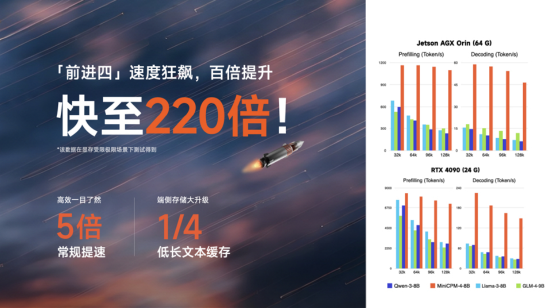
Core Insights - The fourth generation of the "MiniCPM" model, known as MiniCPM 4.0, has been released, featuring two parameter scales: 8B and 0.5B, achieving the best performance in its class [2][3] - MiniCPM 4.0-8B model utilizes a sparse attention mechanism, demonstrating performance comparable to Qwen-3-8B while requiring only 22% of the training cost [2][4] - The model achieves a remarkable inference speed of 600 Token/s, with a 220x acceleration in extreme scenarios, significantly enhancing long text processing capabilities [2][3] Performance and Architecture - MiniCPM 4.0 offers a 5x acceleration in long text inference speed compared to similar models like Qwen-3-8B and Llama-3-8B, with a maximum acceleration of 220x under memory-constrained conditions [3][4] - The model's architecture, InfLLMv2, reduces the sparsity from the industry standard of 40%-50% to just 5%, allowing for efficient long text calculations with only 1/10 of the computational load [4] - In terms of memory usage, MiniCPM 4.0-8B requires only 1/4 of the cache storage space compared to Qwen3-8B for 128K long text scenarios, indicating significant model compression and efficiency [4] Applications and Market Impact - Based on the 8B version, the company has fine-tuned two specific capability models for use as MCP Client and a research tool, MiniCPM4-Surve, which competes with Deep Research [5] - The MiniCPM series has achieved over 10 million downloads across all platforms, indicating strong market interest and adoption [5]