
集团政治

Search documents
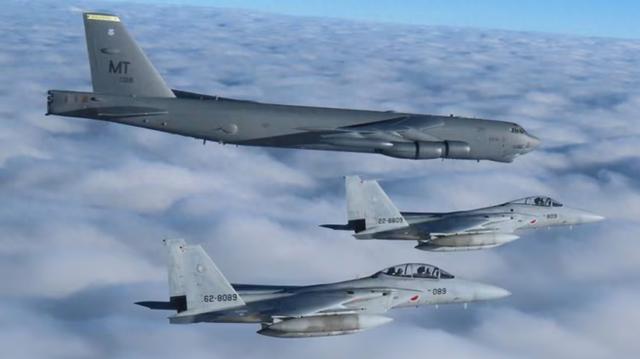
“中美战机对峙”,韩方对美表达不满
Xin Lang Cai Jing· 2026-02-22 04:33
Core Viewpoint - The article discusses the increasing military activities of the U.S. in East Asia during the Chinese New Year, particularly focusing on joint exercises with Japan and the implications for South Korea's defense posture and its relationship with the U.S. and China [1][3][4]. Group 1: U.S.-Japan Military Exercises - The U.S. and Japan conducted joint military exercises involving four B-52 bombers and various Japanese fighter jets in the Sea of Japan and East China Sea, with the exercises seen as a direct response to China [3][4]. - The exercises included tactical training over a wide area, indicating a clear intention to counter China's influence in the region [3][4]. Group 2: South Korea's Position - South Korea's government declined to participate in the U.S.-Japan joint exercises, leading to a shift from a trilateral to a bilateral exercise format, which highlights growing differences between South Korea and the U.S. regarding China [1][4]. - Following the exercises, South Korea expressed dissatisfaction to the U.S. regarding the military activities, indicating a potential shift in the role of U.S. forces in South Korea from deterring North Korea to countering China [6][8]. Group 3: Regional Security Dynamics - The simultaneous deployment of U.S. military assets within the "First Island Chain" is unprecedented and reflects a strategic shift in U.S. defense policy aimed at containing China [3][4]. - South Korea is attempting to balance its security needs with its desire for strategic autonomy, as indicated by discussions to reduce joint exercises with the U.S. to foster dialogue with North Korea [8].

美国又又又退群!缺钱砍项目,联合国如何自救?
Di Yi Cai Jing· 2025-07-23 09:04
Group 1 - The United States has announced its withdrawal from UNESCO, which will take effect at the end of December 2026, marking a return to a previous stance taken during the Trump administration [2][3] - The U.S. has outstanding dues to the United Nations amounting to $1.5 billion for the regular budget and a total of $2.8 billion when including peacekeeping and court budget contributions, which has led to significant budget cuts and layoffs within the UN [2][4] - The UN has been forced to implement budget cuts of 15% to 20% and is considering reducing its workforce by approximately 20%, focusing on retaining junior positions while streamlining senior roles [8][9] Group 2 - UNESCO's budget has become more stable despite the reduction in U.S. contributions, with voluntary donations doubling since 2018, and the U.S. now contributing about 8% of the overall budget [4][6] - The UN is facing a significant reduction in available resources, with estimates indicating that only about $50 billion can be mobilized, down from a peak of $69 billion two years ago, affecting the number of people receiving development aid [8][9] - The UN is exploring structural reforms to enhance efficiency, including consolidating human resources and financial services into unified support centers, and reviewing its task authorizations to eliminate fragmentation and improve inter-agency collaboration [8][9]