
雪球地球

Search documents
约七亿年前“雪球地球”海洋有多冷
Xin Lang Cai Jing· 2026-02-21 18:17
Core Insights - An international research team led by researchers from the Chinese Academy of Sciences has directly measured ocean temperatures from the "Snowball Earth" period, approximately 700 million years ago, revealing that local ocean temperatures could drop to -15°C with extremely high salinity [1][2] Group 1: Research Findings - The study published in "Nature Communications" provides direct quantitative evidence of the extreme marine environment during the "Snowball Earth" period, indicating that despite the cold, liquid water microenvironments may have existed [2] - The research utilized iron isotopes to decode ancient ocean temperature signals, finding that iron formations from this period exhibited a unique isotopic signature indicative of low temperatures [1] - The high salinity of the water, estimated to be over four times that of modern seawater, contributed to a lowered freezing point of approximately -11°C, aligning with the temperature estimates [2] Group 2: Implications - The findings offer new insights into how early life may have survived in extreme climates, contributing to the understanding of Earth's climate system's dramatic changes [2]
【科技日报】7亿年前“雪球地球”海洋温度低至-15℃
Ke Ji Ri Bao· 2026-02-03 02:52
Core Insights - An international team led by researchers from the Chinese Academy of Sciences has innovatively used iron isotopes as a "paleothermometer" to directly measure ocean temperatures during the "Snowball Earth" period approximately 700 million years ago, revealing that local ocean temperatures could drop to as low as -15°C with extremely high salinity [1][2]. Group 1: Research Findings - The study published in "Nature Communications" indicates that during the "Snowball Earth" period, the ocean was entirely covered in ice, with temperatures significantly lower than previously estimated [1]. - The research team successfully decoded the ocean temperature signals by analyzing iron isotopes in ancient iron-rich sedimentary rocks, which are key to understanding historical ocean temperatures [1]. - The iron isotopes from this period showed a "positive shift," indicating lower temperatures, with the signal being more pronounced at lower temperatures [1]. Group 2: Salinity Impact - The study found that despite the extremely low temperatures, seawater did not completely freeze due to the high salinity levels, which were over four times that of modern seawater, lowering the freezing point to approximately -11°C [2].
7亿年前“雪球地球”海洋温度低至-15℃
Huan Qiu Wang Zi Xun· 2026-02-03 01:28
Core Findings - An international research team led by the Chinese Academy of Sciences has innovatively used iron isotopes as a "paleothermometer" to directly measure ocean temperatures during the "Snowball Earth" period approximately 700 million years ago, revealing that local ocean temperatures could drop to -15°C with extremely high salinity [1][3] - The "Snowball Earth" refers to a period between 720 million and 635 million years ago when the Earth experienced two phases of global glaciation, covering the planet from poles to equator in ice, including the oceans [1] Research Methodology - The research team analyzed ancient iron formations, which are sedimentary rocks composed of alternating iron-rich and silica-rich layers, to decode the ocean temperature signals from that era [3] - The findings indicated that iron isotopes during the "Snowball Earth" period were more "positively skewed" than at any other time in Earth's history, suggesting that lower temperatures correspond to a more positive signal [3] Environmental Conditions - Despite the extremely low temperatures, the study found that seawater did not completely freeze due to the high salinity of local water bodies, which was over four times that of modern seawater, lowering the freezing point to approximately -11°C [3] - The extreme cold and high salinity conditions likely formed beneath massive ice shelves, similar to the "ice pump" circulation observed under modern Antarctic ice shelves [3] Scientific Significance - This research provides the first direct quantitative evidence of the extreme marine environment during the "Snowball Earth," revealing that special microenvironments of liquid water may have existed even under global ice cover [3] - The findings offer new insights into how early life could have survived in extreme climates and hold significant scientific value for understanding the dramatic changes in Earth's climate system [3]

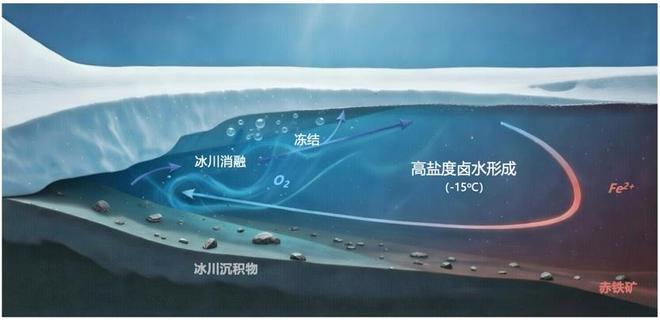
约7亿年前“雪球地球”海洋有多冷?最新研究首次揭示约-15℃
Zhong Guo Xin Wen Wang· 2026-02-03 01:15
Core Insights - The research led by Chinese scientists provides the first quantitative evidence of ocean temperatures during the "Snowball Earth" period, revealing that local ocean temperatures could have dropped to approximately -15°C, with salinity levels significantly higher than modern seawater [1][3][4] Group 1: Research Findings - The study utilized iron isotopes as a "paleothermometer" to directly quantify ocean temperatures from around 700 million years ago during the "Snowball Earth" ice age [1][3] - The research indicates that the ocean during this period was much colder than previously estimated, with temperatures around -15±7°C, which is nearly 20°C lower than the coldest modern deep-sea temperatures [4] - The extreme cold was attributed to high salinity levels in the ocean, which lowered the freezing point to about -11°C, preventing complete freezing of the seawater [4] Group 2: Historical Context - The "Snowball Earth" period, occurring approximately 720 to 635 million years ago, was characterized by global glaciation, where ice covered the entire planet from poles to equator [3] - This research provides insights into the potential existence of unique microenvironments during extreme climatic conditions, which may offer clues about early life survival mechanisms [3]
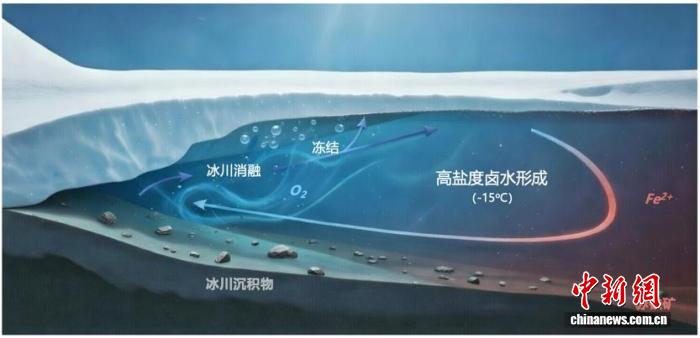
【中国新闻网】中国团队领衔研究首次揭示约7亿年前“雪球地球”海洋有多冷
Zhong Guo Xin Wen Wang· 2026-02-02 03:28
Core Findings - The research led by Chinese scientists provides direct quantitative evidence of ocean temperatures during the "Snowball Earth" period approximately 700 million years ago, revealing that local ocean temperatures could drop to around -15°C, with salinity levels significantly higher than modern seawater [1][2] Group 1: Research Methodology - The research team utilized iron isotopes from ancient "iron formations," which are sedimentary rocks composed of alternating iron-rich and silica-rich layers, to determine the extreme low-temperature environment of the "Snowball Earth" [2] - The iron isotope values from this period were found to be systematically positive compared to any other period in geological history, indicating an extremely low-temperature environment [2] Group 2: Environmental Conditions - The estimated temperature during the formation of "iron formations" in the "Snowball Earth" period was approximately -15±7°C, which is nearly 20°C lower than the coldest modern deep-sea temperatures [2] - The research confirmed that the salinity of the ocean water at that time was extremely high, which could lower the freezing point to about -11°C, corroborating the temperature estimates [2] Group 3: Implications of Findings - This groundbreaking research provides quantitative evidence for the extreme cold marine environment during the "Snowball Earth," suggesting the possibility of unique microenvironments existing under global ice cover [1] - The findings offer new insights into the survival mechanisms of early life in extreme climates and hold significant reference value for understanding drastic climate changes on Earth [1]
中国团队领衔研究首次揭示约7亿年前“雪球地球”海洋有多冷
Xin Lang Cai Jing· 2026-02-01 14:09
Core Insights - The research led by Chinese scientists provides the first quantitative evidence of ocean temperatures during the "Snowball Earth" period, approximately 700 million years ago, indicating that local ocean temperatures could drop to around -15°C, with salinity levels significantly higher than modern seawater [1][2]. Group 1: Research Findings - The study utilized iron isotopes as a "paleothermometer" to determine the ocean temperatures during the "Snowball Earth" period, revealing that the iron isotope values from ancient "iron formations" indicate an extremely low-temperature environment [2]. - The estimated temperature during the "Snowball Earth" period is approximately -15±7°C, which is nearly 20°C lower than the coldest modern deep-sea temperatures [2]. - The research also confirmed that the salinity of the ocean water at that time was so high that it could lower the freezing point to about -11°C, corroborating the temperature estimates [2]. Group 2: Implications of the Research - This groundbreaking research provides quantitative evidence for the extreme cold marine environment during the "Snowball Earth," suggesting the existence of unique microenvironments that could have supported early life in extreme climates [1][2]. - The findings have significant implications for understanding the severe climate changes on Earth and may offer new insights into the mechanisms of life’s survival under extreme conditions [1][2].