
地质研究

Search documents
新研究用医学CT技术帮助揭示地震历史
Xin Hua She· 2026-02-27 05:47
Core Viewpoint - A new study from New Zealand indicates that medical CT technology can analyze ancient sediment cores to reveal earthquake activity history and assess earthquake risk [1] Group 1: Research Findings - Researchers from Waikato University and other institutions scanned 161 sediment cores from 18 ancient lakes in the Hamilton Basin using medical CT equipment [1] - The study successfully identified signs of liquefaction deformation in volcanic ash layers, which typically occur during strong earthquakes [1] - The researchers inferred that at least four geological faults in the region experienced five significant earthquakes over the past 15,700 years, with three of these having magnitudes exceeding 7 [1] Group 2: Risk Assessment - The analysis of these geological faults suggests that the earthquake risk in the area is classified as low to moderate, although there remains a possibility of strong earthquakes occurring [1] - This research represents a global first in using medical CT technology to assist in analyzing earthquake activity, providing a new tool for assessing earthquake risk in various regions [1]
约7亿年前“雪球地球”海洋有多冷?最新研究首次揭示约-15℃
Zhong Guo Xin Wen Wang· 2026-02-03 01:15
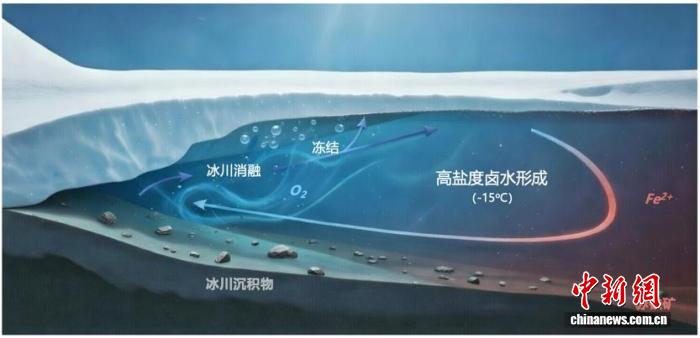
Core Insights - The research led by Chinese scientists provides the first quantitative evidence of ocean temperatures during the "Snowball Earth" period, revealing that local ocean temperatures could have dropped to approximately -15°C, with salinity levels significantly higher than modern seawater [1][3][4] Group 1: Research Findings - The study utilized iron isotopes as a "paleothermometer" to directly quantify ocean temperatures from around 700 million years ago during the "Snowball Earth" ice age [1][3] - The research indicates that the ocean during this period was much colder than previously estimated, with temperatures around -15±7°C, which is nearly 20°C lower than the coldest modern deep-sea temperatures [4] - The extreme cold was attributed to high salinity levels in the ocean, which lowered the freezing point to about -11°C, preventing complete freezing of the seawater [4] Group 2: Historical Context - The "Snowball Earth" period, occurring approximately 720 to 635 million years ago, was characterized by global glaciation, where ice covered the entire planet from poles to equator [3] - This research provides insights into the potential existence of unique microenvironments during extreme climatic conditions, which may offer clues about early life survival mechanisms [3]

海洋地质信息化成果荣获山东省自然资源科学技术进步奖
Zhong Guo Zi Ran Zi Yuan Bao· 2025-11-06 03:08
Core Viewpoint - The China Geological Survey's Qingdao Marine Geological Research Institute has been awarded the second prize in the Shandong Provincial Natural Resources Science and Technology Progress Award for its achievement in "Key Technologies and Applications for the Full Lifecycle Management of Marine Geological Big Data" [1] Group 1: Achievement Overview - The achievement addresses issues such as low aggregation efficiency, poor standardization, management difficulties, and insufficient data mining of heterogeneous marine geological data [1] - A comprehensive solution from technology to product has been proposed, including the development of marine geological survey data collection and aggregation technology [1] Group 2: Technical Innovations - A collaborative software system has been constructed to facilitate marine geological surveys, covering the entire chain from field data collection to service [1] - A stable and flexible marine geological data model has been developed, along with the establishment of technical standards for the "Marine Geological Database Content and Structure," filling a gap in China's marine geological data standard system [1] Group 3: Data Management and Services - A hybrid management technology combining "relational + big data" for marine geological spatiotemporal data has been researched, leading to the establishment of a national-level authoritative marine geological professional database [1] - The project has enabled socialized public services for marine geological data, including the prediction of marine oil and gas resources, intelligent extraction and classification of marine bottom sediments, and the construction of marine geological virtual reality methods [1] Group 4: Award Significance - The Shandong Provincial Natural Resources Science and Technology Award is held annually to encourage the creativity and initiative of scientific personnel in the natural resources system, promoting technological innovation in the field [1] - This year, a total of 19 first prizes, 55 second prizes, and 75 third prizes were awarded [1]
约8600万年前的恐龙蛋有了“出生证明”
Xin Hua She· 2025-09-11 22:21
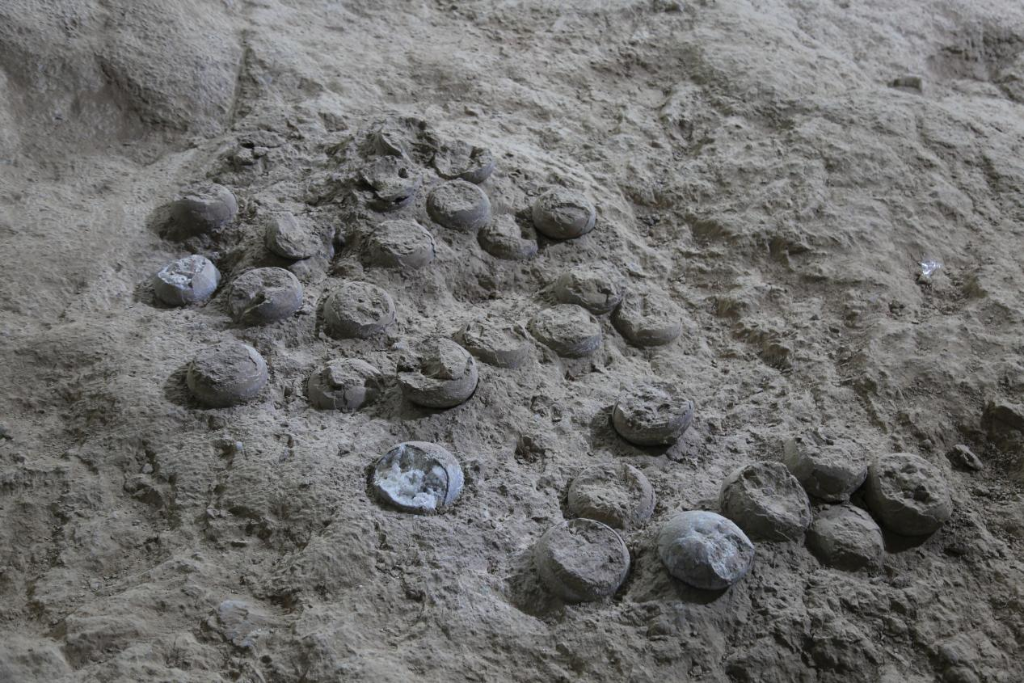
Core Viewpoint - A research team has confirmed the age of dinosaur egg fossils found in the Qinba Mountains of Hubei Province, dating them to approximately 86 million years ago, providing significant insights into the climatic conditions during that period [1]. Group 1: Research Findings - The research utilized carbonate dating technology for the first time in the study of Cretaceous dinosaur eggs, determining the age of the biogenic calcite within the egg shells to be between 87.65 million and 84.17 million years ago [1]. - The findings indicate that the dinosaur egg-laying events occurred during a global cooling period that began around 93 million years ago, marking a significant climatic transition [1]. Group 2: Historical Context - Dinosaur egg fossils were first discovered in the Qinglong Mountain area in the 1990s, leading to the establishment of a national nature reserve in 2001, which currently protects over 3,000 dinosaur egg fossils [1]. - Despite the discoveries, the specific age of these dinosaur eggs had remained a mystery until this recent research [1]. Group 3: Future Research Implications - The current study does not cover all layers of the buried dinosaur egg fossils, indicating that further research is needed to fully reconstruct the egg-laying events and establish a timeline for the evolution of dinosaur egg morphology in the region [3]. - This research provides a new approach for determining the burial times of different dinosaur egg fossils globally and offers theoretical tools for exploring ancient climate changes and the mysteries of dinosaur evolution and extinction [3].
科海观澜/用科技打通更多“两山”转化路径
Zhong Guo Zi Ran Zi Yuan Bao· 2025-06-20 02:05
Core Viewpoint - The article emphasizes the increasing role of technological innovation in transforming ecological advantages into economic benefits, addressing challenges in measuring, trading, and monetizing ecological products through advanced technologies like satellite remote sensing, artificial intelligence, and blockchain [1][2][19]. Group 1: Technological Innovation in Ecological Value - Technological innovation provides effective tools for precise quantification of ecological value, enabling dynamic assessment and quantification of ecosystem services [1][2][19]. - New technologies allow for the conversion of forest carbon sequestration capabilities into tradable carbon reduction credits, facilitating digital rights confirmation and value transformation of ecological resources [1][2][19]. - Digital platforms have been developed to calculate Gross Ecosystem Product (GEP) efficiently, significantly enhancing the recognition of ecological value [1][2][19]. Group 2: Market Mechanisms and Trading Platforms - Technology plays a crucial role in reshaping the trading model of ecological products, with the integration of blockchain and IoT enhancing transaction efficiency [1][2][19]. - Emerging platforms like "Two Mountains Cloud Trading" and "Forestry Carbon Supermarket" have improved the matching of supply and demand for ecological products while reducing transaction costs and ensuring traceability throughout the process [1][2][19]. Group 3: Dual Enhancement of Ecological Products - Technological advancements have effectively driven both the quantity and quality improvements of ecological products, addressing challenges in ecological restoration and promoting continuous environmental improvement [2][20]. - The application of new technologies aids in upgrading traditional green industries, leading to increased production and income, as well as extending product chains through deep processing [2][20]. Group 4: Future Directions for Technological Innovation - There is a need to accelerate breakthroughs in core technologies to solidify the technical foundation for quantifying and transforming ecological value [2][20]. - Innovations in market mechanisms and the establishment of intelligent trading platforms are essential for creating a more efficient digital trading environment [2][20]. - Strengthening interdisciplinary talent cultivation and enhancing public awareness of ecological product value are critical for fostering a green consumption mindset [3][21]. Group 5: International Cooperation and Standards - Deepening international cooperation and actively participating in the formulation of relevant international standards are necessary for advancing global ecological governance systems [4][21]. - The article advocates for leveraging technological innovation as a driving force to continuously unlock the potential of ecological product value, contributing to global green development [5][21].
中国—东盟行业专家共研海岸带减灾防灾
Zhong Guo Zi Ran Zi Yuan Bao· 2025-06-03 02:17
Core Insights - The seminar focused on "coastal zone earth observation and disaster reduction technology cooperation" between China and ASEAN countries, highlighting the importance of collaboration in addressing climate change and natural disasters [1][2] Group 1: Event Overview - The seminar was held in Nanning, Guangxi, organized by the Qingdao Institute of Marine Geology under the China Geological Survey, with nearly 100 participants from China and ASEAN countries [1] - Key topics included the application of earth observation technology in forecasting, disaster reduction, and ecological protection, showcasing innovative research and practical solutions [1] Group 2: Collaboration and Future Prospects - Experts discussed enhancing cooperation in coastal zone earth observation and disaster reduction, emphasizing international collaboration, data sharing, and joint technology development as essential for improving regional disaster response capabilities [2] - The meeting facilitated bilateral cooperation intentions among China, Cambodia, Myanmar, and Thailand, laying a foundation for deeper collaboration in the field [2] - The event served as a sub-forum for the 2025 China (Guangxi) - ASEAN Mining Cooperation Conference, contributing positively to regional development and sustainable practices [2]