风电行业补贴退坡

Search documents
定西高强八成收入来自五大客户,核心产品售价走跌
Xin Lang Cai Jing· 2025-11-19 23:48
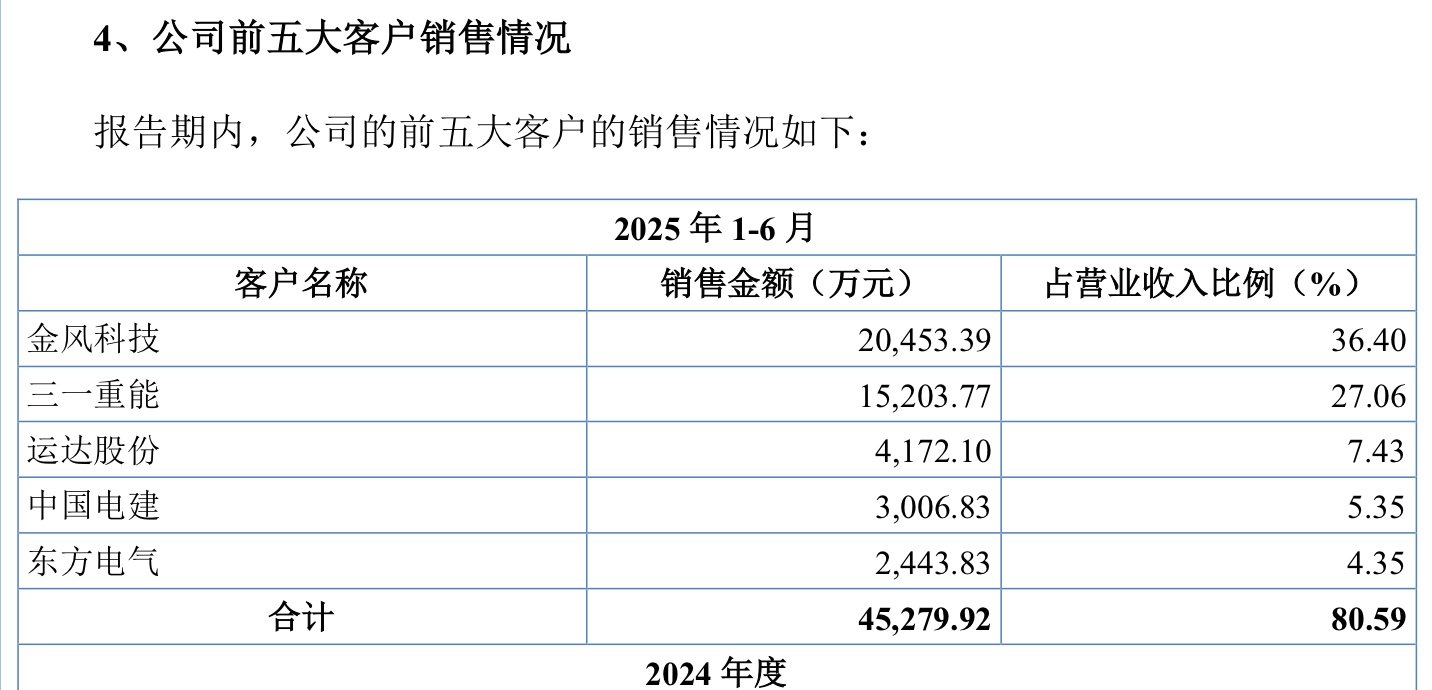
Core Viewpoint - Dingxi Gaokuang is seeking to list on the Beijing Stock Exchange, with over 80% of its revenue coming from its top five customers, while facing challenges from declining product prices and increased market competition [1][2]. Group 1: Customer Dependency - The top five customers contributed over 80% of Dingxi Gaokuang's revenue in the first half of 2025, with Goldwind Technology and Sany Renewable Energy accounting for over 60% [1][2]. - The company has established strong relationships with major clients in the wind power sector, including Goldwind Technology, Sany Renewable Energy, and other large state-owned enterprises [2]. - The reliance on a concentrated customer base poses a risk, as the top two clients alone contributed approximately 63% of the total revenue in the first half of 2025 [2]. Group 2: Financial Performance - Dingxi Gaokuang's revenue has shown stable growth, with figures of 447 million yuan, 592 million yuan, 799 million yuan, and 562 million yuan from 2022 to the first half of 2025 [2]. - Net profits for the same period were 47.64 million yuan, 49.02 million yuan, 61.03 million yuan, and 46.12 million yuan, indicating fluctuations in profitability [2]. Group 3: Product Pricing and Profitability - The price of the core product, wind power fasteners, has decreased from 12,200 yuan per ton in 2022 to 8,467.77 yuan per ton in the first half of 2025 [1][7]. - The gross margin has declined from 20.73% in 2022 to 16.26% in 2024, with a slight recovery to 18.74% in the first half of 2025 [7]. - The company attributes the price decline to increased competition and the bargaining power of major clients, which has negatively impacted profitability [6][7]. Group 4: Expansion Plans and Market Challenges - Dingxi Gaokuang plans to raise 385 million yuan for expansion projects and to supplement working capital, driven by high capacity utilization and optimistic market expectations [8]. - The company faces challenges from the gradual withdrawal of government subsidies in the wind power sector, which may lead to price instability in the future [8].