高铁+演唱会消费模式

Search documents
乘坐“最忙高铁”感受湾区融合
Jing Ji Ri Bao· 2026-02-09 22:19
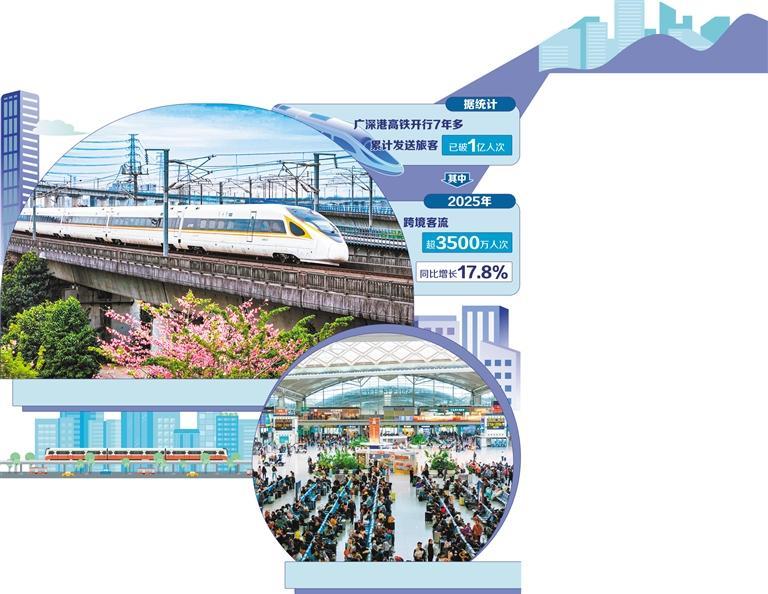
Core Insights - The Guangzhou-Shenzhen-Hong Kong High-Speed Rail (GSHK) has significantly increased its operational capacity, becoming the busiest high-speed rail in China with an average of 387 trains running daily, allowing for a train every 2 minutes during peak hours [2][5] - The rail line has facilitated a surge in cross-border travel, with over 100 million passengers transported since its inception, and a projected 35 million cross-border travelers by 2025, marking a 17.8% year-on-year increase [5][9] - The GSHK is reshaping consumer behavior and tourism patterns, leading to the emergence of new travel trends such as "cross-border commuting" and "high-speed rail tourism" [5][6][7] Group 1: Passenger Experience - Passengers report significant time savings when traveling between Hong Kong and mainland cities, with travel times reduced to as little as 14 minutes from West Kowloon to Futian [5][6] - The high-speed rail has become a popular choice for various demographics, including business travelers, students, and retirees, enhancing connectivity and fostering cultural exchange [3][4][5] Group 2: Economic Impact - The GSHK has stimulated local economies by increasing tourism and business opportunities, with new direct routes to popular destinations like Nanjing and Wuxi [4][7] - The rail line has also encouraged the establishment of service stations at key locations, providing support for Hong Kong businesses and facilitating cross-border commerce [8][9] Group 3: Marketing and Innovation - The railway authorities are leveraging big data to optimize train schedules and enhance marketing strategies, responding quickly to demand fluctuations [7] - Collaborative efforts with the tourism industry have led to themed travel packages and special train services, further promoting high-speed rail travel as a leisure option [7][8]