
黄铁矿诱导金沉淀机制

Search documents
黄金形成过程首次实现纳米尺度“直播”
Xin Lang Cai Jing· 2026-02-25 17:54
Core Insights - A research team led by Zhu Jianxi and Xian Haiyang from the Guangzhou Institute of Geochemistry has utilized in-situ liquid-phase transmission electron microscopy to observe the dynamic process of gold nanoparticle formation on the surface of pyrite in a liquid environment, proposing a new mechanism for gold precipitation induced by pyrite [1][2] Group 1: Research Findings - The study reveals that a special "dense liquid layer" forms at the pyrite-water interface, acting like a "nano-factory" that catalyzes the nucleation, growth, and enrichment of gold in extremely low concentration gold-bearing fluids [1] - The research challenges the traditional view that gold primarily originates from deep hydrothermal fluids, providing new insights into the micro-dynamics of gold enrichment in both hydrothermal gold deposits and surface gold accumulation processes [2] Group 2: Methodology and Observations - The team employed multi-scale and multi-technique approaches, including in-situ liquid-phase transmission electron microscopy, to observe the reaction process between pyrite and a gold solution with a concentration of 10 ppb [1] - Observations indicated that after approximately 13 minutes of contact, a "dense liquid layer" formed around the pyrite, with gold nanoparticles beginning to appear after about 20 minutes, gradually increasing in number and size over time [1][2] Group 3: Implications - This research not only enhances the understanding of the formation process of gold on pyrite surfaces but also has significant implications for interface regulation in green gold extraction processes [2]
【科技日报】黄金形成过程首次实现纳米尺度“直播”
Ke Ji Ri Bao· 2026-02-02 03:28
Core Insights - A research team led by researchers from the Guangzhou Institute of Geochemistry of the Chinese Academy of Sciences has utilized in-situ liquid-phase transmission electron microscopy to observe the dynamic process of gold nanoparticle formation on the surface of pyrite in a liquid environment for the first time [1][2] - The study proposes a new mechanism for gold precipitation induced by pyrite, revealing the presence of a special "dense liquid layer" at the pyrite-water interface, which acts as a "nano-factory" to catalyze the nucleation, growth, and enrichment of gold in extremely low concentration gold-bearing fluids [1][2] Research Findings - The research indicates that gold nanoparticles do not form spontaneously in the solution but are generated within the "dense liquid layer" closely adhering to the pyrite surface [2] - The dissolution of pyrite significantly reduces the oxygen fugacity within this layer, altering the local chemical environment and facilitating the rapid supersaturation of gold ions, leading to their precipitation as solid particles [2] - This mechanism can drive the migration and enrichment of gold at the interface even when the external solution has an extremely low gold concentration, challenging the traditional view that gold primarily originates from deep hydrothermal fluids [2] Implications - The findings provide new insights into the micro-dynamics of gold enrichment in both hydrothermal gold deposits and surface gold accumulation processes, opening new pathways for understanding mineralization processes driven by nanoparticles in nature [2] - The research also holds significant implications for interface regulation in green gold leaching processes [2]
黄金还可以“长”出来?
Xin Lang Cai Jing· 2026-01-26 18:59
Core Viewpoint - Scientists have revealed the dynamic process of gold nanoparticle formation on the surface of pyrite, proposing a new mechanism for gold precipitation induced by pyrite, which suggests that gold can "grow" from common ores [5][7]. Group 1: Research Findings - The research utilized in-situ liquid-phase transmission electron microscopy to report the formation of gold nanoparticles at the nanoscale [5]. - A special "dense liquid layer" exists at the pyrite-water interface, acting as a "nanoscale factory" that can effectively catalyze the nucleation, growth, and enrichment of gold even in extremely low concentrations [6][8]. - This discovery challenges the traditional theory that gold primarily originates from deep hydrothermal fluids, expanding the understanding of mineralization mechanisms [8]. Group 2: Implications and Applications - The "nanoscale factory" mechanism is applicable to both hydrothermal gold deposits and surface gold enrichment processes, indicating a broader relevance in mineral exploration [8]. - The findings may lead to the development of more precise and environmentally friendly technologies for extracting gold from traditional waste ores, potentially guiding global searches for new gold deposits [8].

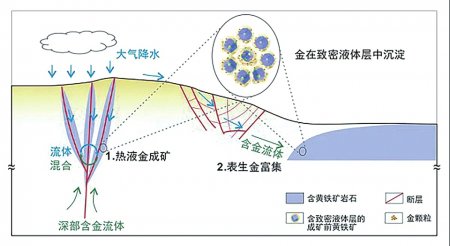
【新华社】矿物表面“长”黄金 我国科学家揭秘自然“炼金术”
Xin Hua She· 2026-01-26 02:31
Core Insights - Researchers in China have unveiled a new mechanism for gold precipitation induced by pyrite, capturing the dynamic process of gold nanoparticle formation on pyrite surfaces at the nanoscale for the first time [1] Group 1: Research Findings - The study reveals that gold nanoparticles do not form spontaneously in solution but are generated in a "dense liquid layer" closely adhering to the pyrite surface [1] - The dissolution of pyrite alters the chemical environment of this liquid layer, leading to rapid supersaturation of gold and subsequent precipitation as solid particles, effectively acting as a "nano-factory" [1] - This mechanism is applicable to explaining the enrichment processes of gold in various natural hydrothermal ore deposits and surface environments [1] Group 2: Implications - The findings provide new insights into the formation of high-grade gold deposits, which is a critical aspect of gold mining [1] - From an application perspective, the mechanism offers guidance for interface regulation in green gold extraction processes [1]
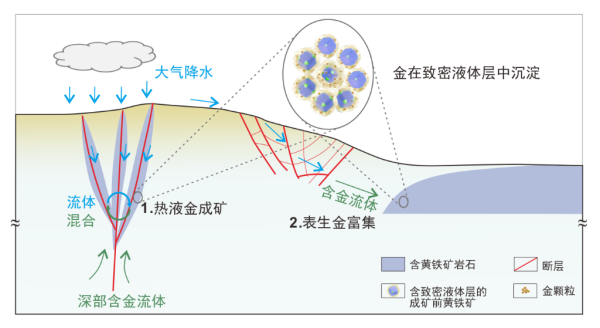
矿物表面“长”黄金 我国科学家揭秘自然“炼金术”
Xin Hua She· 2026-01-23 06:31
Core Insights - Chinese researchers have unveiled a new mechanism for gold precipitation induced by pyrite, providing a fresh perspective on gold ore formation [1][3] - The study captures the real-time process of gold nanoparticle formation on pyrite surfaces at the nanoscale, marking a significant advancement in understanding mineralization processes [1] Group 1: Research Findings - The research utilized in-situ liquid-phase transmission electron microscopy to observe the reaction between pyrite and extremely low concentrations of gold solution [1] - It was discovered that gold nanoparticles do not form in solution but rather in a "dense liquid layer" closely adhering to the pyrite surface, where the chemical environment changes due to pyrite dissolution [1] - This "reaction zone" acts like an efficient "nano-factory," leading to rapid supersaturation and solid particle precipitation [1] Group 2: Implications - The newly identified mechanism is applicable to explaining the enrichment processes of gold in various natural hydrothermal gold deposits, including orogenic, Carlin-type, and shallow low-temperature hydrothermal types [3] - From an application standpoint, this mechanism offers guidance for interface regulation in green gold leaching processes [3]
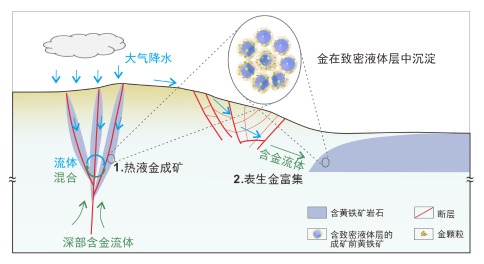
事关黄金,中国科学家首次纳米级“直播”!
Huan Qiu Wang Zi Xun· 2026-01-20 03:43
Group 1 - Chinese scientists have utilized in-situ liquid-phase transmission electron microscopy to observe the dynamic process of gold nanoparticles forming on the surface of pyrite in real-time, proposing a new mechanism for gold precipitation induced by pyrite [1][3] - The research team, led by researchers Zhu Jianxi and Xian Haiyang from the Guangzhou Institute of Geochemistry, observed the reaction process with a gold solution concentration of 10 ppb, revealing that a "dense liquid layer" forms around the pyrite after approximately 13 minutes of contact [3] - Gold nanoparticles begin to appear within this dense liquid layer around 20 minutes after contact, indicating that the mechanism can drive gold migration and accumulation even at extremely low concentrations in the external solution [3][4] Group 2 - The mechanism discovered is applicable to both hydrothermal gold deposits and surface gold enrichment processes, highlighting its significance in understanding gold formation [4]
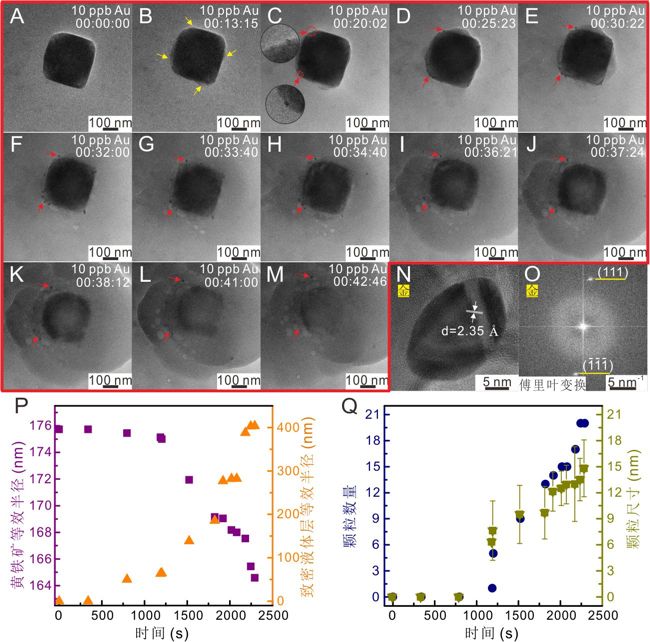
【央视新闻】我国科学家首次呈现纳米尺度黄金形成的动态过程
Yang Shi Xin Wen· 2026-01-20 02:11
Core Insights - The research team from the Guangzhou Institute of Geochemistry has utilized in-situ liquid-phase transmission electron microscopy to reveal the dynamic process of gold nanoparticle formation on the surface of pyrite for the first time [1] - A new mechanism for gold precipitation induced by pyrite has been proposed, highlighting the presence of a "dense liquid layer" at the pyrite-water interface that acts as a "nanoscale factory" for gold nucleation and growth, even in extremely low gold concentration fluids [1][2] Group 1 - The study challenges the traditional view that gold primarily originates from deep hydrothermal fluids, opening new pathways for understanding the mineralization process driven by nanoparticles in nature [2] - The findings provide critical insights into the formation process of gold on pyrite surfaces, which is essential for understanding the genesis of high-grade gold deposits [1] - The mechanism has practical implications for interface control in green gold leaching processes [2]
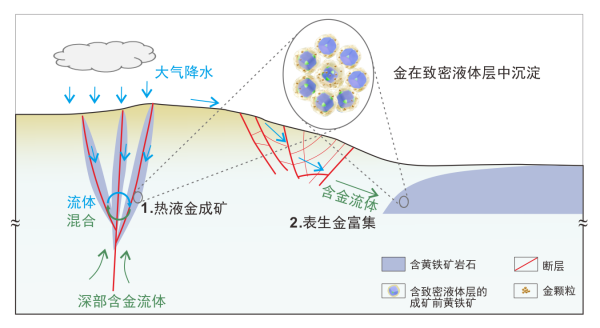
我国科学家首次呈现纳米尺度黄金形成的动态过程
Jin Rong Jie· 2026-01-19 20:08
Core Viewpoint - The research team from the Guangzhou Institute of Geochemistry, Chinese Academy of Sciences, has utilized in-situ liquid-phase transmission electron microscopy to reveal the dynamic process of gold nanoparticle formation on the surface of pyrite, proposing a new mechanism for gold precipitation induced by pyrite [1] Group 1: Research Findings - A special "dense liquid layer" exists at the pyrite-water interface, acting as a "nano-factory" that effectively catalyzes the nucleation, growth, and enrichment of gold even in fluids with extremely low gold concentrations (only a few billionths) [1] - The study provides a new perspective for understanding the genesis of gold deposits [1] Group 2: Publication Details - The related findings were published on January 20 in the international academic journal Proceedings of the National Academy of Sciences [1]