黑洞吸积盘

Search documents
宇宙神秘“小红点”为何那么红?
Xin Lang Cai Jing· 2026-02-10 20:04
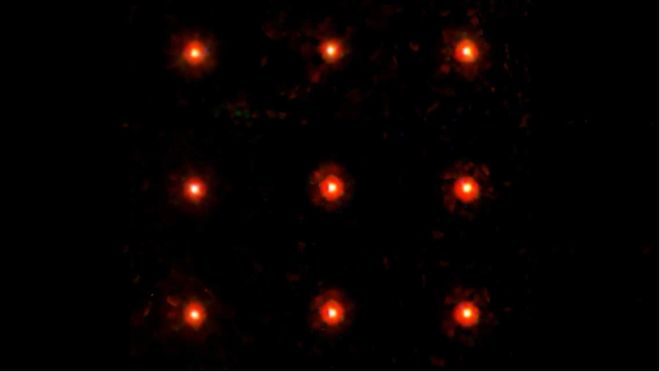
Core Viewpoint - The discovery of numerous small, bright red celestial bodies, referred to as "small red dots," by the James Webb Space Telescope presents a new understanding of their physical mechanisms, challenging existing theories about their color and composition [1][2]. Group 1: Discovery and Characteristics - The "small red dots" are characterized by their abundance, dense structure, and extreme redness, differing from previously discovered galaxies [1]. - Traditional theories suggested that the redness was due to interstellar dust, but observations indicate that these celestial bodies contain very low amounts of dust, posing a challenge to existing models [1]. Group 2: Proposed Mechanism - The research team proposed that the extreme redness of the "small red dots" is due to the radiation from the outer regions of the black hole accretion disk, which falls within the visible to near-infrared spectrum, rather than being a result of dust [2]. - The outer accretion disk is in a quasi-stable state with a relatively low temperature (approximately 2000 to 4000 degrees Celsius), while the inner disk reaches temperatures exceeding 10,000 degrees Celsius, leading to a combined radiation spectrum that matches observational data [2]. Group 3: Implications for Galaxy Evolution - The findings suggest that in the early universe, some smaller galaxies may have formed only a supermassive black hole and a stellar cluster at their centers, with weak large-scale star formation, resulting in visibility limited to the core regions [2]. - Over billions of years, as galaxies grow, stellar births and deaths in the core create significant dust, transitioning the "small red dots" into ordinary galaxies, providing critical insights into the early evolution of galaxies and black holes [2].
星空有约丨宇宙神秘“小红点”为何那么红?我国科学家提出新解释
Xin Lang Cai Jing· 2026-02-06 18:56
Core Viewpoint - The James Webb Space Telescope has discovered a large number of small, bright red celestial bodies, referred to as "small red dots," which differ from previously identified galaxies and have puzzled astronomers [1][2]. Group 1: Discovery and Characteristics - The "small red dots" are numerous, densely structured, and exhibit a very red color, challenging existing astronomical theories [1]. - Traditional models assumed that the red appearance was due to significant amounts of interstellar dust causing a "reddening" effect, but observations show these celestial bodies contain very low dust levels [1][2]. Group 2: Proposed Mechanism - A research team led by Professor Wu Qingwen proposed a new physical mechanism explaining the red color, attributing it to the radiation from the outer regions of the supermassive black hole's accretion disk, which falls within the visible to near-infrared spectrum [2]. - The outer accretion disk is in a quasi-stable state with a relatively low temperature (approximately 2000 to 4000 degrees Celsius), while the inner disk reaches temperatures exceeding 10,000 degrees Celsius, resulting in a "V"-shaped spectral energy distribution that aligns with the observations from the James Webb Space Telescope [2]. Group 3: Implications for Galaxy Evolution - The findings suggest that in the early universe, some smaller galaxies may have formed only supermassive black holes and stellar clusters at their centers, with weak large-scale star formation, leading to the visibility of only the core regions [2]. - Over billions of years, as galaxies grow, the formation and death of stars in the core create significant amounts of dust, transitioning the "small red dots" into ordinary galaxies, providing critical insights into the early evolution of galaxies and black holes [2].
星空有约|宇宙神秘“小红点”为何那么红?我国科学家提出新解释
Xin Hua She· 2026-02-06 12:47
Core Viewpoint - The discovery of numerous small, bright red celestial bodies, referred to as "small red dots," by the James Webb Space Telescope has led to new insights into their physical mechanisms, challenging existing theories about their color and composition [1][2]. Group 1: Characteristics of "Small Red Dots" - "Small red dots" are characterized by their high numbers, dense structures, and extreme redness, differing from previously discovered galaxies [1]. - Traditional theories suggested that the redness was due to a high dust content causing a "reddening" effect, but observations indicate that these celestial bodies contain very low levels of dust, contradicting existing models [2]. Group 2: Proposed Mechanism - The research team proposed that the extreme redness of "small red dots" is due to the radiation from the outer regions of the black hole accretion disk, which falls within the visible to near-infrared spectrum, rather than being a result of interstellar dust [2]. - The outer accretion disk is in a quasi-stable state with a relatively low temperature (approximately 2000 to 4000 degrees Celsius), while the inner disk reaches temperatures exceeding 10,000 degrees Celsius, emitting primarily in the visible to ultraviolet spectrum [2]. Group 3: Implications for Galaxy Evolution - The findings suggest that in the early universe, some smaller galaxies may have formed only supermassive black holes and nuclear star clusters at their centers, with weak large-scale star formation, leading to the visibility of only the core regions [5]. - Over billions of years, as galaxies grow, the formation and death of stars in the nuclear region produce significant dust, which eventually covers the original black hole's outer disk, marking the transition from "small red dots" to typical galaxies, providing crucial information on the early evolution of galaxies and black holes [5].