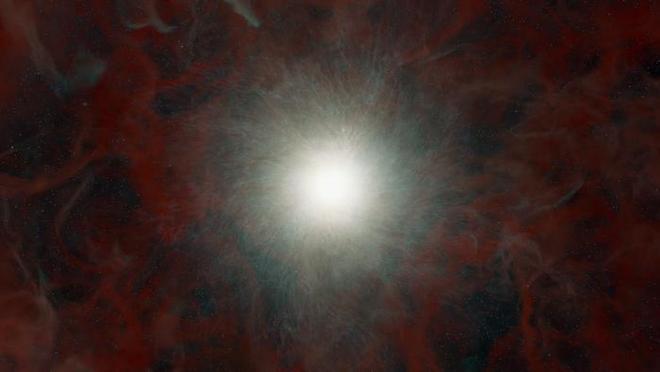
黑洞起源

Search documents
天文学家首次观测到恒星直接坍缩成黑洞
Ke Ji Ri Bao· 2026-02-13 02:57
Core Findings - Astronomers have observed a massive star, M31-2014-DS1, directly collapsing into a black hole without undergoing a supernova explosion, marking a significant advancement in understanding stellar evolution into black holes [1][2] - The research, based on over a decade of monitoring and data analysis, was published in the journal Science, indicating a new phase in human comprehension of stellar endings and black hole formation mechanisms [1] Observation Details - The star M31-2014-DS1 is located approximately 2.5 million light-years away in the Andromeda galaxy, with brightness anomalies detected from 2014, followed by a sharp decline in 2016, where its brightness dropped to one ten-thousandth of its original level by 2022-2023 [1] - The analysis utilized data from NASA's NEOWISE project and various ground and space telescopes, revealing that the star became nearly invisible in visible and near-infrared light, retaining only a faint signal in the mid-infrared spectrum [1] Theoretical Implications - The brightness drop and eventual disappearance strongly suggest that the star's core underwent gravitational collapse to form a black hole, providing direct evidence for a theoretical process where if an outward shock wave fails to eject outer material, it will fall back onto the neutron star, leading to black hole formation [2] - The study highlights the critical role of convective motions in the star's outer layers during this process, with only about 1% of the stellar envelope material ultimately falling into the black hole, while the rest dissipates over a long timescale [2] Broader Impact - The findings have prompted a reevaluation of another star, NGC 6946-BH1, which exhibits similar light variation characteristics, confirming it also belongs to the category of stars that directly collapse into black holes [3] - This research has garnered significant attention in the astronomical community as it not only validates and refines theoretical models of massive star collapse but also provides crucial insights into the origins of black holes, with the potential for long-term monitoring of newly formed black holes using advanced telescopes like the James Webb Space Telescope [3]
天文学家首次观察到恒星直接坍缩成黑洞
Huan Qiu Wang Zi Xun· 2026-02-13 01:13
Core Findings - Astronomers have observed a massive star, M31-2014-DS1, that collapsed directly into a black hole without undergoing a supernova explosion, marking a significant advancement in understanding stellar evolution into black holes [2][3] - The research, published in the journal Science, is based on over a decade of monitoring and analysis of historical data, providing the most comprehensive physical picture of how stars evolve into black holes [2] Observation Details - The star M31-2014-DS1 is located approximately 2.5 million light-years away in the Andromeda galaxy, with brightness anomalies detected from 2014, culminating in a sharp decline in brightness in 2016 [2] - By 2022-2023, the star was nearly invisible in visible and near-infrared light, with brightness reduced to one ten-thousandth of its original level, and only faint signals remaining in the mid-infrared spectrum [2] Theoretical Implications - The brightness drop and eventual disappearance strongly indicate that the star's core underwent gravitational collapse to form a black hole, providing direct evidence for a theoretical process where if the shock wave does not eject outer material, it falls back onto the neutron star, leading to further collapse [3] - The study highlights the role of convective motion in the star's outer layers, which prevents material from directly falling into the black hole, with only about 1% of the star's outer material ultimately being consumed [3] Broader Impact - This research has garnered significant attention in the astronomical community as it validates and refines theoretical models of massive star collapse into black holes, offering crucial insights into the origins of black holes [4] - Future observations, particularly with advanced telescopes like the James Webb Space Telescope, will enable long-term monitoring of similar celestial bodies, establishing a baseline for understanding stellar black hole formation [5]