AI办公生态

Search documents
未来智能以viaim品牌亮相AWE 2026:从AI耳机到更多形态的办公硬件
IPO早知道· 2026-03-13 03:27
Core Viewpoint - The article highlights the emergence of "Future Intelligence" as a key player in the AI hardware sector, showcasing its focus on practical solutions for office environments through its independent brand "viaim" at the 2026 AWE, emphasizing a complete answer to the challenges faced by users in their work settings [3][5]. Group 1: Product Innovation - Future Intelligence's "viaim" booth featured an immersive AI office experience, demonstrating products like the iFlytek AI Conference Headset Pro 3 and Air 2, which effectively filter noise and transcribe meetings into actionable items, showcasing the practical application of AI technology [5][7]. - The company differentiates itself from traditional hardware manufacturers by focusing on real user problems in office scenarios, such as meeting record management and cross-border communication challenges, rather than merely competing on hardware specifications [7][9]. Group 2: Strategic Partnerships and Market Position - Future Intelligence's desktop office product "Meeting Dog Kit 2" was showcased at an Intel event, indicating strong industry recognition and signaling the importance of AI's contextual application in the evolving tech landscape [9][11]. - The article notes that the office environment is seen as a promising area for AI integration, with Future Intelligence concentrating on high-frequency, repetitive pain points in office tasks rather than broad, vague applications [9][11]. Group 3: Future Development and Vision - Future Intelligence emphasizes its "One Brain, Multiple Ends" strategy, with the "viaim brain" at the core of its AI Agent development, aiming to evolve from passive tools to proactive assistants that understand user habits and needs [11][13]. - The company plans to expand its product offerings beyond headphones, aiming to create a closed-loop ecosystem from perception to execution, addressing the growing concern of AI hardware homogenization in the industry [13][16].


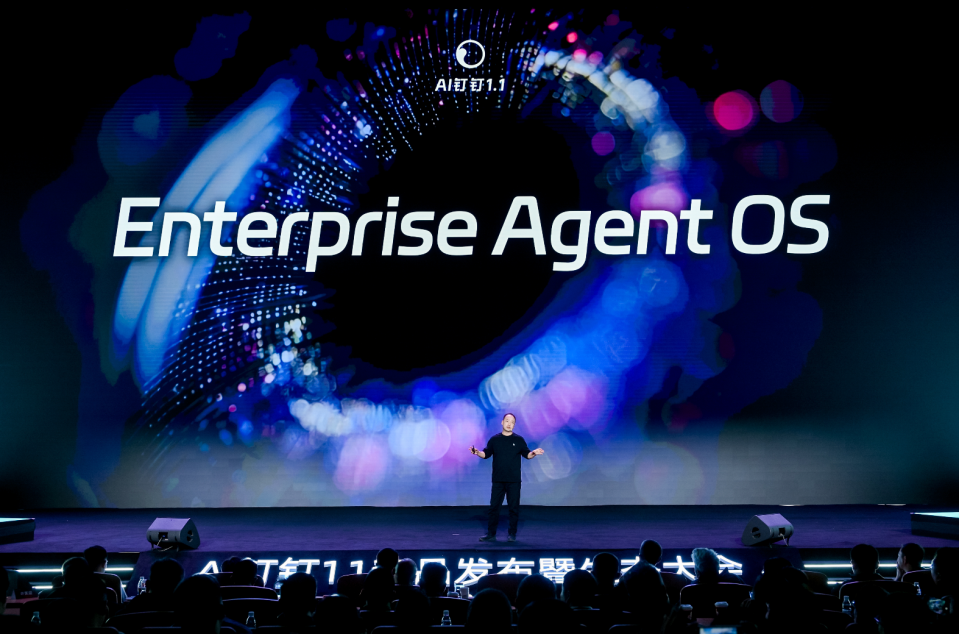
钉钉发布Agent OS:转型操作系统 卡位AI办公生态
Huan Qiu Wang· 2025-12-24 02:39
Core Viewpoint - DingTalk has officially transformed into an AI operating system with the launch of Agent OS and over 20 AI products, marking a significant shift from a collaborative office platform to an intelligent work operating system in the AI era [1][2]. Strategic Shift - The transition from an "application" to an "operating system" indicates DingTalk's ambition to serve as the foundational infrastructure for AI agents, moving beyond its previous role [2]. Product Reconstruction - Agent OS is designed to run and collaborate with AI agents, featuring a product matrix that includes DingTalk ONE, DingTalk Real, Wukong, and DEAP, establishing a comprehensive human-machine collaboration system [4]. - DingTalk Real is a dedicated device for AI agents, equipped with capabilities for entity authorization, data access, and real-time data acquisition, addressing the challenges of secure task execution in complex enterprise environments [5]. Industry Deep Dive - DingTalk is shifting from providing tools to co-creating industry solutions, with AI applications tailored for manufacturing, retail, and healthcare sectors, showcasing its commitment to vertical industry solutions [6][7]. Ecosystem Development - The launch of the DingTalk Enterprise AI Platform (DEAP) aims to facilitate low-threshold development and management of dedicated agents for enterprises, while also enhancing its open platform to ensure high commercial deliverability of AI agents [8]. - DingTalk emphasizes a collaborative AI ecosystem, aiming to build industry models and AI hardware markets with partners, promoting a comprehensive AI application ecosystem [8]. Globalization and Competitive Landscape - DingTalk is pursuing globalization with the introduction of an overseas version and the "One Office" product, aiming for integrated networking and collaboration on a global scale [9]. - The core competitive logic has shifted from the richness of features to the completeness of the ecosystem and the productivity of intelligent agents, while facing challenges in stability, reliability, and data security [9].