AI反垄断

Search documents
欧盟对Meta发起反垄断调查,事关旗下社交平台AI新规
Nan Fang Du Shi Bao· 2025-12-06 15:37
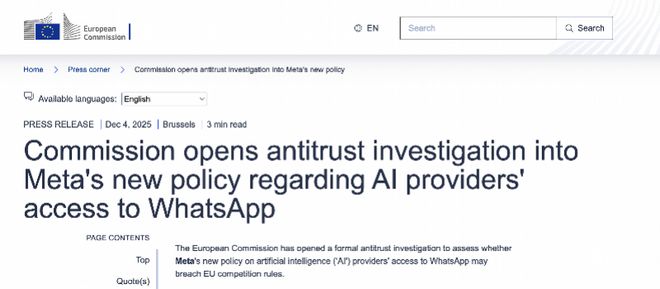
Core Viewpoint - The European Commission has initiated a formal antitrust investigation into Meta regarding a new policy related to AI features in WhatsApp, assessing whether it harms market competition [1][6]. Group 1: Investigation Details - The investigation was announced on December 4, focusing on WhatsApp's updated business API policy that prohibits AI providers from distributing AI assistant services through the platform [1][3]. - The new policy, effective from January 15, 2026, restricts AI and machine learning technology providers from accessing WhatsApp's business solutions for the primary purpose of offering such technologies [3][5]. Group 2: Implications for AI Providers - The policy specifically targets AI providers, including large language models and generative AI platforms, preventing them from using WhatsApp's business solutions for their main functionalities [4][5]. - Despite these restrictions, users can still engage AI providers as third-party service providers, provided they do not use business solution data to develop or improve other AI models [5][6]. Group 3: Competitive Concerns - The European Commission is concerned that this new policy may hinder third-party AI providers from offering services through WhatsApp in the European Economic Area (EEA) [6][7]. - The investigation aims to ensure that European citizens and businesses can benefit from AI advancements and to prevent dominant digital players from abusing their market power, potentially stifling innovative competitors [7][8]. Group 4: Related Investigations - In addition to the current investigation, the Italian Competition Authority has also launched an antitrust inquiry into Meta's integration of "Meta AI" with WhatsApp, assessing whether it constitutes an abuse of market dominance [8].


欧盟对Meta发起反垄断调查 事关旗下社交平台AI新规
Nan Fang Du Shi Bao· 2025-12-06 15:33
Core Viewpoint - The European Commission has initiated a formal antitrust investigation into Meta regarding a new policy related to AI features in WhatsApp, assessing whether it harms market competition [2][3]. Group 1: WhatsApp's AI Provider Policy - In October, WhatsApp updated its business API policy to include a section on "AI providers," explicitly prohibiting AI model vendors from distributing AI assistant services via WhatsApp. This policy will take effect on January 15, 2026 [4]. - The policy restricts AI or machine learning technology providers and developers from directly or indirectly accessing or using WhatsApp's business solutions for providing, delivering, selling, or otherwise making such technologies available [4][7]. - Despite these restrictions, Meta allows users to engage third-party AI providers as long as it does not lead to the use of business solution data for creating, developing, training, or improving other AI models [7]. Group 2: Concerns from the European Commission - The European Commission is concerned that the new policy may prevent third-party AI providers from offering services through WhatsApp in the European Economic Area (EEA). Several AI providers currently use WhatsApp to provide access to their AI assistants for tasks like answering questions and generating content [9]. - The Commission believes that competitors' AI providers may be blocked from reaching their customers via WhatsApp, while Meta's own AI service, "Meta AI," will continue to be available on the platform [9]. - Teresa Ribera, the Executive Vice President of the European Commission responsible for antitrust matters, emphasized the need to ensure that European citizens and businesses can fully benefit from the AI revolution and to prevent dominant digital giants from abusing their market power [9]. Group 3: Ongoing Investigations - The formal investigation by the European Commission will cover the entire EEA except for Italy, to avoid overlap with ongoing procedures by the Italian Competition Authority, which is also investigating Meta's actions [9][10]. - The Italian authority is examining whether Meta's deep integration of "Meta AI" with WhatsApp constitutes an abuse of market dominance, particularly regarding the pre-installation of Meta AI without user consent starting March 2025 [10].