AI本地化运行

Search documents
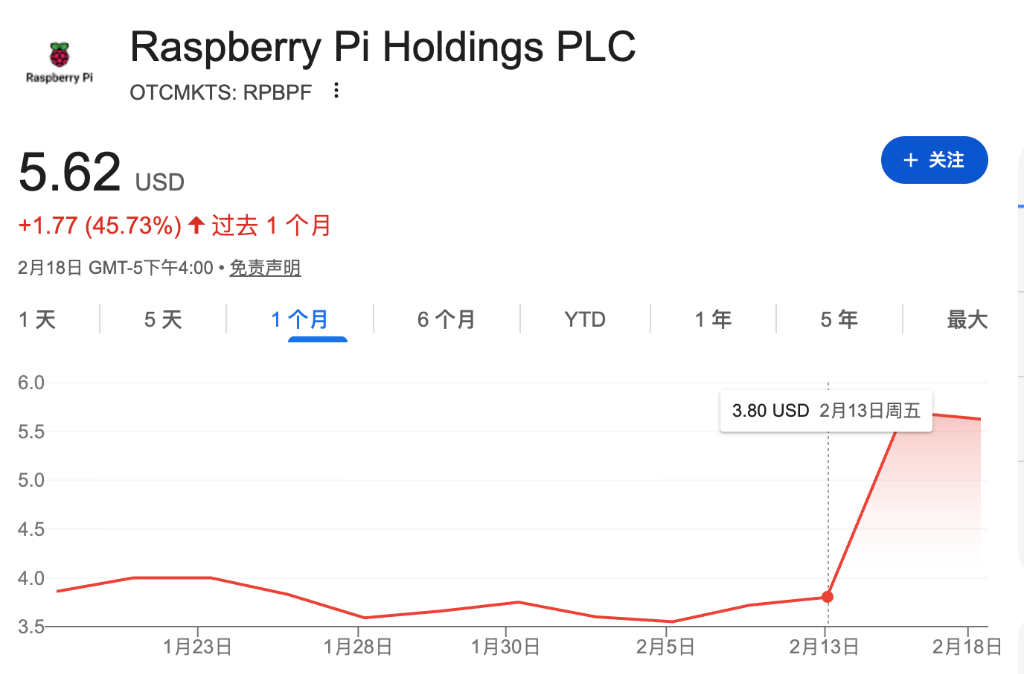
OpenClaw引爆“廉价主机需求”,这家英国电脑制造商股价三天几乎翻倍
Hua Er Jie Jian Wen· 2026-02-19 02:36
Core Insights - The surge in demand for Raspberry Pi is driven by the anticipated need for "cheap hosts" to run the AI tool OpenClaw locally, leading to a near doubling of its stock price within three trading days and a market capitalization exceeding £1 billion for the first time since its IPO in May 2022 [1][4]. Group 1: Market Dynamics - The market excitement is primarily fueled by expectations of hardware demand for localized deployment of AI Agents, with OpenClaw being recognized as the first successful AI Agent capable of running on personal computers [4]. - Social media discussions have amplified interest, with enthusiasts seeking to utilize Raspberry Pi as a cost-effective hardware solution for running OpenClaw [5]. - Despite the initial surge, the stock experienced a sharp reversal, closing with a market cap slightly above £800 million, indicating volatility driven by social media narratives [4][6]. Group 2: Investment Trends - Retail investor participation has significantly increased, with a reported twofold rise in the number of users purchasing the stock compared to the previous 30-day average [6]. - Trading volumes on platforms like AJ Bell have surged, with the trading activity in just two days surpassing the total of the previous week, highlighting the influence of retail investors in this market movement [6]. Group 3: Industry Implications - Analysts suggest that the appeal of running OpenClaw on Raspberry Pi lies in the ability to achieve "good enough" functionality at near-zero incremental costs, providing a key advantage over cloud-based solutions [5]. - The emergence of OpenClaw is seen as indicative of a broader industry shift, with AI models and agents becoming more efficient and moving from centralized cloud servers to cost-effective distributed edge devices [7]. - Concerns are growing regarding the potential disruptive impact of AI Agents on white-collar jobs across various sectors, as the technology matures [4][8]. Group 4: Supply Chain Challenges - Raspberry Pi faces long-term challenges related to memory supply shortages, with rising prices of dynamic random-access memory (DRAM) impacting the cost structure of its low-cost devices [8]. - The company has issued warnings about the uncertainty surrounding the recovery of DRAM prices and supply, which could affect future production and inventory levels [8].