
AI in Software Development

Search documents
月下载破亿工具链被OpenAI打包收购!Python包管理神器uv现在姓O了
量子位· 2026-03-20 03:52
克雷西 发自 凹非寺 量子位 | 公众号 QbitAI OpenAI大手一挥,Python包管理神器uv要被收购了。 OpenAI与uv开发商Astral同时官宣,已经 达成了收购协议 。 对于这个协议,Astral创始人兼CEO Charlie Marsh表示,他创立公司的目标就是提高编程效率,创造出"能够彻底改变Python使用体验的 工具"。 Marsh认为,加入OpenAI,就是向着这个目标迈出的重要一步。 并入CodeX团队,继续支持开源 OpenAI和Astral的这笔交易,具体金额暂未披露,但已经引起了开发者社区的广泛关注。 OpenAI表示,收购完成后 会继续为这些开源产品提供支持 。 Astral创始人Charlie Marsh也确认,他们会坚持目前的开源路线,和整个Python社区一起把工具做得更好。 在保留原有开源项目的基础上,双方也透露了合并后的技术整合方向。 加入Codex团队后,Astral会配合OpenAI探索更深度的功能结合。 大家最关心的问题,就是Astral手里那些高频使用的开源工具,未来会何去何从。 根据双方公布的安排,在收购交易正式完成并拿到监管审批前,OpenAI和A ...


Gitlab (GTLB) - 2026 Q4 - Earnings Call Transcript
2026-03-03 22:30
Financial Data and Key Metrics Changes - Fiscal 2026 revenue grew 26% to $955 million, with non-GAAP operating margin reaching 17%, up approximately 680 basis points year-over-year [19] - Free cash flow increased by 83% to $220 million, with over 7 points of margin expansion [19] - Q4 revenue was $260 million, up 23% year-over-year, exceeding guidance by 3.5 points [20] - Non-GAAP operating margin for Q4 reached 20.5%, 5 points above guidance [20] - Total RPO grew 20% year-over-year to $1.1 billion, with current RPO growing 24% to $719.4 million [22] Business Line Data and Key Metrics Changes - SaaS revenue now represents approximately 32% of total revenue, growing 38% year-over-year, driven by GitLab Dedicated and GitLab Duo [22] - The number of customers with ARR of at least $5,000 reached 10,682, contributing over 95% of total ARR [19] - The $100K-plus customer cohort grew 18% year-over-year to 1,456 customers, representing just over 75% of ARR [19] Market Data and Key Metrics Changes - First order bookings showed particular strength in Asia-Pacific, while performance in the U.S. was softer due to budget constraints and industry challenges [20] - Dollar-based net retention was 118%, with gross retention remaining above 90% [21] - The largest customers continue to expand, but there is pressure in the mid-market and SMB segments [21] Company Strategy and Development Direction - The company identified five strategies to improve growth in FY 2027, including reaccelerating first orders, scaling sales capacity, expanding product packaging, engaging price-sensitive customers, and executing an AI strategy [5][6] - The company is focused on converting pilots to production and expects modest revenue contribution from GitLab Duo Agent Platform in FY 2027, with significant impact anticipated in FY 2028 and beyond [28] - The company is positioned to capture a growing market, emphasizing the importance of security, compliance, and governance in software development [12] Management's Comments on Operating Environment and Future Outlook - Management expressed confidence in the company's ability to execute its growth strategies and highlighted the importance of rebuilding go-to-market capacity [36] - The company is navigating a changing environment with increased customer interest in AI, while also addressing privacy and security concerns [70] - Management noted that FY 2027 is about demonstrating value to customers and maintaining momentum through consistent performance [17] Other Important Information - The board authorized a $400 million share repurchase program, reflecting confidence in the company's fundamentals and growth plan [16] - The company ended the quarter with $1.3 billion in cash and investments, maintaining a strong liquidity position [22] Q&A Session Summary Question: How does GitLab differentiate its security portfolio? - GitLab's security capabilities focus on certifying code readiness for production, which complements tools that suggest secure code at authoring time [31] Question: What is the timing for growth acceleration back to 20%? - The company expects a step function increase in ramp capacity starting around Q3 FY27, with a focus on go-to-market investments [36] Question: What is driving the decline in net retention? - The pressure on net retention is concentrated in the price-sensitive cohort, which represents about 20% of ARR, while enterprise segments remain healthy [43] Question: How does GitLab Duo Agent Platform pricing work? - The Duo Agent Platform offers included credits for Premium and Ultimate seats, allowing customers to use the platform without new contracts, transitioning to a pay-as-you-go model [48] Question: What are the barriers to entry around CI/CD? - The strategic advantage lies in GitLab's ability to integrate security, compliance, and governance into the CI/CD process, making it difficult for competitors to replicate [89]

Cognizant and Cognition Partner to Scale Autonomous Software Engineering and Deliver Business Value Across Enterprise Operations
Prnewswire· 2026-01-28 13:00
Core Insights - Cognizant has announced a strategic partnership with Cognition to introduce autonomous AI software engineers, enhancing the software development lifecycle (SDLC) and accelerating business value [1][4] - The partnership aims to integrate Devin AI, which can independently execute development tasks, with Cognizant's delivery models and platforms, including Cognizant Flowsource™ [2][4] - Cognizant's CEO stated that 30% of their code is currently generated by AI, with a goal to increase this to 50% in the near future, emphasizing the need for robust infrastructure to achieve measurable business outcomes [3] Group 1: Partnership Details - The collaboration combines Devin AI's capabilities with Windsurf, an agentic development environment, to enhance engineering productivity and modernize applications [2][4] - The partnership will focus on enterprise modernization and engineering transformation, leveraging early work in complex engineering environments to improve productivity and support ongoing operations [4][5] Group 2: Implementation and Goals - Cognizant plans to integrate Cognition's technologies into its engineering practices, ensuring secure and scalable adoption in large organizations [3][4] - The partnership is designed to expand across various industries and use cases, promoting responsible and secure AI-native software engineering aligned with business priorities [5]


AI时代,软件成本真能降90%?
3 6 Ke· 2025-12-10 11:26
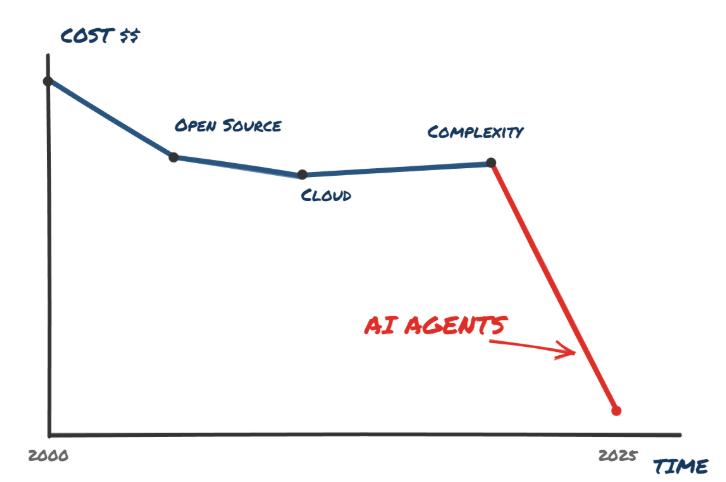
Core Insights - The emergence of AI Agents is significantly reducing labor costs in software development, potentially allowing projects that previously took weeks or months to be completed in just hours or a week [1][4] - The article discusses the transformative impact of AI tools on development processes and suggests that 2026 may mark a pivotal turning point for the industry [1] Software Delivery Costs - The initial wave of cost reduction in custom software development was driven by the rise of open-source solutions, which eliminated high licensing fees associated with proprietary databases [2] - The complexity of software engineering has increased in recent years, leading to a perception that development costs have not decreased significantly [2] Cost Savings from AI Agents - AI Agents are expected to drastically lower labor costs in software development, with the potential for a 90% reduction in costs [5][4] - Traditional development processes require a small team for tasks such as CI/CD setup, data access organization, and extensive testing, which can take a month to complete [5] - With AI Agents, these processes can be completed in a matter of hours, allowing for rapid development and reduced communication overhead [6] Release of Potential Demand - The reduction in production costs does not merely lead to lower spending but can result in increased demand for software solutions, as illustrated by the Jevons Paradox [7] - Many companies have significant untapped software needs, and lowering development costs could lead to a surge in demand for new applications [8] Importance of Domain Knowledge - Despite the advancements in AI, human oversight remains crucial to ensure quality and direction in software development [10] - Developers who master AI tools will become highly efficient in solving business problems, leveraging their domain knowledge to enhance productivity [10] Future of Software Development - The combination of business experts and skilled developers using AI tools will enable rapid iteration and development, potentially reducing the need for large teams [11] - The industry is on the brink of significant change, with the potential for software development to evolve faster than anticipated as AI technology continues to advance [12] AI in Legacy Code Management - AI Agents can simplify the understanding and maintenance of legacy code, making it easier to identify bugs and suggest fixes [13]
智能体崛起,AI+软件研发到新拐点了?
3 6 Ke· 2025-11-13 04:51
Core Insights - The article discusses the transformative impact of large language models (LLMs) on software development processes, highlighting the shift from AI as a mere tool to becoming a core productivity driver in the development lifecycle [1][2]. Group 1: LLM Native Development Era - Many experts believe that AI's role in coding is still seen as an advanced autocomplete rather than a paradigm shift, indicating that the industry is on the brink of a significant change [2][3]. - AI excels in small, well-defined tasks but struggles with complex, large-scale projects, particularly when integrating with existing codebases [2][4]. - The proportion of AI-generated code in teams is rapidly increasing, with some teams reporting over 50% of their code being AI-generated, indicating a deep integration of AI into coding practices [3][4]. Group 2: AI's Role in Development Processes - AI is increasingly being used in various forms beyond traditional IDEs, such as integrated tools in DevOps platforms, which is changing development habits [3][4]. - The effectiveness of AI varies significantly among users, with some leveraging it for simple tasks while others utilize it for more complex processes like building intelligent agents [3][4]. - AI's involvement in development is still evolving, and while it has improved efficiency, it has not yet achieved a true paradigm shift [5][6]. Group 3: AI in Testing - AI is primarily seen as a tool for enhancing efficiency in testing rather than a replacement for human testers, with significant challenges remaining before reaching a fully autonomous development era [5][7]. - AI performs well in generating test cases for straightforward tasks but struggles with complex testing scenarios that require deep domain knowledge [7][8]. - The current state of AI in testing is more about assistance than collaboration, with a long way to go before achieving a fully integrated development environment [7][8]. Group 4: Challenges in AI Implementation - The main challenges in implementing AI in real business scenarios include stability, reliability, and the need for teams to adapt to new workflows [16][18]. - Users often face difficulties in effectively communicating their needs to AI, leading to inconsistent results and a lack of trust in AI tools [18][19]. - The computational power available for AI applications significantly affects user experience and the overall effectiveness of AI tools [18][19]. Group 5: Future of AI in Development - The evolution from AI assistants to intelligent agents signifies a shift towards more autonomous systems capable of executing complete development cycles [24][27]. - The integration of AI into development processes is expected to enhance collaboration and efficiency, but achieving a fully automated workflow will take time [27][29]. - The future landscape will likely favor lightweight, plugin-based ecosystems over monolithic platforms, allowing for gradual integration of AI capabilities into existing workflows [28][29]. Group 6: Value and Skills in the AI Era - The introduction of AI in development roles is reshaping job functions, emphasizing the need for engineers to possess a deeper understanding of both technology and business [33][34]. - Engineers who can effectively leverage AI tools will see their value increase, as AI can handle repetitive tasks, allowing them to focus on more strategic aspects of their roles [35][36]. - The ability to communicate effectively with AI and understand its limitations will be crucial for maximizing productivity and ensuring quality in software development [36][37].