
AMR

Search documents
99.99%机器视觉识别准确率!华睿科技赴港上市,工业相机中国第三、AMR全球第七
Jin Rong Jie· 2026-02-02 10:31
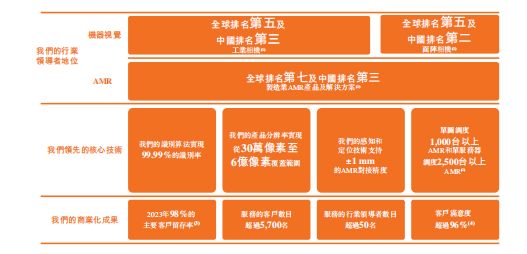
Core Viewpoint - Zhejiang Huari Technology Co., Ltd. is a leading player in the industrial camera and AMR (Autonomous Mobile Robot) sectors, focusing on high-end equipment manufacturing for strategic industries such as new energy, semiconductors, and automotive [1][3]. Business Overview - The company was established in 2016 and primarily operates in two segments: machine vision and AMR, providing critical components and solutions to equipment manufacturers and leading enterprises [1]. - Machine vision is the main revenue source, contributing 66.2% of total revenue in the first three quarters of 2025, while AMR accounts for 33.8% [1]. Market Position - According to Frost & Sullivan, Huari Technology ranks fifth globally and third in China in the industrial camera sector, and ranks seventh globally and third in China in the manufacturing AMR products and solutions market, indicating strong market competitiveness [3]. Technical Capabilities - The company's machine vision recognition algorithm boasts an accuracy rate of 99.99%, with product resolutions ranging from 300,000 to 600 million pixels, and AMR docking precision of ±1mm [5]. - In 2023, customer retention rate reached 98%, with a customer satisfaction rate exceeding 96.4% [5]. Financial Performance - Huari Technology's revenue for 2023 and 2024 was 1.05 billion yuan and 902 million yuan, respectively, with a 27.0% year-on-year revenue growth to 824 million yuan in the first three quarters of 2025 [6]. - The gross margin improved from 29.3% in the first three quarters of 2024 to 35.6% in the same period of 2025, surpassing 2023 levels [6]. Profitability - The company recorded a net loss of 152 million yuan in 2024 due to market demand slowdown and ongoing R&D investments, but significantly narrowed the loss to 26 million yuan in the first three quarters of 2025 [7]. - Adjusted EBITDA reached 20.6 million yuan, with adjusted net profit of 4.7 million yuan, indicating a recovery in profitability [7]. Revenue Growth Drivers - The core components and products of machine vision are the main drivers of revenue growth, with a 40.9% year-on-year increase to 530 million yuan in the first three quarters of 2025 [8]. - The AMR business saw an increase in the sales proportion of high-margin products, raising the AMR gross margin from 19.3% to 36.2% [8]. Industry Outlook - The global industrial camera market is projected to grow at a compound annual growth rate (CAGR) of 11.2% from 2025 to 2029, with the Chinese market expected to grow at 14.0% [8]. - The global manufacturing AMR market is forecasted to grow at a CAGR of 18.3%, with the Chinese market at 16.8% [8]. Policy Support - Chinese policies such as the "14th Five-Year Plan for Robot Industry Development" are promoting industrial automation and intelligent upgrades, providing solid policy support for industry growth [10]. - The demand for machine vision and AMR products is expected to be driven by capacity expansion and equipment upgrades in sectors like new energy, semiconductors, and logistics [10]. Fundraising Plans - The company plans to use the net proceeds from its Hong Kong listing to enhance its machine vision and AMR technology platforms, upgrade smart manufacturing capabilities, expand marketing networks, and supplement working capital [10].

对话产业链大佬:详解移动机器人AGVAMR产业进程
2025-08-07 15:03
Summary of Key Points from the Conference Call Industry Overview - The conference discusses the evolution of Automated Guided Vehicles (AGV) to Autonomous Mobile Robots (AMR), highlighting advancements in navigation technologies such as visual navigation and SLAM laser navigation, which enhance autonomous obstacle avoidance and mobility [1][2][3]. Core Insights and Arguments - **Market Demand**: The domestic intelligent logistics equipment market has broad demand, with major clients in the automotive, photovoltaic, lithium battery, 3C, and logistics sectors. The automotive industry faces rising labor costs and customization needs, while the photovoltaic sector is challenged by complex environments and high handling intensity [1][6][8]. - **Impact of COVID-19**: The pandemic has significantly affected AGV demand across various industries. The photovoltaic sector has entered a downturn, while the automotive industry has faced negative impacts. Conversely, the pharmaceutical, semiconductor, 3C, and logistics sectors have shown positive growth [9]. - **Future Projections**: The automotive industry is expected to recover by 2026, while the photovoltaic sector's fluctuations remain unpredictable. There is substantial potential for warehouse automation transformation, promoting the "goods-to-person" model to reduce costs and improve efficiency [1][10]. Pricing and Product Types - **Product Categories**: The main types of mobile robots include: 1. **Lurking Robots**: Priced between 80,000 to 150,000 CNY, suitable for logistics transfer [5]. 2. **Transfer and Heavy Load Robots**: Prices range from 120,000 to 250,000 CNY, depending on load capacity and customization [5]. 3. **Unmanned Forklifts**: Prices vary based on design complexity and lifting height [3][4]. 4. **Composite Robots**: These are the most expensive due to their integrated functionalities [4]. Industry Applications - **Sector-Specific Needs**: - **Automotive**: Solutions address labor cost increases and safety production requirements, covering various production processes [6]. - **Photovoltaic**: AGVs are designed for automatic docking and complex handling due to high environmental demands [8]. - **Lithium Battery**: Solutions focus on labor shortages and material traceability [8]. - **3C Industry**: High SKU variety necessitates efficient management through WMS systems [8]. - **Logistics**: Demand fluctuates significantly during peak periods, requiring scalable solutions [8]. Competitive Landscape - **Market Dynamics**: The domestic market is characterized by a mix of system integrators, equipment manufacturers, software developers, and platform companies. Key players include Hikvision, New Times, and others, each focusing on specific industry applications [18][19]. - **Overseas Expansion**: The overseas market is expected to grow significantly, with projections indicating that overseas profitability may surpass domestic by 2025 [21]. Profitability and Cost Management - **Profitability Factors**: The profitability of AGV and solutions businesses is influenced by revenue and cost control. Automation in e-commerce logistics can enhance operational efficiency and reduce labor costs [12]. - **Investment Recovery**: The investment payback period in the Ada industry has shortened to approximately 1.2 to 1.5 years [13]. Future Trends - **Technological Advancements**: The integration of AI and robotics in logistics solutions is anticipated to drive growth, with ongoing improvements in load calculations and software algorithms [24]. - **Challenges for Forklift AGVs**: The lower sales and penetration rates of fork-type AGVs are attributed to limited application scenarios and compatibility issues with different pallet types [22][23]. Conclusion - The intelligent logistics equipment market is poised for growth, driven by technological advancements and increasing demand across various sectors. Companies are focusing on enhancing their offerings and expanding into overseas markets to capitalize on emerging opportunities.
