Agent Evaluation

Search documents
Agent Observability Powers Agent Evaluation
LangChain· 2026-02-09 20:44
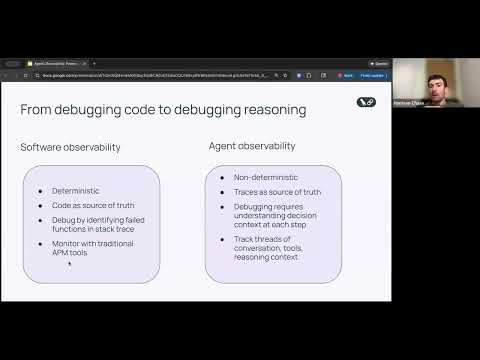
Welcome everyone to this webinar on observing uh agents and how agent observability powers agent webinar on observing uh agents and how agent observability powers agent evaluation. Uh my name is Harrison. I'm the co-founder CEO.Joined with me is VC. Do you want vec. Do you want to do a quick intro.>> Yeah, sounds good. Yeah, super excited to be talking about this. I'm Vivec.I work on a bunch of our deep agents work here at LinkedIn. Awesome. So, it's right at the top of the hour and I see a bunch of people ...

从组件到系统,Agent 的 Evaluation 怎么做?
机器之心· 2025-10-12 01:27
Core Insights - The article discusses the evolution of Agent Evaluation in AI, emphasizing the need for new assessment benchmarks as AI systems transition from passive language models (LLMs) to autonomous AI agents capable of planning and interacting with digital environments [3][4][5]. Group 1: Agent Evaluation Challenges - The complexity of evaluating agents arises from the need to measure their end-to-end success rates, reliability, and efficiency in dynamic environments, unlike traditional LLM evaluations which focus on static outputs [5][6]. - The evaluation of agents must consider their interactions with the environment and the emergent properties that arise from these interactions, rather than just the quality of text output [7][8]. Group 2: Evolution of Evaluation Paradigms - The evolution of Agent Evaluation paradigms reflects the increasing complexity and application scope of AI systems, with each generation of benchmarks designed to address the limitations of the previous ones [9][10]. - The article outlines a comparison of different evaluation generations, highlighting the shift from static assessments of LLMs to dynamic evaluations of agents that can operate in real-world scenarios [10][11]. Group 3: Key Evaluation Frameworks - New frameworks such as GAIA, MCP-universe, MCPMark, and MCP-AgentBench have emerged to address the unique challenges of Agent Evaluation, focusing on dynamic interactions and the ability to perform tasks in real-time [8][10]. - The core value of an agent is defined by its autonomy, planning capabilities, and interaction with the environment, necessitating evaluation methods that can measure these action-oriented competencies [11].

Break It 'Til You Make It: Building the Self-Improving Stack for AI Agents - Aparna Dhinakaran
AI Engineer· 2025-06-10 17:30
Agent Evaluation Challenges - Building agents is difficult, requiring iteration at the prompt, model, and tool call definition levels [2][3] - Systematically tracking the performance of new prompts versus previous ones is challenging [4] - Including product managers or other team members in the iterative evaluation process is difficult [5] - Identifying bottlenecks in applications and pinpointing specific sub-agents or tool calls that create poor responses is hard [6] Evaluation Components - Agent evaluation should include evaluating at the tool call level, considering whether the right tool was called and if the correct arguments were passed [7][11] - Trajectory evaluation is important to determine if tool calls are executed in the correct order across a series of steps [7][20] - Multi-turn conversation evaluation is necessary to assess consistency in tone and context retention across multiple interactions [8][22][23] - Improving evaluation prompts is crucial, as the evals used to identify failure cases are essential for improving the agent [8][27] Arise Product Features - Arise offers a product for tracing and evaluating agent performance, allowing teams to ask questions about application performance and suggest improvements [12][13] - The product provides a high-level view of different paths an agent can take, helping to pinpoint performance bottlenecks [14][15] - Users can drill down into specific traces to evaluate tool call correctness and argument alignment [17][18]