Anchoring Bias

Search documents
"Sunk Cost Fallacy:" How Amazon Capitalizes on Prime Days
Youtube· 2025-10-07 18:30
Core Insights - Amazon is a major player in the retail sector, with 38% of all US shoppers purchasing from the platform, indicating its significant influence on e-commerce [2][3] - The company has expanded its promotional events, such as Prime Day, to increase sales opportunities, with the recent event lasting four days instead of two, and additional days planned for the fall [3][4] Membership and Consumer Behavior - Amazon Prime, a membership program costing $139 annually, encourages consumer loyalty and increased spending, with Prime members averaging $110 per month compared to $38 for non-members [5][8] - The sunk cost fallacy plays a role in consumer behavior, as members feel compelled to continue shopping on Amazon after making an initial investment in the Prime membership [6][7] Pricing Strategies - Amazon employs psychological pricing strategies, such as the anchoring bias, where original prices are shown alongside discounted prices to create a perception of savings [10][11] - There are concerns about price inflation during sales events, where items may be priced higher than usual, leading to skepticism about the authenticity of discounts [15][16] Competitive Landscape - Competing with Amazon poses challenges for small businesses, but insights from successful brands can provide valuable lessons for marketing and consumer engagement [17][19] - The importance of branding and customer experience is emphasized, as these factors can provide a competitive edge in a market dominated by large companies like Amazon [20]



Mastering Minds: The Power of Debate and Training | Abdulrhman AlFityani | TEDxAl Kursi
TEDx Talks· 2025-08-11 15:04
Cognitive Biases & Decision Making - The discussion highlights the importance of critical thinking and questioning pre-conceived notions, referencing the movie "12 Angry Men" as an example of challenging assumptions [1] - The text introduces the concepts of "soldier" and "scout" mindsets, contrasting the biased, defensive approach of the "soldier" with the truth-seeking, exploratory approach of the "scout" [1] - The text emphasizes the value of adopting a "scout" mindset, characterized by curiosity, open-mindedness, and a willingness to consider alternative perspectives, drawing on the quote from Imam Shafi'i about the possibility of being wrong [1] - The report identifies several cognitive biases that can affect decision-making, including confirmation bias (seeking evidence that supports pre-existing beliefs) [1] - The report identifies several cognitive biases that can affect decision-making, including the halo effect (generalizing based on limited information) [1] - The report identifies several cognitive biases that can affect decision-making, including the swimmer's body illusion (confusing correlation with causation) [1] - The report identifies several cognitive biases that can affect decision-making, including anchoring bias (over-relying on the first piece of information received) [1] - The report identifies several cognitive biases that can affect decision-making, including the bandwagon effect (following the crowd) [1] Debate & Persuasion - The text discusses the challenge of defending a viewpoint one personally disagrees with in competitive debate, arguing that understanding the potential flaws in one's own beliefs strengthens one's position [2] - The text concludes by encouraging individuals to incorporate a "scout" mindset into their decision-making processes, urging them to question their assumptions and seek truth [2]

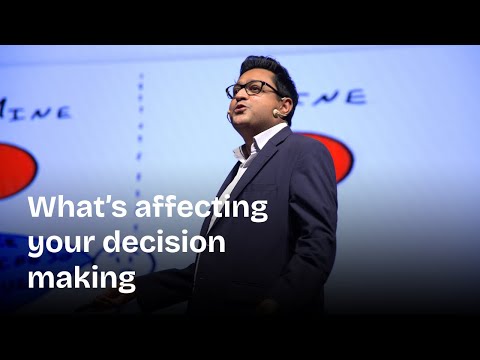
What's Affecting Your Decision Making | Neil Parikh | TEDxNM College
TEDx Talks· 2025-07-22 16:01
Behavioral Finance & Investment Biases - The speaker argues that people are inherently lazy and greedy, leading to a desire for instant gratification, which negatively impacts investment decisions [1][3] - The financial industry is affected by people's sentiments and behaviors, which are formed by habits [6] - Speculation is increasing among all generations due to impatience and the need for instant gratification, with a large percentage of exchange volumes being futures and options [5] - Good investment habits include regular saving, investing, and sticking to a financial plan with disciplined asset allocation [6][7] - Bad investment habits include buying based on tips, following social media influencers blindly, and deviating from a financial plan due to short-term gains [8] Investment Risks & Cognitive Biases - Greed, exemplified by over-allocation to small-cap stocks, can lead to excessive risk-taking and significant losses [9][10] - Fear of missing out (FOMO) drives people to invest in already high-priced assets, reducing the risk-to-reward ratio [10][12] - Overconfidence, fueled by market rallies, can lead to abandoning studies or jobs for speculative trading, which is a dangerous trend [13][14] - Availability bias can lead to making decisions based on recent, frequent, and extreme information, rather than a comprehensive view [17][18] - Confirmation bias leads investors to seek out opinions and information that confirm their existing beliefs, ignoring contradictory information [19][20][21] - Herd mentality can lead to scams and inflated prices, making it crucial to be a contrarian investor [23][24] - Anchoring bias, where investors fixate on their purchase price, can prevent them from selling losing investments and missing out on better opportunities [26][27] - Endowment bias, where people overvalue what they own, can hinder rational decision-making about assets [28][30] Overcoming Biases & Improving Investment Decisions - Understanding and overcoming biases is crucial for making better decisions and becoming a successful investor [15][16] - The speaker advises to control urges, delay instant gratification, and be aware of personal biases [31]