Army Transformation Initiative

Search documents
Textron(TXT) - 2025 Q4 - Earnings Call Transcript
2026-01-28 14:02
Financial Data and Key Metrics Changes - Textron reported a revenue growth of 16% in Q4 2025, totaling $4.2 billion, and an 8% increase for the full year, reaching $14.8 billion [4][20] - Segment profit for Q4 2025 was $380 million, up 34% year-over-year, and for the full year, it was $1.4 billion, up 14% [19][20] - Adjusted EPS for Q4 was $1.73, compared to $1.34 in the previous year, and for the full year, it was $6.10, up from $5.48 [20] Business Line Data and Key Metrics Changes - Textron Aviation saw a revenue increase of 36% in Q4, totaling $1.7 billion, and a 13% increase for the full year, reaching $6 billion [21][22] - Bell's revenue grew by 11% in Q4 to $1.3 billion, and for the full year, it increased by 20% to $4.3 billion [23] - Textron Systems reported a 4% revenue increase in Q4, totaling $323 million, and a slight increase for the full year, reaching $1.2 billion [24] - Industrial segment revenues decreased by 5.5% in Q4 to $821 million, primarily due to the divestiture of the Powersports business [25] Market Data and Key Metrics Changes - Textron Aviation ended the year with a backlog of $7.7 billion, while Bell's backlog was $7.8 billion, reflecting growth in both military and commercial sectors [22][23] - The general aviation industry remains healthy, with Textron Aviation experiencing strong order flow and a nearly $8 billion backlog [11][12] Company Strategy and Development Direction - The company is focused on executing its growth strategy through ongoing investments in new products and programs to drive organic growth and margin expansion [8] - Textron plans to continue its investment in the MV-75 program, which is central to the Army's Transformation Initiative, and aims to accelerate production [12][14] - The company is also looking to enhance its supply chain resilience and vertical integration to mitigate risks and improve efficiency [36][52] Management's Comments on Operating Environment and Future Outlook - Management expressed confidence in the company's strong position and future opportunities, particularly in Textron Aviation and the MV-75 program [11][12] - The outlook for 2026 includes projected revenues of approximately $15.5 billion, reflecting a 4.5% increase from 2025, and adjusted EPS in the range of $6.40-$6.60 [17][33] - The company anticipates manufacturing cash flow before pension contributions to be between $700 million and $800 million [28] Other Important Information - The company repurchased approximately 2.3 million shares in Q4 2025, returning $187 million to shareholders, and a total of 10.7 million shares for the year, returning $822 million [27] - Textron is eliminating the Textron eAviation segment as a separate reporting entity to realign its business activities [28] Q&A Session Summary Question: What are the top priorities for the company now that Lisa is CEO? - Lisa outlined three priorities: execution, portfolio focus, and building resilience across the business [36] Question: How should we think about the MV-75 program in the near and medium term? - Lisa indicated that the Army's push for acceleration has allowed for significant progress, with production timelines moved forward by 2.5-3 years [44] Question: Will Textron grow or prune its portfolio? - Lisa emphasized the need for ongoing evaluation of each business against performance criteria, aiming for growth in high-quality aerospace and defense areas [50][52] Question: How is Textron managing supply chain challenges? - Lisa noted that while recovery is ongoing, key components like engines remain a challenge, and efforts are being made to upskill the workforce [60] Question: What is the expected revenue impact from the MV-75 program? - David mentioned that the program could yield between 40 and 60 units per year, significantly increasing overall revenue [71]

Textron(TXT) - 2025 Q4 - Earnings Call Transcript
2026-01-28 14:00
Financial Data and Key Metrics Changes - Textron reported a revenue growth of 16% in Q4 2025, totaling $4.2 billion, and a full-year revenue increase of 8% to $14.8 billion [3][19] - Segment profit for Q4 2025 was $380 million, up 34%, and for the full year, it reached $1.4 billion, up 14% [3][19] - Adjusted EPS for Q4 was $1.73, compared to $1.34 in the previous year, and for the full year, it was $6.10, up from $5.48 [3][19] - Manufacturing cash flow before pension contributions was $510 million in Q4, up $204 million year-over-year, and $969 million for the full year, an increase of $277 million [19][25] Business Line Data and Key Metrics Changes - **Textron Aviation**: Revenue increased by 36% in Q4 to $1.7 billion, with full-year revenue up 13% to $6 billion. Segment profit for Q4 was $208 million, up 108% [20][21] - **Bell**: Revenue grew by 11% in Q4 to $1.3 billion, with full-year revenue up 20% to $4.3 billion. Segment profit for Q4 was $101 million, down from the previous year [21][22] - **Textron Systems**: Revenue increased by 4% in Q4 to $323 million, with full-year revenue slightly up to $1.2 billion. Segment profit for Q4 was $43 million, up $1 million [22] - **Industrial**: Revenue decreased by 5.5% in Q4 to $821 million, with full-year revenue down 9% to $3.2 billion [23] Market Data and Key Metrics Changes - Textron Aviation ended the year with a backlog of $7.7 billion, while Bell's backlog was $7.8 billion, reflecting growth in both military and commercial sectors [20][21] - The general aviation industry remains healthy, with Textron Aviation experiencing strong order flow and a nearly $8 billion backlog [11][12] Company Strategy and Development Direction - The company is focused on executing its growth strategy through ongoing investments in new products and programs to drive organic growth and margin expansion [8] - Textron is prioritizing operational rigor, capital allocation, and building resilience across its businesses [34] - The MV-75 program is a key focus, with significant investments in production capacity and a push for accelerated timelines [5][12] Management's Comments on Operating Environment and Future Outlook - Management expressed confidence in the company's position and future opportunities, particularly in the defense sector and the MV-75 program [9][12] - The company anticipates revenue growth of approximately 4.5% in 2026, projecting revenues of about $15.5 billion and adjusted EPS in the range of $6.40-$6.60 [16][30] Other Important Information - The company repurchased approximately 10.7 million shares in 2025, returning $822 million to shareholders [25] - Textron is eliminating the Textron eAviation segment as a separate reporting entity to streamline operations [26] Q&A Session Summary Question: What are the top priorities for the company now that Lisa is CEO? - Lisa outlined three priorities: execution, portfolio focus, and building resilience across businesses [33] Question: How should we think about the MV-75 program in the near and medium term? - The Army's push for acceleration has allowed Textron to move the program forward by about 2.5-3 years, with aircraft deliveries expected to begin sooner [41] Question: Will Textron grow or prune its portfolio? - Lisa indicated that management will evaluate each business for returns and strategic fit, aiming to accelerate growth in high-quality aerospace and defense areas [46] Question: How is Textron managing supply chain challenges? - The company is focused on recovering the supply chain and addressing workforce attrition through in-house training programs [58] Question: What is the expected impact of the MV-75 program on future revenues? - The MV-75 program is expected to significantly increase revenue, with historical double-digit margins anticipated as production ramps up [70]
Gen. George on the Army’s push into new tech
CNBC Television· 2025-06-17 19:07
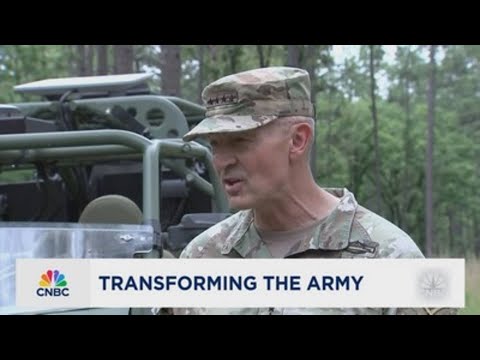
Transformation & Technology Adoption - The Army is undergoing a paradigm shift, changing technology, organization, and operational methods [2] - The Army aims to accelerate the integration of technology into formations by ceasing procurement of less effective equipment [5] - The Army is moving towards modular, software-defined technologies, including robotics, to enhance adaptability and innovation [8] - The Army emphasizes continuous transformation and evolution with technology, moving away from outdated systems [16][17] - The Army is exploring AI and autonomy to expedite deployment of needed capabilities on the battlefield [8] Procurement & Industry Collaboration - The Army is changing its procurement approach to adapt to rapidly changing technology, including buying in tranches for technologies like drones [6] - The Army is inviting industry partners to participate in training rotations to identify needs and solutions [9] - The Army seeks increased involvement of industry partners in manufacturing for the Army, leveraging commercial technologies [30][31] - The Army is balancing the need for exquisite capabilities with more affordable and rapidly fieldable technologies [22][23] Personnel & Training - The Army is adapting training and organizational structures to incorporate lessons learned from global conflicts [24][26] - The Army is re-evaluating required personnel skills, including the need for coders, cyber spectrum managers, and autonomous system operators at various levels [18]

How the Army is cutting costs and rethinking policy to move faster on new tech
CNBC· 2025-06-16 15:54
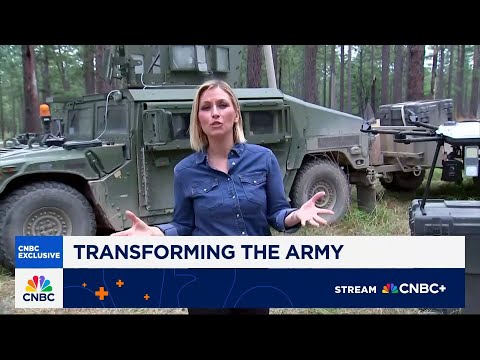
Core Insights - The U.S. Army is undergoing a significant transformation with the introduction of "transformation in contact" (TIC) brigades, which utilize advanced technologies such as artificial intelligence, autonomous vehicles, and drones [2][3] - The Army Transformation Initiative aims to restructure the military, focusing on rapid adaptation and modernization in response to evolving battlefield dynamics [3][4] - The initiative includes job repositioning and a shift in defense spending towards more cost-effective and quickly produced military technologies, moving away from traditional, expensive systems [4][5][6] Group 1 - The Joint Readiness Training Center in western Louisiana, known as the "Box," spans 242,000 acres and is used for soldier combat training [1] - The 1st Brigade of the 101st Airborne Division recently completed a two-week training rotation, showcasing the Army's commitment to modernizing its forces [1][2] - The TIC brigade represents the most advanced military unit to date, equipped with nearly 400 drones and enhanced connectivity through SpaceX Starlink [2][3] Group 2 - The Army is experiencing a "paradigm shift" as it embraces new technologies and operational strategies to maintain pace with advancements in warfare [3] - The Army Transformation Initiative, approved by Defense Secretary Pete Hegseth, is expected to be the largest restructuring in a generation, focusing on agility and effectiveness [3][4] - The initiative aims to eliminate ineffective procurement practices and prioritize investments in technologies that enhance battlefield performance [5][6]


The seismic shift transforming how the U.S. Army operates, buys weapons and prepares for future wars
CNBC Television· 2025-06-13 17:22
Army Transformation Initiative - The US Army is undergoing a significant restructuring to modernize its operations, procurement, and preparation for future warfare [1][2] - The Army Transformation Initiative is led by Secretary Dan Driscoll and Chief of Staff General Randy George [3] - The initiative aims to accelerate the Army's operational speed and efficiency by discontinuing the acquisition of outdated technologies [3] Technological Advancements - The Army's most modern brigade incorporates nearly 400 drones, autonomous vehicles, and an AI-enabled network [4] - The brigade utilizes drones from Skyo and Shield AI, along with Starlink-enabled internet connections [4] - General Motors infantry squad vehicles are being retrofitted with autonomous driving capabilities through a partnership with Silicon Valley startup Applied Intuition [5] - The integration of 40 new technologies from 10 different companies focuses on continuous transformation [6] Collaboration and Innovation - Non-traditional defense contractors have engineers embedded with the 2,000 soldiers to facilitate rapid problem-solving and technology integration [5] - On-site engineers resolved a drone power issue within 24 hours, avoiding weeks of troubleshooting [5][6]