
CCUS (Carbon Capture

Search documents
The 2026 buildout that turns a resource into a platform
The Market Online· 2026-03-04 20:00
Core Insights - U.S. Energy Corp. is undergoing a strategic transformation, with significant developments expected by 2026 that will establish a fully integrated industrial gas and carbon management hub [1][3] Infrastructure Development - The centerpiece of the 2026 plan is a processing facility designed to handle approximately 8 million cubic feet per day of inlet capacity, which will produce high-purity helium and refined CO₂ [4][5] - The facility will require about 2.5 megawatts of power, primarily sourced from the regional electrical grid, with backup from U.S. Energy's natural gas infrastructure, emphasizing the importance of integrated ownership [6] Pipeline Installation - A critical phase in the development will begin in Spring 2026, involving the installation of roughly 10 miles of in-field gathering pipelines to transport gas from existing wells to the processing plant, with completion expected by the third quarter of 2026 [8][9] Regulatory Positioning - U.S. Energy has submitted the first Monitoring, Reporting, and Verification (MRV) plans in Montana, which, once approved, will position the Kevin Dome program among the 20 largest CCUS projects in the U.S., providing a competitive advantage [10][11] Resource Control - U.S. Energy controls nearly 80,000 net acres at the Kevin Dome, containing approximately 1.3 trillion cubic feet of CO₂ and 2.3 billion cubic feet of helium, ensuring long-term feedstock for industrial gas sales and carbon management services [12][13][14] Revenue Model - The company is developing a closed-loop revenue model that monetizes both helium and CO₂ through distinct pathways, with helium targeting premium markets and CO₂ used for enhanced oil recovery and geological sequestration [15][16][17][18] Market Context - The demand for industrial gases like helium and CO₂ is increasing, driven by their essential roles in the digital economy and the need for long-term CO₂ sequestration solutions, positioning U.S. Energy as a key player in this emerging market [19]



Enerflex(EFXT) - 2025 Q4 - Earnings Call Presentation
2026-02-26 15:00
February 2026 Enerflex Ltd. Corporate Presentation All amounts presented in US Dollars unless otherwise stated Enerflex at a Glance TSX / NYSE EFX / EFXT Annual dividend CAD$0.17/sh Market Cap (1) US$2.4 B Dividend Yield (1) ~0.6% Operating Years 45 Employees ~4,400 Transforming Energy for a Sustainable Future North America Latin America Eastern Hemisphere Enerflex Geographies Enerflex Key Offices Enerflex Manufacturing Facility 1) Based on an EFXT closing share price of $19.82 as of February 25, 2026. 2) C ...

吃碳吐油 变“废”为宝 探访我国首个实现年注碳百万吨的油田
Zhong Yang Ji Wei Guo Jia Jian Wei Wang Zhan· 2026-01-26 06:13
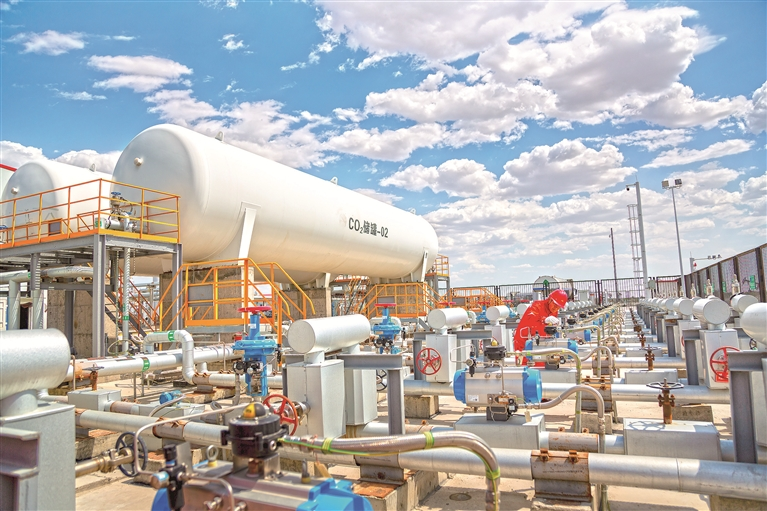
Core Viewpoint - The Xinjiang Oilfield has achieved a significant milestone by becoming the first oilfield in China to inject over 1 million tons of carbon dioxide annually by 2025, playing a crucial role in the country's dual carbon goals and the transformation of traditional industries through green low-carbon technologies [4][12]. Group 1: CO2 Injection Technology - The CO2 injection method enhances oil recovery by increasing pressure and reducing viscosity, allowing for the extraction of oil trapped in rock formations [5][7]. - CO2 injection can improve oil recovery rates by 10% to 20% compared to water injection, potentially raising total recovery rates to between 40% and 60% [7]. - The Xinjiang Oilfield has been exploring CO2 capture, utilization, and storage (CCUS) technologies for over 20 years, with successful pilot projects demonstrating significant increases in oil production [8][10]. Group 2: Environmental Impact and Carbon Management - The CO2 used for oil extraction is sourced from industrial emissions in the surrounding areas, ensuring a high purity level of over 99% after processing [11][12]. - Approximately 80% of the injected CO2 is permanently stored underground, while the remaining 20% is recycled back into the system, contributing to a circular economy [12]. - The current daily CO2 injection rate has reached over 4,800 tons, with a cumulative injection surpassing 200,000 tons, equating to the carbon absorption of 18 million mature trees annually [12]. Group 3: Challenges and Future Directions - The application of CCUS technology is still in its early stages, facing challenges such as carbon source supply and complex geological structures that hinder accurate modeling [10]. - The Xinjiang Oilfield is committed to overcoming these challenges by enhancing collaboration with carbon source providers and improving geological research to better understand underground reservoirs [10][12]. - The ongoing advancements in CCUS technology are expected to facilitate the large-scale application of carbon management strategies across various oilfield types in Xinjiang [10].

“三板斧”推进节能减碳 | 大家谈 如何当好“碳路先锋”
Zhong Guo Hua Gong Bao· 2025-09-12 03:12
Core Viewpoint - Energy conservation and carbon reduction are crucial for achieving carbon peak and carbon neutrality, with the oil and chemical industry playing a significant role in this transition through three main strategies. Group 1: Capacity Transformation - The first strategy involves accelerating capacity transformation by promoting carbon capture, utilization, and storage (CCUS) projects, which will lead to industrialization of various petrochemical facilities [1] - The industry should focus on developing the hydrogen energy sector, increasing investments in projects like wind and solar hydrogen production, seawater hydrogen production, and blue hydrogen purification technologies [1] - Efforts should be made to deeply utilize waste heat and pressure from petrochemical facilities to minimize energy waste [1] Group 2: Process Reengineering - The second strategy emphasizes process reengineering, breaking down traditional production silos through raw material substitution, process innovation, energy restructuring, by-product recycling, and digital empowerment [2] - Petrochemical companies should prioritize low-carbon raw material substitution and adapt processes to reduce redundancy [2] - High-efficiency, low-consumption processes should replace traditional methods, promoting interconnectivity among facilities to reduce waste [2] - Advanced equipment should replace outdated machinery, focusing on steam production facility upgrades and using green gas alternatives [2] - Accelerating the construction of CCUS projects and resource recycling for waste catalysts and liquids is essential [2] Group 3: Carbon Emission Management - The third strategy involves improving the carbon emission management system by implementing a lifecycle carbon accounting and trading management system for petrochemical production [3] - A complete system should be established that quantifies carbon emissions, manages them, and incentivizes reductions through market mechanisms [3] - The entire process from crude oil extraction, transportation, refining, chemical synthesis, to product usage and disposal should be clearly defined for carbon accounting and assessment [3]